


Description
Who the Liberty 4 NC is aimed at
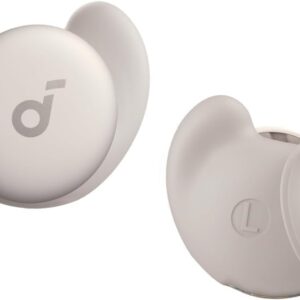
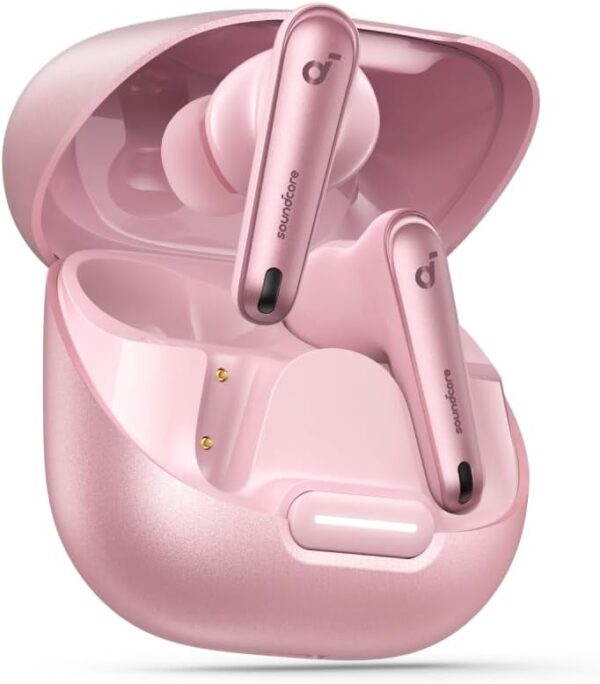
The Soundcore Liberty 4 NC is Anker’s mainstream noise cancelling earbud, positioned for travel and commuting rather than for sport. Almost every design choice on the listing points that way: an 11mm driver for low end weight, adaptive noise cancellation, a battery figure built around long journeys, and a water rating that is deliberately modest. With 17,004 ratings behind it and an average of 4.2 out of 5, it also has one of the larger feedback samples in this catalog, which is worth more than most specification tables.
What separates it from the rest of the Soundcore line is that the codec story here is actually documented, which is rare. Anker names LDAC rather than gesturing at high resolution audio, and it publishes separate battery figures for noise cancellation on and off rather than quoting one headline number. Those two things make this listing easier to evaluate than most, and we credit that before getting to the parts that do not hold up.
Connection: LDAC, multipoint and the condition attached
Bluetooth 5.3 is published, along with multipoint connection and quick pairing on Android. Multipoint is the practically useful item: it lets the buds hold two devices at once, so a laptop meeting can interrupt phone audio without a manual reconnect. The Bluetooth version itself is not a sound quality figure. It governs connection housekeeping, power behavior and support for newer standards, and nothing more.
The high resolution claim and what it requires
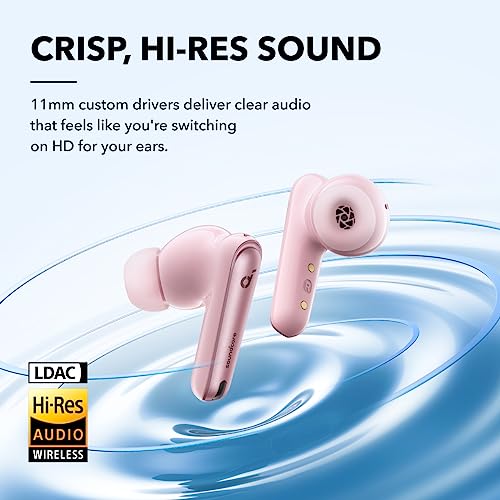
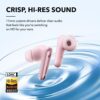
Anker states Hi-Res wireless audio and names LDAC as the mechanism, describing it as transferring three times more data than regular Bluetooth. LDAC is Sony’s codec, licensed broadly across Android, and it does carry a substantially higher bitrate than SBC. The condition is absolute and the marketing never states it plainly: LDAC only engages when the source device also supports LDAC and has it enabled. That means a reasonably current Android phone with LDAC available in its Bluetooth or developer settings. iPhones do not support LDAC. If you connect these to an iPhone, an iPad or most Windows laptops, you will be listening over AAC or SBC and the high resolution wording describes a capability you cannot reach. The three times more data figure is a comparison to SBC at its baseline, not a measurement of audible improvement.
The rest of the connection feature set is solid for the class. Auto play and pause on wear is stated, which means wear detection is present, a feature many listings at this level omit. Six beamforming microphones with a noise reduction algorithm handle calls. HearID 2.0 builds a personal sound profile, and the app offers 22 equalizer presets plus a fully adjustable curve.
Battery: four numbers, all of them useful
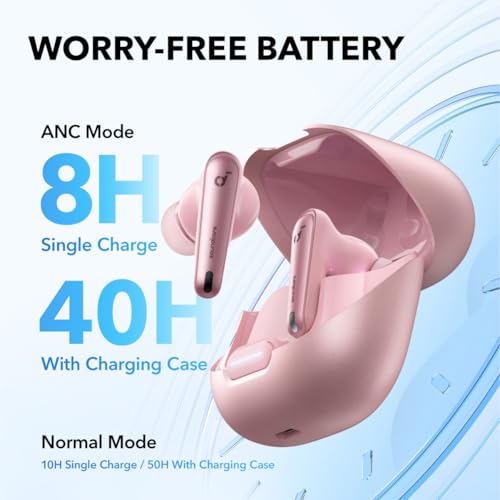
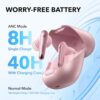
This is the part of the listing that is done properly. In normal mode, Anker rates 10 hours of playback on a single charge and up to 50 hours with the case. With active noise cancellation switched on, the figures drop to 8 hours in the buds and 40 hours with the case. Publishing both states is the honest way to do it, because ANC always costs runtime and most brands quote only the flattering figure. Plan around 8 hours if you intend to run cancellation continuously, which is the whole reason to buy this model. Wireless charging is supported on the case.
The one figure that does not fit is the structured specification field reading “Battery Life = 30 Hours”. That matches none of the four published numbers and appears to be a data entry error. We are flagging it rather than trying to reconcile it. As always, the quoted playtimes assume moderate listening volume, and higher volume shortens all four figures by an amount nobody publishes.
Fit, seal, and a water rating the listing contradicts itself on
The driver is 11mm, which is large for a true wireless earbud and consistent with the bass forward tuning Anker aims for. Impedance is listed at 10 ohms and the frequency range as 20 Hz to 20 kHz, with no tolerance figure, which as usual makes the range close to meaningless. Controls are touch based.
Here is the significant omission: the included components field lists only “Charging case”. The number of ear tip sizes in the box is not published anywhere on this listing. That is a real gap, because seal is the single largest factor in perceived bass on a sealed earbud, and it also sets the ceiling on how much the noise cancellation can achieve, since active cancellation works on top of whatever passive isolation the tip provides. Anker normally ships a wide tip range on this line, but this page does not say so and we are not going to assume it. Compare that with our Soundcore Space A40 review, where five sizes are explicitly listed.
The water rating is IPX4, and Anker states it plainly in a bullet: protection against a sudden downpour or an accidental spill. IPX4 is the splash and sweat tier. It is not immersion, it is not a swim rating, and it is not waterproof. The structured specification field on this same page nonetheless reads “Water Resistance Level = Waterproof”, which directly contradicts Anker’s own bullet. Go by IPX4. No IP rating covers seawater or pressurized water in any case, and gasket performance degrades with age.
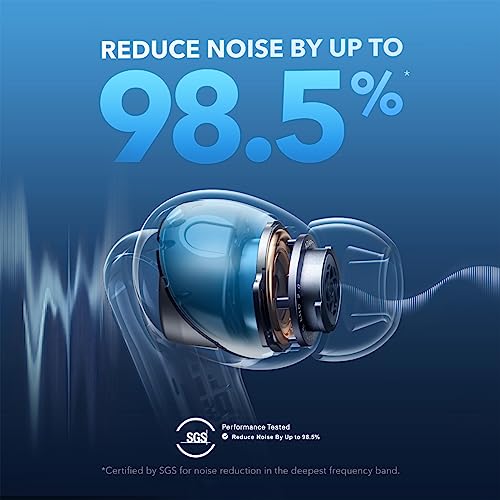
On the noise cancellation figure: Anker claims up to 98.5 percent noise reduction, attributing it to an in ear sound sensor, an oversized driver and an isolation chamber. That number comes from Anker, no test standard is named, and no frequency band is specified. Active cancellation genuinely works well on constant low frequency sound such as engine drone, cabin noise and ventilation. It works considerably less well on speech and on sudden sounds. A single percentage with no methodology does not describe that difference and should not be read as making a cabin silent.
One use case to rule out. This is a closed, actively cancelling earbud with wear detection. It is not appropriate for cycling or for road running, where hearing approaching traffic is a safety requirement, and a transparency mode is a processed approximation of your surroundings rather than a substitute for open ears. If awareness while moving is what you need, start with our open fit headphone listings.
What else is missing, and what to compare against
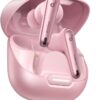
A few fields are simply wrong. Carrying case weight is listed as 0.47 pounds, roughly 213 grams, which is far too heavy for an earbud case and is almost certainly the shipping weight. Product dimensions of 4.25 by 4.25 by 2.17 inches describe the retail box. Control type reads Volume Control while control method reads Touch, which are not the same kind of field. Color is listed as Pastel Pink even though the title describes no color, so confirm what you are ordering.
Amazon places the listing around 7,795th in Electronics and 886th in earbud and in ear headphones. If you want a smaller housing from the same brand and can live without the documented battery split, the Soundcore P30i review is the closest sibling, and the Soundcore A3949 review covers a bass focused alternative. If you want a flagship where the codec and rating picture is more fully documented and are prepared to spend accordingly, see our Sony WF-1000XM5 review. Wider comparisons live in our wireless earbud listings.
Buy or skip
Buy it if you commute or fly regularly, you are on an Android phone that supports LDAC, and you want multipoint and wear detection at this level. Skip it if you are on an iPhone and were buying for the Hi-Res line, because LDAC will not engage. Skip it if you need more than splash protection, since IPX4 is the real rating regardless of what the specification field says. And if getting a seal has been a problem for you in the past, confirm the ear tip sizes with Anker before ordering, because this listing does not state them.