

Description
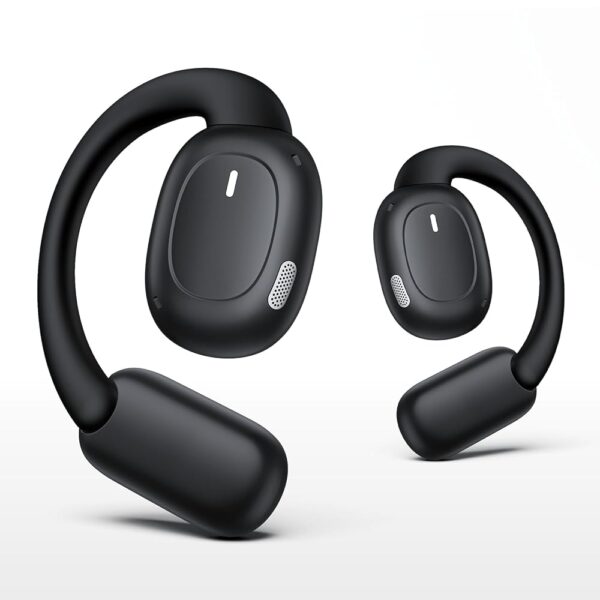
The Phegittg T68 is an open ear hooked headphone in black, ASIN B0F3WVL3RY, listed since April 2025, with a 5.0 star average across 82 ratings and a rank of 50th in Amazon’s Open-Ear Headphones category and 3,071st in Electronics. Before the specifications, one naming point needs stating plainly, because it affects what you think you are buying.
Check the brand name before you order
The product title ends with the word “P0cbuds”, spelled with a zero in place of the letter O. The third feature bullet then refers to the product as “PocBuds open ear headphones”. The brand and manufacturer fields, however, both read Phegittg, and the model number is T68.
PocBuds is a separate brand that sells its own earbuds, and one of its products is reviewed elsewhere on this site. This listing is not from that company. Whether the zero in the title is a typing error or a deliberate search term, the practical effect is the same: a buyer looking for PocBuds may land here and receive a Phegittg product. Confirm the brand on the packaging when it arrives, and do not expect PocBuds support or warranty to cover it.
The open ear design, and what it is good for
This is a genuine open ear product. The buds hang on flexible silicone hooks and sit outside the ear canal, weighing 6 grams each, which is light for the shape. Nothing is inserted and nothing seals, so outside sound reaches your ears essentially unobstructed. That makes this the right shape of product for running or riding where you need to hear vehicles, and the wrong shape for a plane or an open office where you want noise blocked.
The fifth bullet makes a fit argument worth repeating because it is unusually specific: most earbuds concentrate their weight at the speaker end, while this design distributes weight evenly across both ends of the hook, which reduces the tendency to rotate or sag over a long session. That is a sensible engineering point rather than a marketing phrase.
Two qualifications belong with the awareness argument. Music masks sound even when nothing is blocking your ear, so how much you hear depends on volume as much as on design, and an open fit tempts you to raise the level to overcome wind and traffic. Keep the volume where a nearby conversation is still audible. Some jurisdictions also restrict wearing any headphones while cycling regardless of design, so check local rules. If you want the same shape from listings that document themselves more fully, the TOZO OpenEgo and the PSIER SP06 are the direct comparisons.
The children marketing note
The Age Range field reads “Adult,Kid”, which puts this product in front of children. No volume limiting feature is published anywhere on this page, no maximum output figure is given and no parental control is described. A listing that markets to children without publishing a limit gives a parent nothing to work with, and a volume limit is only meaningful if it cannot be bypassed by the child or by the app.
If you are buying for a younger listener, the volume ceiling will have to be set in the phone or tablet’s own accessibility settings rather than in this product, and an open ear design does not by itself reduce the level reaching the ear. Nothing in this specification supports treating it as a product designed around a child’s hearing.
Battery: both halves are published
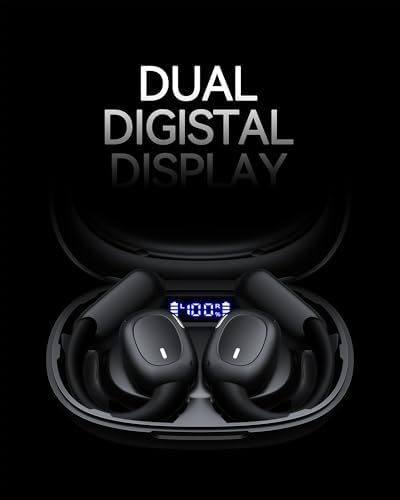
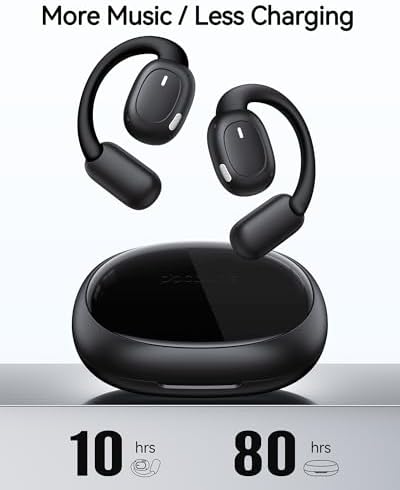
The first bullet gives 10 hours of continuous playback on a single charge and up to 80 hours in total with the charging case. Ten hours per charge is long and is the number that governs a training week; 80 hours is how long the whole system runs between wall charges, implying roughly seven recharges held in the case. The case carries an LED display showing its remaining charge and the charging status of the buds.
No case capacity in milliamp hours is published, so there is no way to sanity check the 80 hour figure the way you can on listings that give the cell size. No charging time is published either, for the buds or the case. Every quoted playtime is a best case at moderate volume, and this listing does not state the volume. That qualification bites harder on an open design, because outdoor listening tends to run louder to overcome wind and traffic, so expect real world runtime below the quoted figure.
The Batteries field reads “3 D batteries required (included)”. D cells are the large cylindrical batteries used in flashlights and radios, and no earbud takes one, let alone three. That field is import noise.
Drivers, calls and leakage
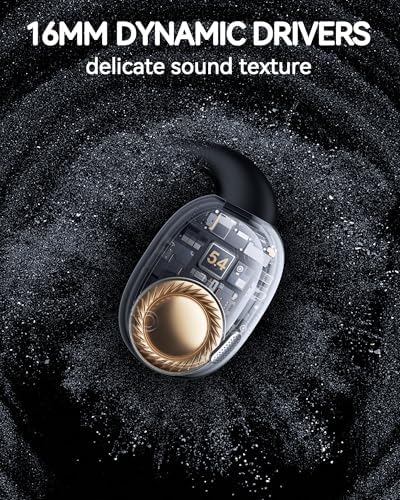
The third bullet gives 16 millimeter dynamic drivers with a titanium coated diaphragm. Sixteen millimeters is large, which matters more on an open design than a sealed one, because an open bud has no seal to reinforce the low end and needs to move more air to produce audible bass. Titanium coating stiffens the diaphragm so it flexes less at higher output. Both are credible claims. There is no impedance, sensitivity or frequency response figure to go with them.
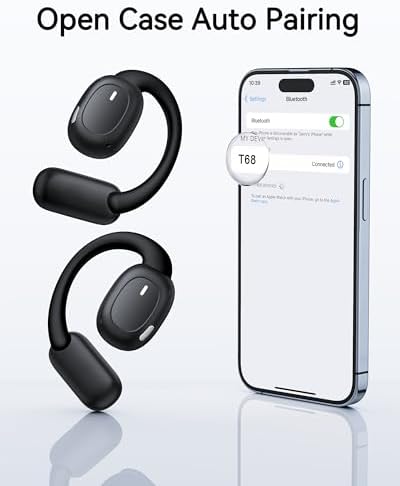
No codec is named anywhere on this page. There is no SBC, AAC, aptX or LDAC claim, so assume SBC only, the baseline every Bluetooth device supports, and treat the “studio-like details” phrase in the same bullet as marketing rather than a specification. Bluetooth 5.4 is stated in the title, though the specification block contains no Bluetooth version field, no range figure and no profile list. Multipoint pairing, a companion app and wear detection are not mentioned. Assume none exist.
The fourth bullet claims dual microphones for calls and says engineers have iterated the call program to “minimize sound leakage”. Leakage is the real weakness of open designs, since people near you hear what you are playing. No figure, test distance or reference is given for the reduction, so treat it as a manufacturer claim. In a quiet room, expect someone beside you to hear something.
What is missing, and the verdict
There is no IP rating anywhere on this page: no code in the title, no water resistance field in the specification and no bullet mentioning sweat or rain. On a product marketed for running, that is a conspicuous omission rather than a neutral one. Confirm a rating with the seller before training in it. Included Components reads only “Cable, Open Ear Headphones”, which does not confirm what else ships, though the battery bullet clearly assumes a charging case. Package weight is 4.6 ounces.
For sealed alternatives if isolation turns out to matter more to you than awareness, the HUAWEI FreeClip takes a clip on middle path, and the fully sealed shortlist sits in the in ear and earbud style headphones section. The rest of this shape is collected under open ear headphones.
Buy it if you run or ride outdoors and want to keep hearing traffic, 10 hours per charge with an 80 hour total suits you, and a 16 millimeter driver at this price is the specification you want. On battery disclosure and driver size this listing is above average for its bracket.
Do not buy it expecting isolation, which an open design cannot provide. Do not buy it as a PocBuds product, because it is not one. Do not train in it in the rain until the seller confirms an IP code, since none is published. And do not treat it as a hearing safe product for a child, because no volume limit exists on this page.