

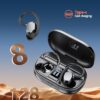
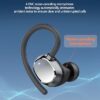


Description
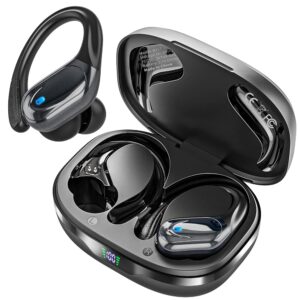
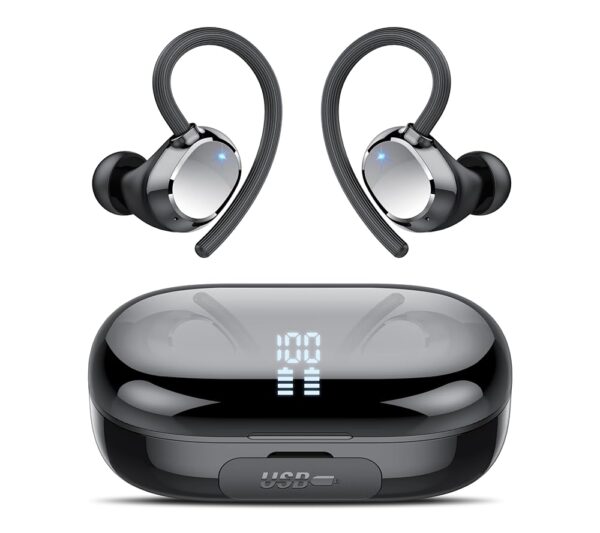
The hadbleng Q22, model Q22-BC-01, is an earhook true wireless set in what the listing calls Dream Black, ASIN B0F2N2KWNL, listed since December 2024. It carries a 4.4 star average across 1,046 ratings and ranks 585th in Amazon’s Earbud and In-Ear Headphones category and 4,371st in Electronics. The headline is a 2600 milliamp hour charging case, which is enormous for this class of product and is the reason for the 128 hour claim in the title. Several other fields in the specification are physically impossible and are covered below.
Who this suits, and what the big case buys you
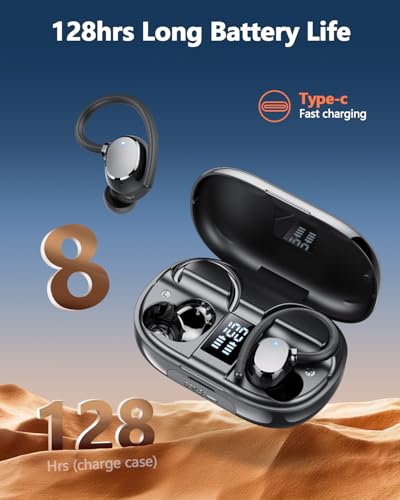
The first bullet gives 8 hours of playtime from a single charge and 120 hours from the 2600 milliamp hour case, which adds to the 128 hours in the title. Unlike most inflated totals in this catalog, the arithmetic here is plausible: a 2600 milliamp hour case genuinely can hold that many recharges of a small bud, and the specification independently records the same 2600 figure and a 2 hour case charging time.
The sixth bullet explains the other reason for the capacity: the case reverse charges a phone, tablet or other device, and the listing states it can add more than 30 percent to a phone battery. That is a real feature and a sensible use of the space. The tradeoff is bulk and weight, since a 2600 milliamp hour cell is roughly the size of a small power bank, and the case measures 60 by 30 by 20 millimeters.
The buyer this suits travels, camps or works away from sockets and wants one object that charges both the buds and the phone. If you want the earhook fit without the power bank, the Bcaikair BX17 and the Catitru T16 are the closer comparisons, and the Beats Powerbeats Pro are the reference version of the shape.
Connection and audio: what is published and what is not
Bluetooth 5.3 is stated with a 15 meter range, roughly 49 feet, which is optimistic for line of sight. The third bullet claims an 85 percent improvement in audio data transfer speed against an unnamed baseline, which is not a checkable figure and does not describe anything a listener would hear. Bluetooth version numbers change connection stability, power draw and LE Audio groundwork, not sound quality.
No codec is named anywhere on this page. There is no SBC, AAC, aptX or LDAC claim, so the “Hi-Fi technology” wording in the second bullet is marketing rather than a specification. Assume SBC only, the baseline every Bluetooth device supports. The drivers are 13 millimeter dual layer graphene diaphragms, and graphene coatings are a common way of stiffening a diaphragm so it flexes less at high output. Multipoint pairing, a companion app, transparency mode and wear detection are not mentioned. Assume none exist.
On noise handling the page contradicts itself mildly. The title and second bullet describe ENC, which is call side microphone processing, while the Noise Control field reads “Passive Noise Cancellation”, meaning the seal from the ear tips. Neither is active noise cancellation, and none is claimed, so there is no ANC here.
Two audio figures that cannot be right
The specification lists Sensitivity as 38 dB and Impedance as 80 ohms. Headphone sensitivity is normally quoted somewhere between 95 and 110 decibels per milliwatt; 38 decibels would be inaudible in practice. Eighty ohms is also far outside the normal earbud range of 16 to 32 ohms and would ordinarily require an amplifier rather than a phone. Both figures should be treated as data entry errors, not as specifications, and neither should be used to compare this product against anything else.
The weight fields are impossible
Item Weight reads 50 milligrams and Carrying Case Weight also reads 50 milligrams. Fifty milligrams is about the weight of a grain of rice. A case containing a 2600 milliamp hour lithium cell weighs somewhere in the region of 60 to 90 grams, which is more than a thousand times that figure. The fourth bullet separately quotes 6 grams per bud, which is credible for a hooked design. Ignore both weight fields entirely and work from the 6 gram bullet figure and the case dimensions.
Other broken fields: Batteries reads “3 A batteries required (included)”, and no A cell goes into an earbud. “Number of Items” reads 5, which counts the box contents rather than the products. Control Type reads “Siri” on a product the bullets describe as using touch. Ear Placement and Form Factor both read “Over Ear”, which describes the hook rather than an over ear headphone.
Fit, water resistance and the use cases to reject
Six ear caps in three sizes ship in the box, itemized properly along with the case, cable and manual. Three pairs is a good count, and on a hooked design the hook holds position while the tip decides the seal, which is the combination you want. A sealed bud that does not seal loses its bass and sounds thin, so this matters.
The water claim is broken. The title says “IP7 Waterproof” and the specification field says “Waterproof”. IP7 is not a valid IP code: real codes carry two positions, one for solid ingress and one for liquid, which is why genuine ratings read IPX4 for splash resistance or IPX7 for immersion. The correct reading is that no water rating is published for this product.
That makes the Recommended Uses field actively dangerous. It lists swimming, motorcycling and cycling among the intended activities. Swimming should be rejected outright: there is no valid IP code on this page, no immersion rating, and no earbud with an unpublished rating belongs in a pool. Motorcycling and cycling should be rejected for a different reason. These are sealed isolating earbuds with no transparency mode, so they remove your awareness of traffic, sirens and engine noise, and wearing them on a road is unsafe regardless of what any listing recommends. Snowboarding and skateboarding, also listed, carry the same awareness problem.
Use these in a gym, on a treadmill or while traveling. If you need outdoor awareness, the designs that leave the ear canal open are the correct shape, and the sealed alternatives are collected in the in ear and earbud style headphones section. If secure sports fit is the priority from an established brand, the Jabra Elite 8 Active publishes a real IP rating.
Who should buy this, and who should not
Buy it if the 2600 milliamp hour case is the point, you want one object that charges your buds and tops up your phone, and 8 hours per charge suits your day. The battery arithmetic on this listing actually closes, three tip sizes are included, and 1,046 ratings at 4.4 stars is a substantial sample by the standards of this bracket.
Do not buy it on the sensitivity or impedance figures, which are both impossible. Do not treat “IP7” as a rating, and do not swim in these under any circumstances. Do not ride a motorcycle or a bicycle in them. And confirm the case weight before buying if pocket size matters, because the specification claims 50 milligrams and the real figure will be closer to 80 grams.
![SAMSUNG Galaxy Buds 3 Pro AI True Wireless Bluetooth Earbuds, Noise Cancelling, Sound Optimization, Redesigned Comfort Fit, Silver [US Version, Amazon Exclusive, 2Yr Warranty]](https://wirelessemporium.com/wp-content/uploads/2025/04/samsung-galaxy-buds-3-pro-ai-true-wireless-bluetooth-earbuds-noise-300x300.jpg "SAMSUNG Galaxy Buds 3 Pro AI True Wireless Bluetooth Earbuds, Noise Cancelling, Sound Optimization, Redesigned Comfort Fit, Silver [US Version, Amazon Exclusive, 2Yr Warranty]")