
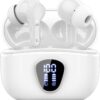
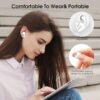
Description
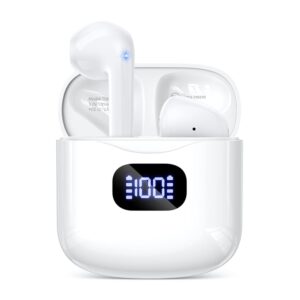
The BESNOOW I53 in white is a true wireless set, ASIN B0F1XSNGBT, listed since March 2025, manufactured by Shenzhen iSK Technology Co. Ltd. It carries a 5.0 star average across 582 ratings and ranks 782nd in Amazon’s Earbud and In-Ear Headphones category and 6,504th in Electronics. Before going further: at least three separate listings for a BESNOOW I53 exist on this site, differing by color and ASIN, and their published figures and rating counts are not identical. The blue I53 listing and an earlier I53 listing are worth comparing before you order, because the ratings behind them differ sharply.
Who this suits
This is a general purpose sealed earbud aimed at gym use, commuting and calls. The specification is unusually complete for the price: it publishes a driver size, an impedance figure, the case capacity, the case dimensions and weight, and both halves of the battery claim. That level of disclosure is rare in this bracket and it makes the product easier to judge than most of its rivals.
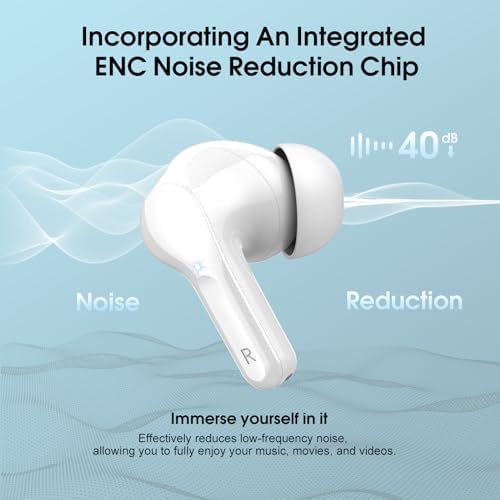
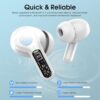
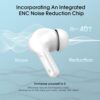
There is no active noise cancellation. The Noise Control field reads “Sound Isolation”, which is passive blocking from the ear tips, and the title’s “ENC Noise Cancelling Mic” refers to microphone side processing that cleans up what the other party hears on a call. Those are different things. The second bullet claims ENC filters out more than 80 percent of external noise during calls, with no test standard or measurement method named, so treat that as a manufacturer figure. If cancellation for the listener is what you want, sets with a published ANC design such as the Soundcore A20i answer the question directly.
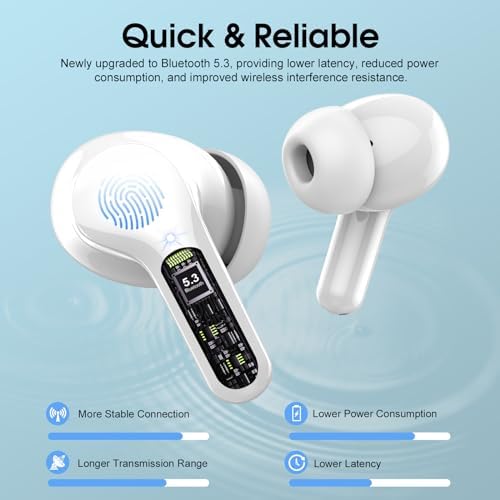
Connection: Bluetooth 5.4, and a lossless claim with no codec
Bluetooth 5.4 is stated with a 15 meter range, roughly 49 feet, which is optimistic for line of sight and will shorten through walls and bodies. A magnetic hall switch handles reconnection, so taking the buds out of the case powers them on and reconnects them. The first bullet claims a “30% faster transmission speed” against an unnamed baseline and promises “no delay”, with no latency figure in milliseconds to support it. Bluetooth version numbers affect connection stability, power draw and LE Audio groundwork, not sound quality.
The third bullet claims “lossless CD-level audio transmission”. No codec is named anywhere on this page. There is no SBC, AAC, aptX or LDAC claim, which means there is no mechanism by which lossless or CD level audio could reach these earbuds. Lossless over Bluetooth requires a specific codec carried by both the phone and the buds. The claim is unsupported by the published specification, and the working assumption should be SBC only, the baseline every device supports. The title’s use of “HiFi Stereo” is marketing on the same basis.
Multipoint pairing, a companion app, transparency mode, wear detection and firmware updating are all absent from this listing. Assume none exist.
Battery: 48 hours in the title, 40 in the specification
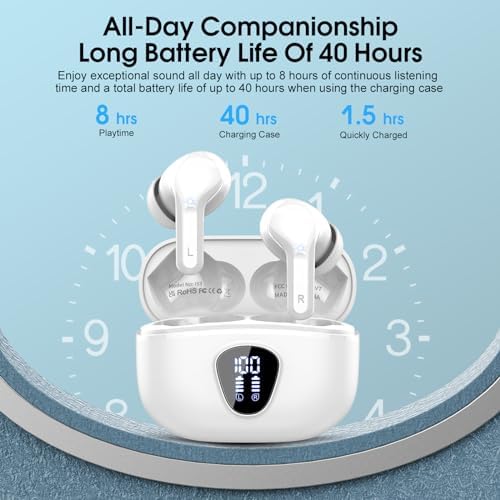
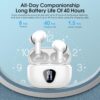
The fourth bullet says up to 8 hours of music playback on a single charge, and up to 48 hours of battery life with the charging box, charging fully in 1.5 hours. The specification block then lists “Carrying Case Battery Average Life: 40 Hours” and gives the case capacity as 400 milliamp hours. Forty and forty eight are two different totals on the same page.
The 400 milliamp hour capacity is the useful number here, because it lets you sanity check the claim. A 400 milliamp hour case charging a pair of buds that run 8 hours each would realistically deliver four or so recharges before losses, which lands closer to 40 hours than 48. Plan around 8 hours per charge, which is the figure that governs your day, and treat the total as roughly 40.
The case is fully specified: 59.98 by 20 by 27.98 millimeters, 35 grams, charging in 1.5 hours. Each bud weighs 3.7 grams. Publishing case dimensions and weight is unusual and genuinely useful if pocket size matters to you. All quoted playtimes are best case at moderate volume, and this listing does not state the volume. The TOZO T20 is a useful comparison on runtime in the same bracket.
One field is import noise: Batteries reads “3 A batteries required (included)”, and no A cell goes into an earbud.
Drivers, fit and the water code that is not real
The driver is 14.2 millimeters, which is large for an in ear design, with an impedance of 32 ohms. Thirty two ohms is on the higher side for an earbud and is a plausible figure, though with no sensitivity number alongside it there is no way to judge how loud it will run from a given phone. There is no frequency response figure.
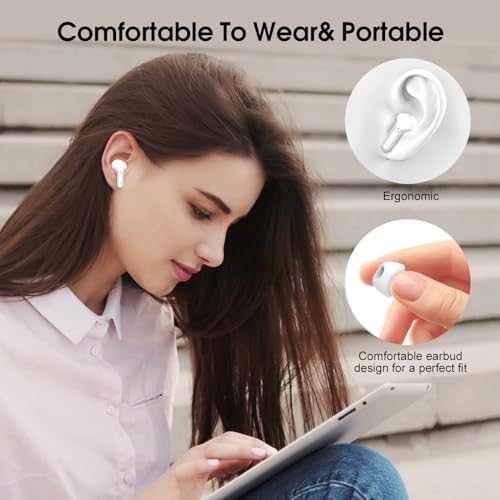
Fit is well covered. Three sizes of silicone tips ship in the box, itemized in the components field along with the case, the cable and the manual, and each bud weighs 3.7 grams. Tips decide the seal, and a sealed bud that does not seal loses its bass and sounds thin, so three sizes is a real advantage. Controls are touch on both buds with a full gesture set including volume.
The water claim is broken. The title says “IP7 Waterproof” and the fifth bullet says “IP7-rated nano-coating technology”. IP7 is not a valid IP code, because real codes carry two positions, one for solid ingress and one for liquid, which is why genuine ratings read IPX4 for splash resistance or IPX7 for immersion. The specification field says only “Waterproof”, which is a phrase and not a code. The correct reading is that no water rating is published. Treat the set as sweat resistant at best. Even a genuine IPX7 excludes seawater, chlorinated pool water and pressurized water, and seals degrade with age and heat.
Use cases the listing gets wrong
The Recommended Uses field lists cycling, snowboarding and skateboarding, and the sixth bullet says to use these “whether you are exercising, driving, or running”. Driving and cycling should both be rejected. These are sealed isolating earbuds with no transparency mode, so wearing them removes your awareness of sirens, horns, traffic and your own vehicle, and in many places wearing headphones while driving is restricted or illegal. Snowboarding and skateboarding carry the same awareness problem on shared ground.
Use these indoors or on a treadmill. If you need to hear your surroundings, the designs that leave the ear canal open are the correct product shape, and the wider sealed shortlist is in the true wireless earbuds section.
Who should buy this, and who should not
Buy it if 8 hours per charge suits you, you value a listing that publishes an impedance, a case capacity and case dimensions, and three tip sizes in the box matters. A 5.0 average across 582 ratings is a substantial commercial signal, and on specification disclosure this is one of the better budget listings in this catalog.
Do not buy it for the lossless claim, which has no codec behind it. Do not expect 48 hours when the case capacity and the specification field both point closer to 40. Do not treat “IP7” as a rating. Do not wear these while driving, cycling or boarding. And check the ASIN, because several BESNOOW I53 listings exist with very different rating counts behind them.