Description
The player this set is designed for
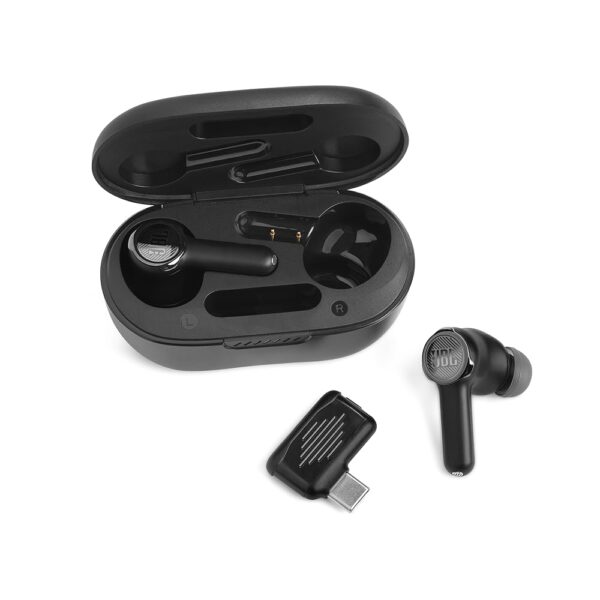
JBL Quantum TWS is a gaming product wearing an earbud shape. That framing explains almost every design decision on the listing. It ships with a USB-C dongle that establishes a 2.4GHz link, it carries JBL QuantumSURROUND for positional audio, and it advertises six beamforming microphones for voice chat. The target is someone playing on a handheld console, a laptop or a PC who does not want a headband, and who is willing to carry a dongle to get latency down. Someone shopping purely for a commuting earbud is looking at the wrong product, because the features that justify the price here are the ones that only activate when a dongle is plugged into a compatible device.
The secondary use case JBL pitches is the switch between game audio and a phone call, handled by a feature it calls Dual Source. In practice that means the buds hold the 2.4GHz dongle link and a Bluetooth phone link at the same time, and let you take the call without dropping the game session. It is a narrower form of multipoint than a general two device pairing, and the listing does not claim conventional multipoint across two Bluetooth phones.
The connection story, and the claim we cannot verify
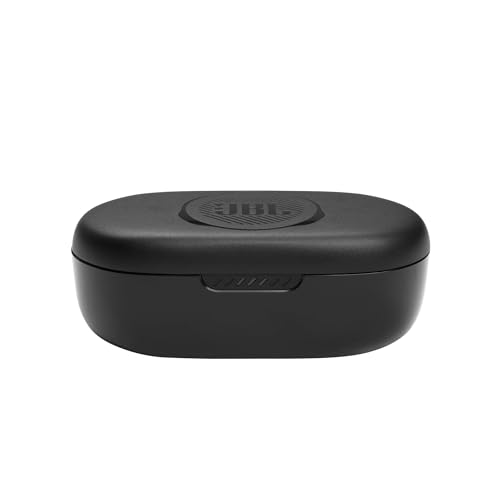
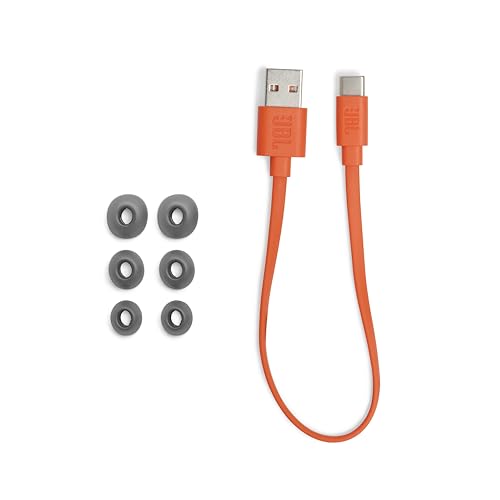
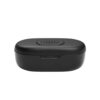
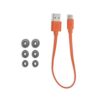
There are two radios in play. The Bluetooth side is listed as version 5.2 with a quoted 10 meter range, and it is what you use with a phone or tablet. The 2.4GHz side runs through the bundled USB-C dongle, which stores inside the charging case, and it is the low latency path. Wireless earbuds over standard Bluetooth carry enough audio delay to be noticeable in competitive play, and a proprietary 2.4GHz link is the usual fix. That part of the pitch is credible and is the main reason to choose this over a normal set.
Why the lossless wording needs a caveat
JBL repeatedly describes the 2.4GHz connection as “lossless wireless” in the product copy. The listing names no codec for that link, publishes no bit depth and publishes no sample rate. A lossless claim without a named codec and a stated sample rate is not something the published specification supports, so we are flagging it rather than repeating it. On the Bluetooth side no codec is named either, which means the only safe assumption is SBC, the baseline every device supports, with AAC possible but unstated. If a specific high resolution codec matters to you, this listing does not give you the information to check it, and you would need to confirm with JBL before ordering.
QuantumSURROUND carries its own restriction, and JBL states it plainly: it works on PC only, and only in combination with the JBL QuantumENGINE software. On a console, a phone or a Mac, that feature is not available. It is not a property of the earbuds so much as a property of the PC software stack they connect to.
Battery, split into the two figures that matter
JBL rates the buds themselves at up to 8 hours and the charging case at 16 hours of backup, for 24 hours combined. The number to plan around is 8, because that is what you get in your ears before the case is needed. The 24 hour figure describes how long you can go between wall charges, not how long a session can run. As with any quoted playtime, 8 hours is a best case at moderate volume, and JBL does not publish a separate figure for adaptive noise cancellation switched on, nor for the 2.4GHz dongle link, which typically draws more power than Bluetooth. Both of those will reduce the real number and neither reduction is quantified.
The specification table then muddies this. It lists “Charging Time = 8 Hours” and “Carrying Case Battery Charging Time = 16 Hours”. Those look like the playtime figures pasted into charging time fields, because an 8 hour recharge on a true wireless earbud would be extraordinary and a 16 hour case recharge even more so. We are naming the inconsistency rather than guessing at the real charge duration. If charge speed matters to you, treat both figures as unpublished.
Fit, seal, controls and the water rating
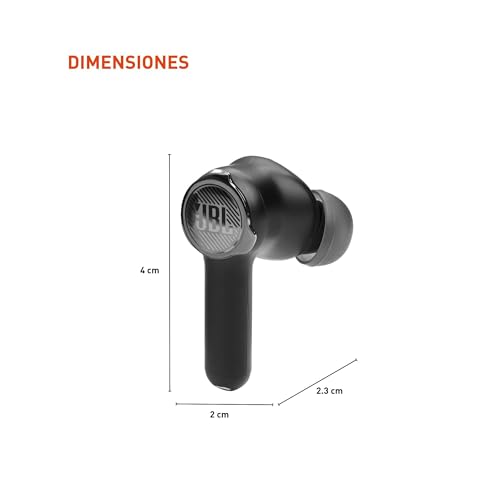
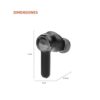
Three sizes of ear tips are included. That is a standard count and enough for most ears, though seal quality is what decides both bass response and how much the noise cancellation can achieve, so it is worth trying all three rather than assuming the preinstalled pair is right. This is a sealed in ear design, and the housings are listed at 11 grams for the pair, which is roughly 0.388 ounces. Controls are touch based, and the listing gives no gesture map.
The water rating stated in the product title is IPX4. That is the splash and sweat tier: protection against water spray from any direction. It is not an immersion rating, it will not survive being dropped in a sink, and it should never be called waterproof. Notably, the structured specification block does not repeat the IPX4 code at all and simply says “Water Resistance Level = Water Resistant”, which is a phrase with no defined meaning. The IPX4 code from the title is the more specific of the two and is what we would go by. Keep in mind that no IP rating covers seawater or pressurized water, and that gasket performance degrades with age.
One safety point that follows directly from the design. This is a closed, actively noise cancelling earbud. Ambient Aware exists to let outside sound back in, but a transparency mode is a processed approximation of your surroundings and it is not a substitute for open ears. Do not use this set for cycling or for running on roads. If awareness while moving is your actual requirement, the correct category is an open design, and our open fit headphone listings are the right starting point.
What is missing from the specification, and the alternatives
The listing does not mention wear detection, so assume audio does not pause when you remove a bud. It does not publish an ANC attenuation figure, which at least means there is no unsupported decibel headline to argue with, but it also gives you nothing to compare. Driver size is not published, only that a dynamic driver is used, and impedance is listed at 16 ohms with a 20 Hz to 20,000 Hz frequency range that carries no tolerance figure and therefore says almost nothing about tuning. There is no mobile app named for the earbuds themselves, only QuantumENGINE on PC.
Customer feedback sits at 3.9 out of 5 across 322 ratings, which is the softest score among the JBL sets in this catalog and worth weighing. Amazon places the listing around 49,893rd in Electronics and 3,265th in earbud and in ear headphones. If a dongle is not something you want to carry and you would rather have a general purpose JBL set, our JBL Tune Flex review and our JBL Vibe Beam review both cover simpler options with no gaming dependency. If low latency gaming is the whole point and you would accept a smaller earbud with a different feature set, the TOZO G1 gaming earbud review is the closest true wireless comparison here. And if you would actually be better served by a headband, the ASTRO A20 Gen 2 review covers a dedicated wireless gaming headset. Wider comparisons live in our wireless earbud listings.
Who should buy it and who should not
Buy it if you game on a device with a spare USB-C port, want low latency without wearing a headband, and will genuinely use the dongle. Skip it if you are buying for music alone, because the same money buys stronger codec support elsewhere. Skip it if you were persuaded by the lossless wording, because the listing does not back it with a codec. Skip it if you need immersion protection, since IPX4 is splash and sweat only. And do not buy it for road cycling or outdoor running, where a sealed noise cancelling design is the wrong tool.