




Description
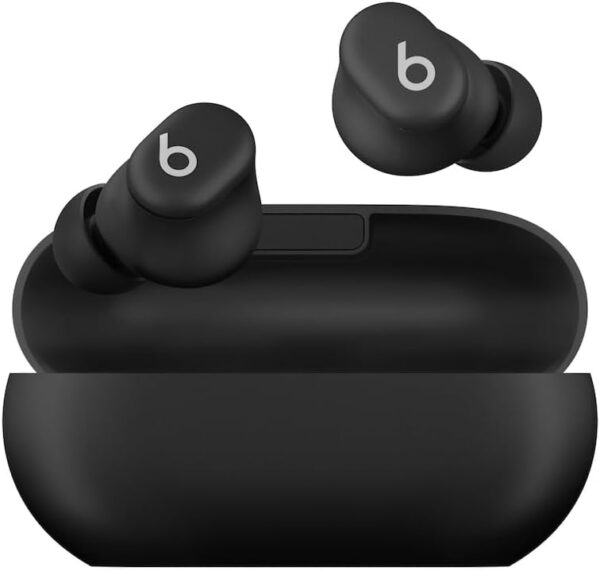
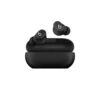
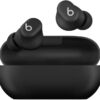
The Beats Solo Buds are a true wireless in-ear set built around one deliberate omission: the case has no battery. Beats calls it the smallest case the brand has made, and the reason it is small is that it stores the buds rather than recharging them. Every other figure on this listing follows from that decision, so it is the place to start.
Who these are for
These suit someone who wants a genuinely pocketable set, charges from a phone or laptop rather than a wall adapter, and does not need noise cancellation. Beats gives the weights precisely: 5.7 grams per bud, 22 grams for the case, 33.4 grams together. For comparison, most true wireless cases in this catalog weigh two to three times that, because they carry a battery. Beats lists dual compatibility for iOS and Android with one-touch pairing, which is the practical difference between this and an Apple-only set.
They are not a workout set and they are not a travel set. There is no IP rating published anywhere on this record, no water resistance field at all, and no sweat resistance claim. Do not treat them as gym-safe. For an ear-hook sports design with a published ingress claim, the Aptkdoe HD65 is a different shape of product entirely, though its own rating needs reading carefully.
How they connect
Beats states Class 1 Bluetooth, which is a transmit power class rather than a version number, and describes it as giving extended range with fewer dropouts. Class 1 does generally mean more range than Class 2, so the claim is meaningful, but this listing publishes no Bluetooth version at all and no codec.
No codec is named, so the high fidelity wording is unsupported
One bullet says the dual-layer drivers minimize distortion, “ensuring high-fidelity sound.” That is a driver claim, not a transmission claim, and no audio codec appears anywhere on this record. Where nothing is named, SBC is the only codec that can be assumed, because SBC is the baseline every Bluetooth device supports. Nothing here supports a high resolution or lossless claim over the wireless link, and any codec that did appear would still require your phone to support the same one for it to be used.
Multipoint is not mentioned. Wear detection, the feature that pauses playback when you take a bud out, is not mentioned. An app is not mentioned. Active noise cancellation is not mentioned, and the absence there is deliberate rather than an oversight: the Solo Buds sit below the cancellation-equipped models in the Beats range. Any noise reduction you get is passive isolation from the tip seal, which is why tip fit matters so much on this set. For active cancellation from the same family, the Beats Studio Buds are the model that publishes it.
The battery picture, and why it reads differently here
Beats quotes up to 18 hours of listening time on a single charge, with Fast Fuel giving up to 1 hour of playback from a 5 minute charge. On most true wireless listings a figure like 18 hours would be the combined bud-plus-case number, and the per-bud runtime would be a fraction of it. Here it is the other way round. The attribute data is explicit that 18 hours is the single-charge figure for the buds themselves, and no case battery figure is published anywhere, because there is no case battery to publish.
That is a genuinely long bud runtime, and it is the strongest argument for this product. It also means the recharge is a stop rather than a top-up. With a powered case you drop the buds in for ten minutes between uses. Here you plug the case in and wait, and the listing does not publish how long a full charge takes.
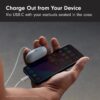
Two practical points sit alongside that. Beats states in capital letters that the power adapter and USB-C charging cable are sold separately, so the box does not contain a way to charge them. It also states that you can charge directly from a phone, tablet or laptop, which is the intended workflow and requires the port on that device to supply power. Anyone buying these as a gift should account for the missing cable.
Fit, drivers and controls
Beats describes a custom acoustic architecture with dual-layer drivers positioned in axial alignment to aim sound at the ear canal, and laser-cut vents that relieve pressure. Venting is a real comfort feature on a sealed in-ear, because trapped pressure is what makes some earbuds feel like a plugged ear after an hour.
The listing does not state how many ear tip sizes are included, and no included-components list appears on this record. That is a meaningful gap on a set with no active cancellation, because passive isolation is entirely a function of the seal, and a poor seal makes any earbud sound thin at the bottom end. Confirm the tip provision before ordering if your ears are at either end of the size range.
Each bud carries custom microphones with what Beats calls a noise-learning algorithm for call quality. That is outbound processing, improving what the person on the other end hears. It does nothing for what you hear.
The bud is 1.9 centimeters high and 2.05 centimeters long, which is small, and the form factor is listed as in-ear. There is no ear hook, no wing tip and no stem described, so retention depends entirely on the tip.
What the listing does not publish
Absent here: driver diameter, frequency response, Bluetooth version, codec support, IP rating, ear tip count, full charge time, control type and control method. The source category path on this record contains nothing but reviewer names, so there is no usable category data at all. Buyers should treat this as a listing that sells a shape and a battery figure rather than a specification.
For comparison inside our own catalog, the Apple AirPods 4 take the opposite approach with an open fit and a powered case, the JBL Vibe Beam is a conventional sealed set with a charging case, and the JLab Go Air Pop covers the compact end with a published ingress rating. The wider wireless earbud listings are the place to compare battery splits properly.
Who should buy them, who should not
Buy the Solo Buds if you want the smallest case in this catalog, an 18 hour bud runtime that no powered-case set matches per charge, and cross-platform pairing that works on Android as well as iOS. Skip them if you want active noise cancellation, if you need any water resistance, if a case that recharges the buds is what you picture when you think of true wireless, or if you would rather not buy a charging cable separately.