


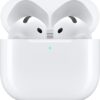

Description
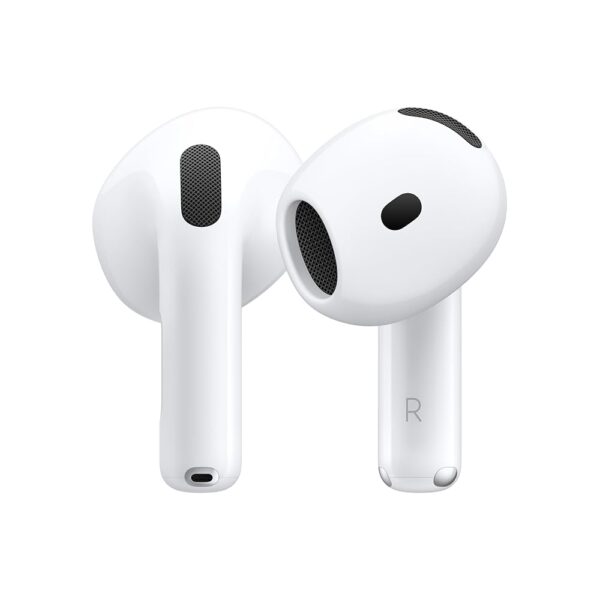
The Apple AirPods 4 in this listing are the variant with active noise cancellation, model MXP93LL/A. The detail that shapes everything about them is the fit: AirPods 4 have no ear tips and do not seal the ear canal. Apple is doing active cancellation on an open design, which is unusual, and it is the right place to start because it sets what the cancellation can and cannot achieve.
Cancellation without a seal
Almost every cancelling earbud in this catalog is a sealed in-ear, because active cancellation works against a closed cavity. The system measures outside noise with a microphone and plays an inverted signal into a small, controlled volume of air. When the ear canal is open, that volume leaks, and low frequency cancellation becomes far harder to achieve.
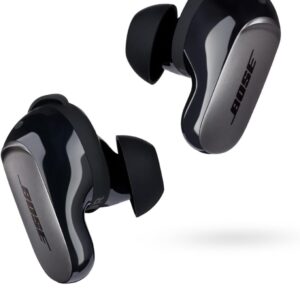
Apple’s answer is the H2 chip and a great deal of processing, and the company does claim active noise cancellation for this model. What a buyer should expect is meaningful reduction of steady low frequency noise, but less of it than a well-sealed bud such as the Bose QuietComfort Earbuds delivers, and considerably less isolation of speech and mid-range sound, because there is no physical barrier doing the first stage of the work.
The flip side is real. An unsealed bud does not create ear pressure, does not need a tip size chosen correctly, and leaves you more connected to your surroundings. If sealed earbuds have never been comfortable for you, that trade may be the whole argument.
Who these suit, and the ecosystem question
These are for someone inside the Apple ecosystem who wants an open fit. The feature list depends on it heavily: Siri by voice, Siri Interactions responding to a nod or a head shake, Personalized Spatial Audio with dynamic head tracking, Conversation Awareness lowering the volume when you speak, Adaptive Audio blending cancellation and transparency automatically, and audio sharing between two sets. Most of that is Apple platform behavior rather than Bluetooth behavior.
Apple publishes the sensor list, which is more than most makers do: dual beamforming microphones, an inward-facing microphone, an optical in-ear sensor, a motion-detecting accelerometer, a speech-detecting accelerometer and a force sensor. The optical in-ear sensor is wear detection, so playback pausing when a bud comes out is confirmed here rather than assumed, which is unusual in this catalog.
Controls are physical presses on the stem: once to play or pause, once to answer or mute, twice to end a call or skip forward, three times to skip back, press and hold for Siri. Physical presses rather than taps means fewer accidental triggers.
How they connect
Bluetooth 5.3 is stated. No audio codec is named anywhere on this record, which is worth saying plainly on an Apple product. There is no AAC entry, no aptX and no LDAC. Where nothing is named, SBC is the only codec that can be assumed, because SBC is the baseline every Bluetooth device supports. Nothing here supports a high resolution or lossless claim, and any codec that did appear would still require the source device to support the same one.
Multipoint in the standard Bluetooth sense is not mentioned. Apple hardware performs automatic switching between an iPhone, an iPad and a Mac on the same account, which is a different mechanism and does not extend to a Windows laptop or an Android phone. Treat multipoint as unconfirmed if a non-Apple device is part of your setup.
The battery figures, published in full
Apple gives all four states, which is rare and worth crediting. With active cancellation enabled: up to 4 hours of listening on a single charge and up to 20 hours using the case. With noise control off: up to 5 hours on a single charge and up to 30 hours total. Talk time is up to 4.5 hours per charge.
Four hours per charge with cancellation running is short. It is shorter than the 6 hours the JBL Tune Flex gives in the same state, and roughly half what a sealed cancelling bud typically manages. What offsets it is a very small case that recharges quickly, so the pattern is short sessions with frequent returns to the case rather than one long run.
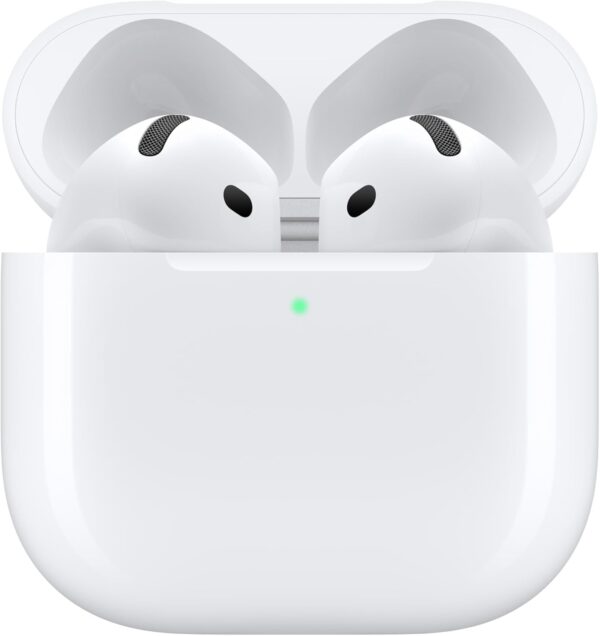
The case charges over USB-C, on an Apple Watch charger, or on any Qi-certified pad, and it contains a speaker for Find My proximity search. Apple calls it the smallest case in the industry with wireless charging. One practical note: the USB-C charge cable is sold separately, so the box contains the buds, the case and documentation only.
Fit, weight and the water rating
Each earbud is 30.2 by 18.3 by 18.1 millimeters and weighs 4.3 grams. Apple describes a refined contour and a shorter stem compared with the previous generation, aimed at stability without a tip. Since there is no tip to change, fit is fixed: these either suit your ears or they do not, and there is no adjustment path if they do not. That is the single biggest risk with an unsealed design and it cannot be mitigated after purchase.
The water rating is IP54 for both the earbuds and the charging case, stated clearly and with the code attached. The 5 covers dust ingress at a protected level and the 4 covers splashing from any direction, which means sweat and rain. It is not an immersion rating, so these should not be submerged, worn in a shower or taken swimming, and Apple’s phrasing about heavy workouts should be read against the code rather than the adjective. No IP rating covers seawater or pressurized water, and protection degrades as seals age.
Voice Isolation improves calls by reducing background noise around your voice. That is outbound processing that helps the person you are speaking to and does nothing for what you hear.
What is missing, and what to compare
Unpublished on this record: driver diameter beyond “custom high-excursion Apple driver,” frequency response, impedance, sensitivity, charge times, and any decibel figure for the cancellation. The source category path contains only reviewer names, so there is no usable category data. Nearly every feature bullet carries an asterisk pointing to legal disclaimers that are not reproduced in the listing, which is worth knowing before treating any single claim as unconditional.
Within our own listings, the Apple AirPods Pro 2 are the sealed alternative with stronger cancellation, the Apple AirPods 3rd generation are the unsealed model without cancellation, and the Amazon Echo Buds take a similar unsealed approach outside the Apple ecosystem. The wider wireless earbud listings cover the rest.
Who should buy them, who should not
Buy AirPods 4 with cancellation if sealed earbuds do not suit your ears, if you live on Apple hardware, and if confirmed wear detection and an IP54 rating cover what you need. Skip them if you want the strongest cancellation available, if 4 hours per charge is too short, if you need multipoint with a non-Apple device, or if you would rather have a tip you can change when the fit is not right the first time.