Description
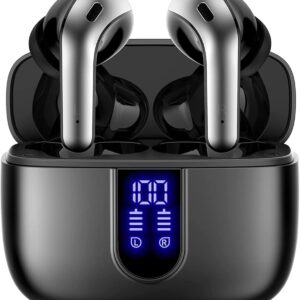
The TOZO G1 is a set of in-ear true wireless earbuds sold on a gaming angle: a low latency listening mode, a switchable game and music profile, and an LED light on each bud that pulses while the earbuds are in use. TOZO lists the model number as G1, the ASIN as B0BDYWXV6L, and the color reviewed here as Dark Black. Amazon shows the G1 carrying a 4.2 star average across 1,796 ratings, ranked 63,921st in Electronics and 3,604th in Earbud and In-Ear Headphones at the time the listing data was captured. That is a mid-catalog position rather than a headline seller, which matters when you are deciding how much weight to put on the review count.
Who this suits, and who it does not
The G1 is aimed at someone playing games on a phone or a tablet who wants to stop using the built-in speaker and does not want to run a cable. The audio and video synchronization argument is the whole pitch. If your listening is mostly podcasts, commuting music and calls, the G1’s low latency mode is not doing anything for you and the LED lights are a cosmetic feature you are paying for. If your gaming happens on a PC or a console, note that the listing names no dongle and no wired option at all: the “Cable Feature” field says “Without Cable,” so the only route in is Bluetooth from whatever your source device offers. Many consoles do not offer usable Bluetooth audio without an adapter, and the listing does not address that.
How it connects, and what that actually buys you
TOZO lists Bluetooth 5.3 with a 10 meter range. Bluetooth 5.3 is a chipset generation, not a sound quality tier. What a newer Bluetooth version genuinely tends to improve is connection housekeeping: power draw, how gracefully the link handles interference, and eligibility for newer low energy audio features. It does not on its own make music sound better, and no listing should be read as implying that it does.
More importantly, the listing names no audio codec anywhere. There is no mention of AAC, aptX, aptX Adaptive or LDAC. In the absence of a named codec, the only thing you can safely assume is SBC, which every Bluetooth audio device supports as a baseline. Any high resolution or high fidelity language attached to this product is therefore unsupported by the published specification. If codec support is something you care about, the honest answer is that this listing does not tell you, and a codec only functions when both the earbuds and the phone support it.
The 45 millisecond latency figure
TOZO quotes 45 milliseconds of audio latency in the low latency mode. No measurement method and no source device are named, and latency in practice is decided as much by the phone’s Bluetooth stack and the game’s own audio buffer as by the earbuds. Take 45 milliseconds as the manufacturer’s best case on their own bench. It is low enough that gunfire and footstep cues should feel roughly aligned to the picture, but it is not a specification you can verify from the listing, and it is not comparable to a wired connection. Anyone who needs frame-accurate audio for competitive play is still better served by a cable.
The battery picture, separated properly
This is where the listing muddles two different numbers. TOZO states up to 6 hours of play on a single charge from the buds themselves, and a further 30 hours from the charging case. The specification block lists “Battery Life = 6 Hours” and “Carrying Case Battery Average Life = 30 Hours.” So the bud runtime is 6 hours and the case reservoir is quoted at 30 hours, which the marketing then compresses into a “30H Ultra Long Playtime” headline. Read the small number, not the large one: 6 hours is what you get before the buds go back in the case.
The field “Charging Time = 30 Hours” is plainly wrong. Charging time and case battery life have been filled with the same value. The listing does not publish an actual recharge duration for the buds or the case, and it does not publish a fast charge figure. The case is described as supporting wireless charging, and a USB-C cable is in the box.
One further caution on the 6 hour figure: quoted playtimes are almost always measured at moderate volume with the extra features off. The G1’s LED breathing lights draw power continuously while the buds are in use, and the listing does not say whether the 6 hour figure was measured with the lights on or off. It also does not say whether game mode costs runtime. Assume less than 6 hours if you run the lights.
Fit, seal, controls and the water rating
Six pairs of ear tips ship in the box, sized XS through XXL. That is a genuinely useful specification and more than most budget sets include, because seal is what decides whether an in-ear sounds full or thin. A loose tip drains perceived bass and then people reach for the volume control to compensate, which is the wrong fix. If the G1 sounds hollow, change the tip before you change the volume.
Controls are touch based, with media control listed. The listing does not mention wear detection, transparency mode, multipoint pairing to two devices at once, or a companion app, and where a listing is silent on those you should assume they are absent rather than assume they are present. The three level LED indicator is described as showing battery state from 0 to 100 percent.
On water resistance the listing says “Waterproof” and gives no IP code at all. That is not a rating, it is a word. Without an IPX number there is nothing that tells you whether the G1 survives sweat, rain or immersion, and we will not translate marketing language into a rating that was never published. If you want a set with an actual immersion rating in writing, the TOZO T9 at least states an IPX7 figure in its own specification. It is also worth noting that no IP rating, published or not, covers seawater or pressurized water, and that seals degrade with age and sweat exposure.
Several internal contradictions are worth naming rather than smoothing over. The form factor field says “Over Ear” while the ear placement field says “In Ear”; these are earbuds, so the over-ear entry is wrong. The marketing copy claims bass extending to 16Hz while the specification block states 20Hz to 20kHz. The battery field describes “1 Lithium Metal batteries required,” which does not describe a rechargeable earbud. And “Controller Type = Wired or Wireless Gaming Controller,” “Is Autographed = No” and “Number of Power Levels = 1” are all leftovers from other product categories, which tells you the specification block is partly machine-generated.
What the listing leaves out, and where to look instead
Not published: any codec, any IP code, driver diameter, impedance, sensitivity, microphone count, ANC of any kind, multipoint, app support, or a recharge time. That is a lot of blank space for a product being sold on technical performance. Before buying, confirm the codec your phone will actually negotiate and whether the LED lights can be turned off.
If the gaming framing is not what you need, TOZO’s mainstream sets publish more of their specification. The TOZO T10 is the long-running sports oriented model, the TOZO T12 sits a tier up, and the TOZO NC2 is the one in the range that actually claims hybrid active noise cancellation rather than implying it. Anyone comparing across brands can work through the wider wireless earbuds listings, and the earbud headphones section holds a further overlapping set of in-ear models.
A note on volume. Sealed in-ear earbuds remove the natural cue that tells you the room is loud, and long gaming sessions are where volume creeps up unnoticed. The G1 publishes no volume limiter and TOZO lists the age range as adult. Set the level once the seal is working properly, then leave it alone.
The short version
Buy the G1 if you play games on a phone or tablet, want a cheap set of in-ear buds with a low latency mode, and can live on 6 hours of bud runtime. Skip it if you need a stated water rating, a named codec, active noise cancellation, multipoint, or anything approaching a complete published specification, because on every one of those points this listing is silent.