

Description
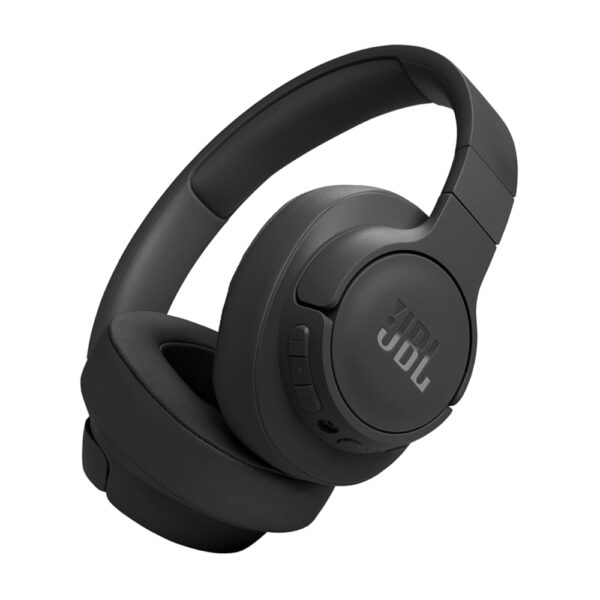
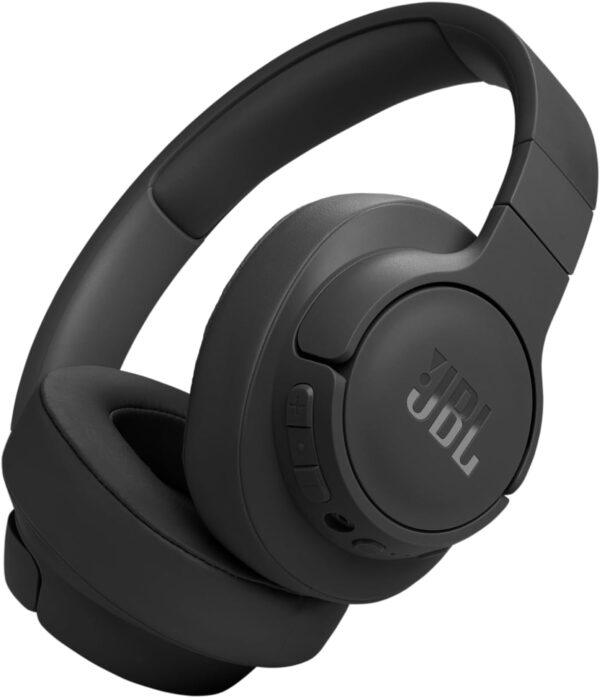
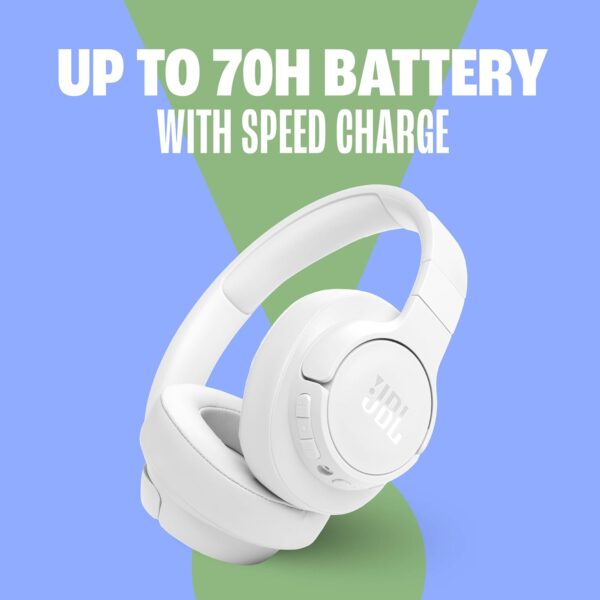
The JBL Tune 770NC is a closed over-ear Bluetooth headphone with adaptive noise cancellation, sitting in JBL’s mainstream Tune line rather than its premium Tour range. The headline numbers are a quoted 70 hours of battery life, Bluetooth 5.3, a flat-folding design, and a stated weight of 8.2 ounces. JBL lists the first availability date as March 2024, so this is a current-generation model rather than old stock.
Who this headphone is for
This suits a commuter, a student or an office listener who wants noise cancellation and a battery they can forget about, and who is not chasing a specific high bandwidth codec. The included components are a cable and a user manual, and the material is listed as plastic, which is consistent with a light headphone built to be carried rather than admired. At 8.2 ounces it is roughly half the weight of a gaming over-ear such as the SteelSeries Arctis Pro Wireless, and that difference is what makes an all-day headphone practical.
It is not a workout headphone. No IP rating appears anywhere in this listing, and no water resistance field is populated at all, so it should not be described as sweat resistant. It is also the wrong choice for cycling or road running, because a sealed closed-back design with active cancellation running takes away your ability to hear traffic. The Ambient Aware mode reduces that problem but does not solve it, and no manufacturer’s transparency mode should be relied on for road safety.
How it connects, and what the codec silence means
Bluetooth 5.3 is listed, with a 10 meter range, and JBL adds that LE Audio arrives through an over-the-air update rather than being active out of the box. It is worth being clear about what a Bluetooth version number does and does not mean. Version 5.3 governs connection stability, power efficiency and which feature sets the chip can support. It does not by itself make music sound better, and a headphone on 5.3 is not audibly superior to one on 5.0 for that reason alone.
No codec is published, so no high resolution claim can be made
This listing names no audio codec at all. There is no AAC entry, no aptX, no aptX Adaptive and no LDAC. With nothing named, SBC is the only codec that can be assumed, because SBC is the baseline every Bluetooth device supports. That means nothing on this record supports a high resolution or lossless claim, and even if the headphone did support a better codec, your phone would have to support the same one for it to be used. Most iPhones, for instance, do not support aptX or LDAC at all.
LE Audio, once the update lands, brings the LC3 codec and generally better efficiency at a given bitrate. That is a real improvement, but it requires the phone to support LE Audio too, and a firmware update that is described as forthcoming is not a feature you should buy on today.
The genuinely useful connectivity feature here is multipoint. JBL states the Tune 770NC can connect to two Bluetooth devices simultaneously, giving the example of taking a call on a phone while watching a movie on a tablet. Multipoint is the feature that changes daily use more than any specification on the sheet, and many headphones at this level omit it. The Sony WH-CH720N is the natural comparison in this bracket for anyone weighing that feature.
The battery figure, and what it assumes
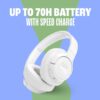
JBL quotes up to 70 hours of battery life with speed charge, and states that five minutes of charging returns an extra three hours of music. The attribute data gives a charging time of two hours. Being a one-piece over-ear headphone with no charging case, there is no combined figure hiding a shorter per-use runtime, which makes this simpler to read than a true wireless quote.
The important omission is the noise cancellation state. Manufacturers routinely publish two playtime figures for an ANC headphone, one with cancellation off and a considerably shorter one with it on, and this listing publishes only the higher number. It does not say whether 70 hours is measured with ANC active. Active cancellation runs microphones and a processing chain continuously, and it always costs battery. Read 70 hours as the ceiling with cancellation off and moderate volume, and expect materially less with adaptive ANC running all day.
One field on this record is out of place: “Carrying Case Battery Charging Time = 2 Hours.” This is an over-ear headphone with no charging case. The value has been copied from the headphone charging time into a field that belongs to true wireless earbuds, and it should not be read as evidence of a powered case.
Fit, drivers, controls and cancellation
The drivers are 32 millimeter dynamic units, which is modest for an over-ear cup and reflects the weight target rather than a compromise. Ear pad material is not specified beyond a general plastic construction, and the listing does not state whether the pads are user replaceable, which is the part most likely to wear out on a headphone worn daily. Clamping force is not published either, and clamping force is what decides whether a light headphone stays put or slides.
Controls are physical buttons on the ear cup rather than touch panels, which JBL describes for volume, calls and voice assistant access. Google Assistant, Siri and Amazon Alexa are all listed as supported. VoiceAware feeds your own voice back into the cups during calls, which is the feature that stops people shouting on a sealed headphone. The JBL Headphones app supplies preset EQ modes and an adjustable EQ curve, plus the Ambient Aware and TalkThru modes.
On the cancellation itself, JBL describes it as adaptive, meaning the level adjusts to the surrounding noise rather than staying fixed. No decibel reduction figure is published, and no test standard is named, which is the normal state of affairs and also the reason such figures should be treated cautiously when they do appear. What is worth knowing is what active cancellation is good at: it removes constant low frequency sound such as engine drone, cabin noise and air conditioning very effectively, and it does comparatively little against speech. No headphone makes an open-plan office silent.
What the listing leaves out, and what to compare
Unpublished on this record: impedance, sensitivity, frequency response range, ear pad material and replaceability, whether the included cable carries analog audio or is charge-only, whether wear detection exists, and any ingress rating. Wear detection in particular is the kind of feature that is easy to assume and frequently absent, and JBL does not mention it here.
For alternatives inside our listings, the Soundcore Q20i and the Soundcore Life Q20 compete directly on long battery and cancellation, while the JBL Tune 510BT is the on-ear, cancellation-free sibling for anyone who does not want ANC at all. The wider wireless over-ear listings we track are the place to compare codec support side by side.
Who should buy it, who should not
Buy the Tune 770NC if you want a light folding over-ear with multipoint and a battery that will outlast a week of commuting, and if adaptive cancellation for transport noise is the main job. Skip it if you need a named high bandwidth codec, if you want any water resistance, if you are buying for cycling or running near traffic, or if you would rather not wait on an over-the-air update for the LE Audio feature the listing advertises.