




Description
The Botesty Sound “lris” is a wired over-ear headphone with an in-line microphone, a 4.9 foot nylon braided cord and a 3.5mm plug. It became available on December 28, 2024 and shows a 4.6 star average across 46 ratings, ranked 971st in Electronics in the captured listing data. Forty six ratings is a very small sample. A 4.6 average across 46 people tells you far less than the same average across 46,000, and it is worth keeping that in proportion when comparing this against long-established products in the same catalog.
Start with what it is not. There is no Bluetooth, no battery, no charging port, no codec, no app and no active noise cancellation. It is a cable and two drivers. Everything below is written on that basis.
Who this suits
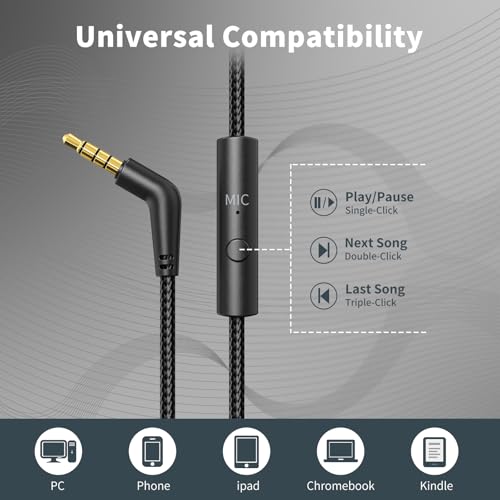
Botesty names online learning, calls, video meetings, travel, commuting and school. The in-line microphone is the feature that separates this from a plain listening headphone, and it makes the product a low cost answer to a specific problem: someone who needs to be heard on a call from a laptop or a tablet without buying a headset with a boom arm.
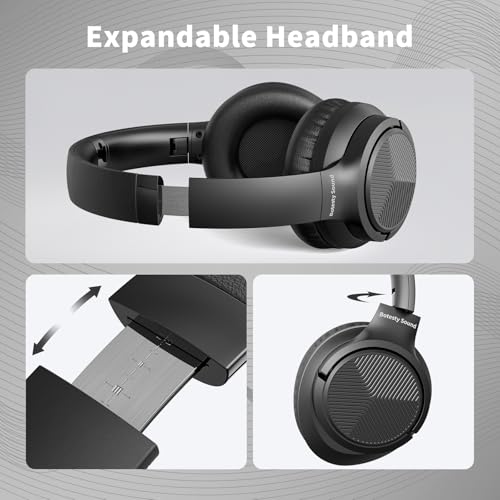
The design supports that use: 90 degree rotating ear cups so the headphone can hang flat around the neck between calls, a folding frame, memory protein cushions, and an adjustable headband. The 120 degree curved plug is a genuinely practical detail, because a right-angled plug is far less likely to be snapped off when a laptop sits on a lap or a bag.
It is not a workout or outdoor product. The record states “Water Resistance Level = Not Water Resistant” plainly, and there is no IP code. A 4.9 foot cable is also long enough to catch on things while moving.
The connection, and what an analog cable settles
Because this is wired, all of the usual wireless questions disappear. There is no codec to negotiate, no Bluetooth version to check, no multipoint, no pairing and no latency. For video calls and for watching anything, that last point is a real advantage: audio lines up with the picture because nothing is being buffered.
What the cable does not do is set the quality on its own. The sound depends entirely on the headphone amplifier inside whatever you plug into. A laptop jack, a phone dongle and a desktop audio interface are three different things. Nothing about a 3.5mm plug makes audio high resolution or lossless, and Botesty sensibly makes no such claim. The listing’s “Superior Sound” heading is brand language rather than specification.
One practical warning: most current phones no longer have a 3.5mm jack. The listing names smartphones, tablets, laptops, Kindle and MP3 or MP4 players as compatible, but you will need an adapter for any phone without a headphone socket, and on some phones an adapter also affects whether the in-line microphone works. Check that before buying if calls from a phone are the intended use.
What is published about the microphone, which is very little
Botesty says the microphone is “positioned on the cable for clear, high-quality sound, even in noisy environments.” There is no microphone count, no noise reduction technology named, no sensitivity figure and no mention of whether an in-line remote handles volume or call answering. The control fields say “Control Type = Button Control” and “Controller Type = Button,” which implies a button exists on the cable, but the listing never describes what it does. That is a gap on a product sold primarily for calls.
There is no battery section
This product has no runtime, no charging time and no playtime figure, because it has no battery. That is a durability advantage worth weighing: there is no cell to degrade and no firmware to be abandoned. A wireless model such as the KVIDIO over-ear headphone quotes 65 hours of playtime, which is a good number, but every one of those hours is drawn from a battery that will eventually reach the end of its life.
The trade is mobility. The JBL Tune 510BT is the obvious comparison for anyone deciding between wired and wireless at this level, since it is a similarly light folding over-ear that runs untethered but has no analog input at all.
Fit, isolation and a form factor the listing cannot decide on
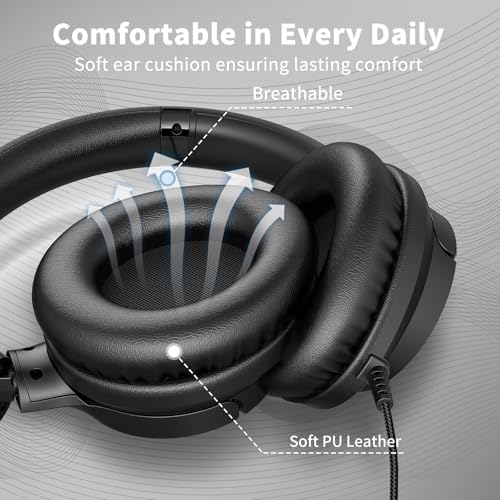
The cushions are described as soft memory protein, the cups as rotating through 90 degrees, and the headband as adjustable. Impedance is listed at 40 ohms, which is on the higher side for a product intended for laptops and phones, though the listing publishes no sensitivity figure, so there is no way to judge how loudly it will actually play from a weak output. The listed weight of 8.4 ounces sits beside package dimensions, so read it as a packaged weight rather than the weight of the headphone.
The record cannot decide what shape this headphone is. The form factor and ear placement fields both say over ear, and the marketing copy repeatedly says over ear, but the sales rank places it 20th in On-Ear Headphones and 49th in Over-Ear Headphones at the same time. Those are different products in different categories. We are flagging that rather than picking one, and it matters, because on-ear pads press on the ear and over-ear pads seal around it, which is the single biggest comfort difference in this shape.
There is no active noise cancellation on this product. There are no microphones for it, no modes and no electronics, and the listing correctly never claims any. Any isolation comes from the pads alone, which helps with mid and high frequency noise and does very little against constant low frequency sound. If cabin drone is the problem, this is not the answer, and something like the Panasonic RP-HT161-K will not solve it either, since it is passive as well.
The point about children, stated plainly
The comfort bullet says the adjustable fit makes these “suitable for adults and kids.” The specification block, in the same record, gives the age range as “Adult.” The listing contradicts itself on who this is for.
More importantly, this is a passive wired headphone with no electronics at all, which means no volume limiter exists and none can exist. There is no decibel cap, no app and no hardware limit. The level is set entirely by the phone, tablet or computer it is plugged into. We cannot describe this or any headphone as safe for a child’s hearing. If it is going to a younger listener, set a volume limit on the source device and check that it cannot be switched off in settings.
What is missing, and where else to look
Not published: driver diameter, sensitivity, a full frequency range (one field records “Frequency Response = 20 Hz,” which is half of a range), the actual headphone weight, cable material beyond “nylon braided,” or what the in-line button does. The included components are listed as just a user manual and the headphones, so no adapter or case is in the box. The model name is given as “lris,” which appears to be a lower case L standing in for a capital I, so searching for a replacement later may be harder than it should be.
For a wired alternative with a fully published driver specification, the Sony MDR-7506 is the studio standard in this catalog, though it has no microphone. The wider over-ear selection is in the wireless headphones section.
Who should buy it
Buy the Botesty lris if you want a simple cabled over-ear headphone with a microphone for calls and classes from a laptop, and you value a right-angled plug and a braided cord. Skip it if you need wireless, active cancellation, a published driver specification, or certainty about whether it sits on your ears or around them, because the listing itself is ranked in both categories at once.