




Description
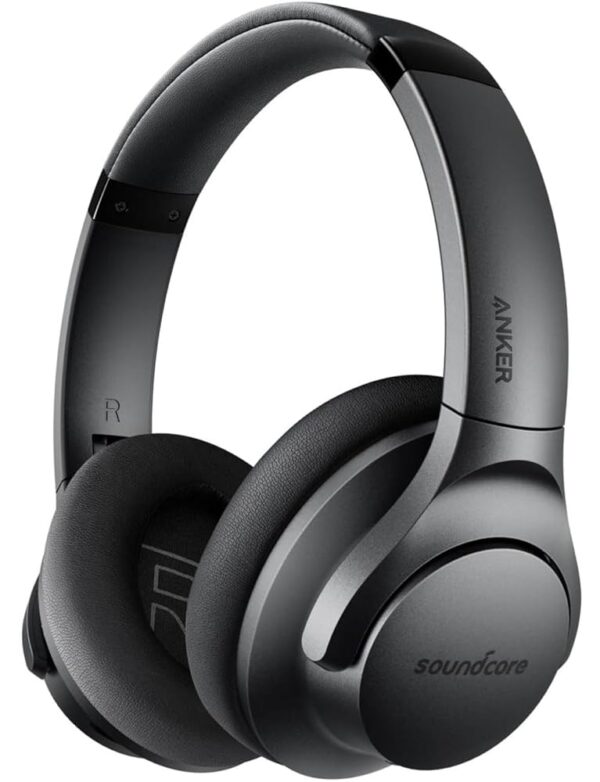
The Soundcore Life Q20, model A3025 from Anker, is an over-ear Bluetooth headphone with hybrid active noise cancellation, 40mm drivers and a quoted 60 hours of playback. It has been on sale since March 21, 2019 and shows a 4.5 star average across 84,327 ratings, ranked 711th in Electronics and 37th in Over-Ear Headphones in the captured listing data. That is a very large review base for a product at this level, and it is the reason the Q20 keeps appearing in budget cancellation shortlists.
The listener this is built for
The Q20 is a travel and desk headphone for someone who wants noise cancellation without stepping up to a flagship model. Anker lists travel and home as the intended uses, and the feature set matches: memory foam ear cups, a folding over-ear design, a travel pouch in the box and a battery figure long enough to cover several flights. The field “Water Resistance Level = Not Water Resistant” is stated plainly, so this is not a gym headphone and Anker does not pretend otherwise.
It is also not a headphone for anyone who needs modern conveniences. There is no mention anywhere in the listing of multipoint pairing to two devices at once, no transparency or ambient mode, no wear detection and no app-based equalizer. Where a listing says nothing about a feature, assume it is absent. If those features matter to you, check the newer Soundcore Q20i and Soundcore A3035 listings before settling on this one.
Connection, and the Hi-Res claim that needs a condition attached
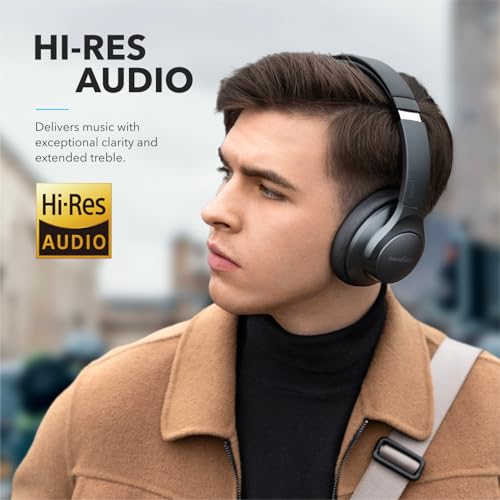
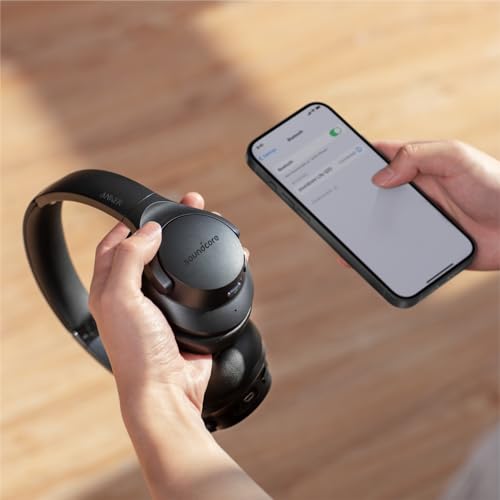
The listing gives Bluetooth 5 with a 10 meter range, and that is the entire wireless specification. No codec is named anywhere. There is no mention of AAC, aptX, aptX HD or LDAC. That matters a great deal here, because the headline bullet on this listing reads “Hi-Res Audio: Custom oversized 40 mm dynamic drivers produce Hi-Res sound,” and cites high frequency response reaching 40 kHz.
Read what that claim is actually attached to. It is attached to the driver, not to the wireless link. A 40 kHz capable driver describes what the transducer can move; it says nothing about what arrives over Bluetooth. High resolution audio over Bluetooth requires a codec such as LDAC or aptX HD, supported by both the phone and the headphone, and this listing names none. The box does contain an AUX cable, and over that analog connection the driver’s capability is what limits you rather than a Bluetooth codec. Taken as a wireless claim, the Hi-Res wording is unsupported by the published specification. Taken as a wired claim, it is at least consistent with the 20 Hz to 40 kHz range the listing gives.
The cancellation figure and what it means
Anker states the hybrid system reduces ambient noise “by up to 90%,” attributing the tuning to more than 100,000 tests conducted by its engineering team on four ANC microphones. Two things about that number. First, it is Anker’s own figure with no independent test standard named, and a percentage is not a decibel measurement, so it cannot be compared against any competitor’s published attenuation. Second, the underlying physics is the same for every ANC headphone: cancellation works well on constant low frequency noise such as engine and cabin drone, and poorly on speech and sudden sounds. Anker’s own wording, “low and mid-frequency noises such as cars and airplane engines,” is the accurate part. Expect an office conversation to still come through.
Battery: two figures, and the listing is clear about both
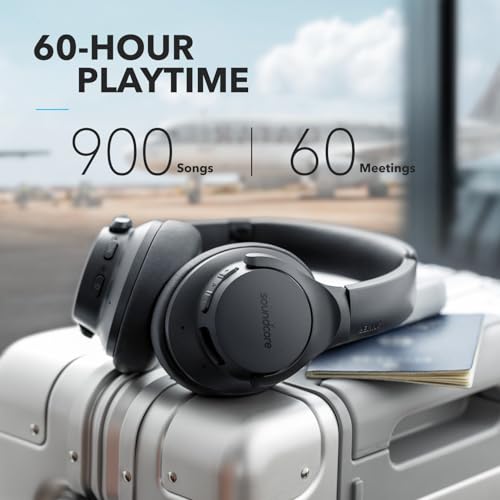
This is one of the more honest battery disclosures in this catalog. Anker gives 60 hours in standard music mode and 40 hours with active noise cancellation on, measured at 60 percent volume. Both the condition and the mode are stated, which is exactly what most listings omit. The specification block records only “Battery Life = 60 Hours,” so if you read the field and not the bullet you would take away the wrong number. If you plan to run cancellation, plan on 40 hours.
Fast charging returns 4 hours of listening from 5 minutes on the cable, and a full charge is quoted at 2 hours. The charging port is the age showing: the box contains a “Micro Cable,” the color variant is named “Micro Black,” and the style field says “Micro.” This is a Micro-USB product, not USB-C. On a 2019 design that was standard, but in practice it means carrying a cable you may no longer own.
Fit, controls and the fields that do not add up
The Q20 is an over-ear design with memory foam cups, a plastic and PC build, and a listed weight of 0.58 pounds, or 9.3 ounces, which is roughly 263 grams. That is a normal weight for a cancelling over-ear headphone. Over-ear cups seal around the ear rather than pressing on it, which is why this shape blocks low frequency noise better than an on-ear design before the cancellation circuit even switches on. Impedance is listed at 16 ohms, which is easy for a phone to drive over the AUX cable.
Controls are where the record contradicts itself. The specification fields say “Control Method = Touch” and “Controller Type = Touch,” while Anker’s own BassUp bullet instructs you to “double press the play button.” A play button is not a touch surface. The listing describes physical buttons in its copy and touch controls in its specification, and we are not going to guess which shipped.
Three further fields are simply wrong. “Cable Length = 15 Meters” is not a plausible length for an included AUX cable. “Cable Feature = Without Cable” sits beside an included components list containing two cables. And “Wireless Communication Technology = Bluetooth, RF” adds a radio technology the product does not use. A separate field, “Frequency Response = 40000 Hz,” is a single number where a range belongs, and the range is given properly elsewhere as 20 Hz to 40 kHz.
What the listing does not publish
Missing: any Bluetooth codec, microphone count for calls as opposed to for cancellation, multipoint, transparency mode, an app, sensitivity, or the exact decibel attenuation of the cancellation. The marketing claims “100% Stronger Bass” from the BassUp mode and “Incredible Sound Loved by 20 Million+ People,” neither of which is a measurement. Treat both as brand language.
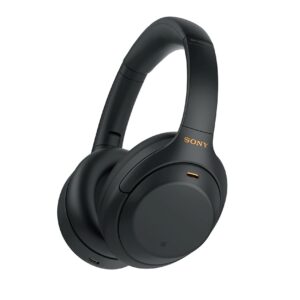
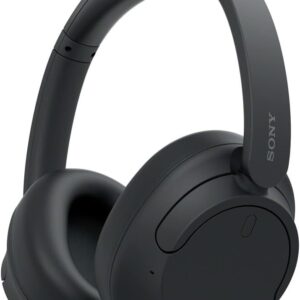
If you want cancellation from a listing that publishes more of its specification, the Sony WH-1000XM4 documents multipoint, wear detection and speak-to-chat explicitly, and the Sony WH-CH720N is the closer current competitor. Broader comparison across the shape sits in the wireless headphones section.
A note on volume. The 40 hour ANC figure is quoted at 60 percent volume, which is a useful reminder that the headline battery numbers on any headphone assume a moderate level. There is no volume limiter published on this product and Anker lists the age range as adult. Cancellation genuinely helps here, because it removes the background noise that otherwise pushes people to turn the music up.
Who should buy it
Buy the Life Q20 if you want long battery life and usable cancellation on a plane or at a desk, you are happy on a Micro-USB cable, and you value the AUX input for wired listening. Skip it if you need multipoint, a transparency mode, an app, USB-C charging, or any Bluetooth codec better than the baseline, because the listing publishes none of those.