





Description
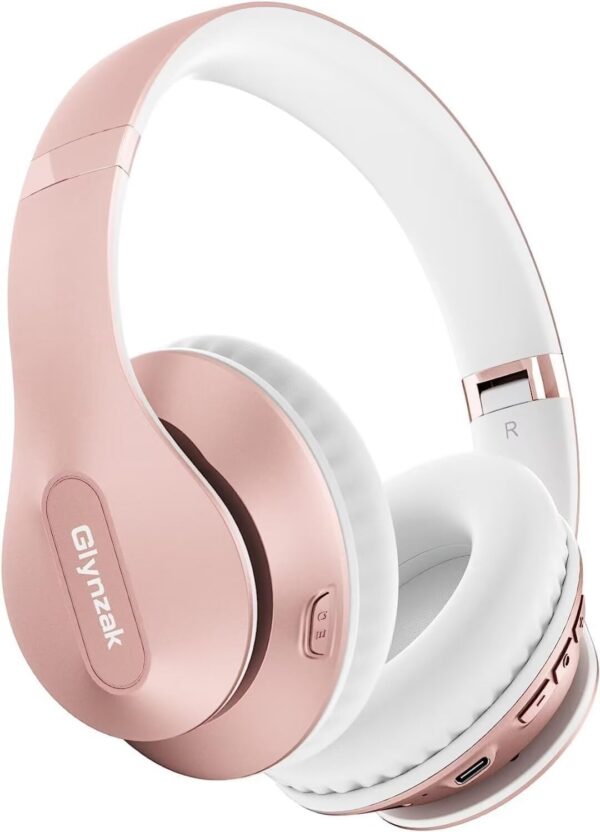
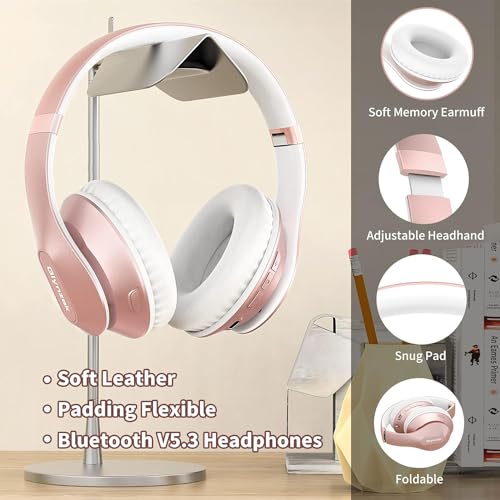
The Glynzak WH207A is a folding over-ear Bluetooth headphone in rose gold, available since November 16, 2022, built around a single 40mm dynamic driver per side, a 500mAh battery quoted at 65 hours, six equalizer modes selected by a button, and a 3.5mm wired option. It shows a 4.6 star average across 8,314 ratings and is ranked 311th in Electronics and 16th in Over-Ear Headphones in the captured listing data, which is a strong sales position for a brand most buyers will not recognize.
It is also one of the more contradictory records in this catalog. Several specification fields describe features the marketing copy never mentions, one describes a battery type the product cannot use, and one field is still in Chinese. All of that is covered below, because on a product with no brand reputation to lean on, the specification is all you have.
Who this suits
This is a travel, commute and desk headphone. The folding design, the long quoted battery and the included analog cable point at journeys, and the six EQ presets, named as bass, pop, rock, classic, jazz and vocal, are aimed at someone who wants tone control without installing an app. That is a reasonable design decision: a button on the cup works even when there is no app support left in five years.
The ear cups are PU artificial leather over soft cushions that surround the ear rather than pressing on it, which is more comfortable over long sessions than an on-ear design. The listed weight of 10.5 ounces appears alongside package dimensions, so read it as a packaged weight rather than a headphone weight; the actual weight of the headphone is not published.
Connection: Bluetooth 5.3, and a claim it cannot support
Glynzak lists Bluetooth 5.3 and describes it as delivering “more stable connection, faster transmission speed with wider transmission range.” The first and third parts are fair; a newer Bluetooth generation does improve link housekeeping and power behavior. The bullet then adds that it lets you “hear music the way it was originally heard,” which is a sound quality claim that a Bluetooth version number cannot support.
No codec is named anywhere in the record. There is no mention of SBC, AAC, aptX or LDAC. The title claims “HiFi Stereo” and the first bullet claims “hi-fi stereo sound,” and neither is backed by any published transmission specification. Over Bluetooth, what reaches the driver is decided by the codec both the phone and the headphone support, and this page identifies neither. SBC is the only baseline you can assume.
Multipoint pairing to two devices at once, transparency mode, wear detection and an app are all unmentioned, so treat them as absent. The included components are listed as the headphones, a 3.5mm audio cable, a charging cable and a manual, and charging is over USB-C with a full charge quoted at 2.5 hours.
The noise cancellation field is not supported by anything else
The specification block reads “Noise Control = Active Noise Cancellation.” Nothing else in the listing supports that. None of the five feature bullets mentions active cancellation, no microphones are described for it, no cancellation mode or button is listed, and no decibel figure is given. The closest the copy comes is the phrase “reduces environmental noise,” which sits in a sentence about the driver and the EQ and reads as passive isolation from the cups. We are naming the contradiction rather than resolving it. Do not buy this headphone for active cancellation on the strength of one specification field the rest of the page contradicts. If cancellation is what you want, the Soundcore Q20i and the JLab JBuds Lux ANC both document a real system.
Battery: the one figure that comes with a capacity
Glynzak publishes a 500mAh battery and quotes up to 65 hours of continuous playtime in wireless mode, with a full charge in 2.5 hours over a USB-C cable. Publishing the capacity as well as the runtime is more than most listings in this catalog manage, and it makes the claim at least internally checkable.
No volume level or test condition is attached to the 65 hours, and quoted playtimes are always measured at a moderate level. Sixty five hours is plausible for a headphone with no active cancellation circuit running, which is normally the largest continuous draw. There is no fast charge claim and no figure for how long the wired mode works with a flat battery, though an analog connection generally does not need power.
The field “Batteries = 1 AA batteries required” is wrong. The product has a built-in 500mAh rechargeable cell, which is what the marketing copy describes, and an AA cell has no place in it. A second field, “Number of Items = 5,” appears to have counted the box contents rather than the product.
The waterproof claim, and what it is actually attached to
The specification field says “Water Resistance Level = Waterproof” and gives no IP code at all. Look at where the word comes from in the marketing copy: the comfort bullet says the ear cups “are made of PU artificial leather, waterproof and not easy to deformation.” That is a claim about the pad material resisting sweat and moisture, not a claim about the headphone as a device. It has been promoted into a product-level field it does not belong in.
Without an IPX code there is nothing that tells you whether this headphone survives rain, sweat or neither, and we will not translate a pad material description into a rating that was never published. Treat it as an indoor and fair weather headphone, and note that no IP rating covers seawater or pressurized water even where one is published.
Fit, controls and the fields that make no sense
Impedance is listed at 32 ohms, the driver at 40 millimeters, and the frequency range at 20 Hz to 20,000 Hz, which is the standard nominal figure quoted on nearly every headphone. Control is by buttons on the cup for volume, track skipping, pause, calls and pairing, per the final bullet. The specification block, meanwhile, says “Control Method = Touch, Voice” and “Controller Type = Touch.” The copy describes buttons and the fields describe touch controls, and the listing does not reconcile them. “Cable Feature = Retractable” is not supported by anything else on the page either.
One field, “Specific Uses For Product,” has never been translated and still contains Chinese characters meaning personal and business use. It is a small thing, but it tells you how much editorial attention this listing received.
A hearing claim that needs correcting
The comfort bullet states that the cushion “prevents over ear bluetooth headphones from resonating between the headphone shell and ear bones when the volume is too high, protecting your ears with a good cushion.”
Ear padding does not protect hearing from high volume. A cushion changes comfort and seal, and a better seal can reduce how loud you need to go, but nothing about foam or PU leather reduces the sound pressure the driver puts into your ear canal. There is no volume limiter published on this product, no decibel cap and no app to set one. If you want a limit, it has to be set on the source device. Do not read that bullet as a safety feature, because it is not one.
What is missing, and where else to look
Not published: codec, Bluetooth range, actual headphone weight, sensitivity, microphone count or placement, multipoint, cancellation attenuation, or app support. For alternatives, the KVIDIO over-ear headphone in this catalog publishes a nearly identical specification, 65 hours, 40mm drivers, Bluetooth 5.3, 32 ohms and an aux cable, under a different brand name, which is worth knowing before you treat them as separate options. The Panasonic RP-HT161-K is the simple wired alternative. Wider comparison sits in the wireless headphones section.
Who should buy it
Buy the WH207A if you want a long quoted battery with a published capacity, hardware EQ presets that need no app, USB-C charging and a wired fallback in the box. Skip it if you need active noise cancellation, since the listing contradicts itself on whether it exists, or if you need a published IP code, a named codec, or a specification block whose fields can be trusted one by one.