
Description
The listener this Jabra set is built around
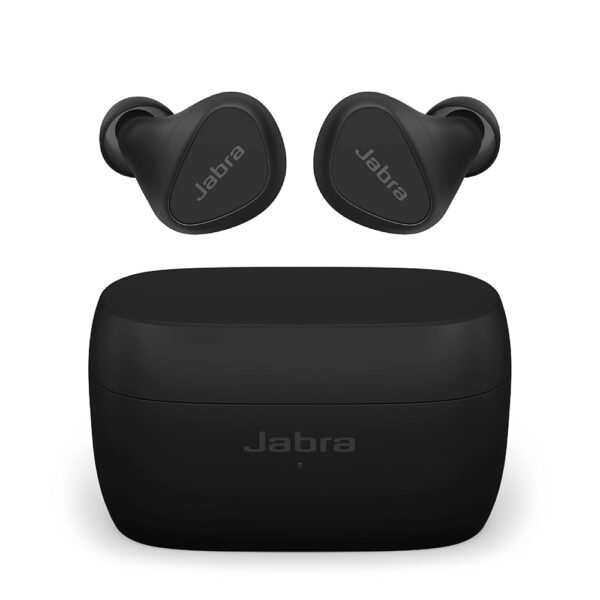
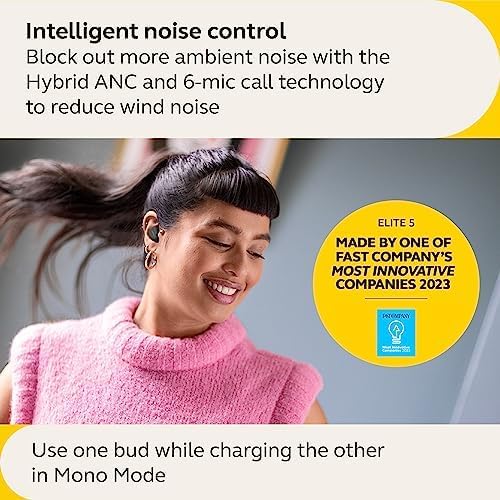
The Jabra Elite 5 is a mid tier true wireless in ear set aimed at someone who spends a large part of the day on calls and wants noise cancellation as a secondary benefit rather than the headline. Jabra builds the pitch around six microphones, hybrid active noise cancellation and a small housing, and the listing is specific that external microphones stay active during calls while internal microphones engage when wind is detected. That ordering matters. If your main use is a commute soundtrack, this is not the strongest argument in the catalog. If your main use is taking calls from a home office, a train platform or a busy street, the microphone array is the reason to look here.
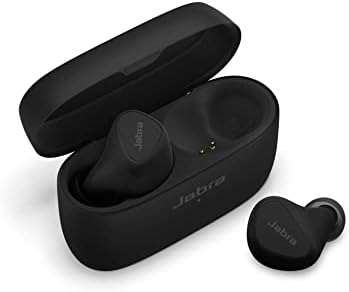
This particular entry is the black Amazon exclusive colorway. Jabra sells a functionally identical Titanium Black version, and we cover it separately in our Jabra Elite 5 Titanium Black review. The two listings disagree with each other on published specifications, which we get to below, and that disagreement is worth knowing about before you assume the colors are the only difference.
How it connects, and what the connection actually buys you
Jabra publishes SBC, AAC and Qualcomm aptX support. Those three codecs cover very different situations. SBC is the baseline that every Bluetooth device supports and is the fallback when nothing better is negotiated. AAC is the codec that matters on Apple hardware, and the listing does confirm Made for iPhone status. aptX is the interesting one, because it only takes effect when the phone or tablet on the other end also supports aptX. Most iPhones do not. If you are on iOS, you will be listening over AAC and the aptX line on the box changes nothing for you. On an Android phone with a Qualcomm chipset that carries aptX licensing, the codec can engage. Jabra does not publish which aptX variant is present, so there is no basis here to describe this as a high resolution or lossless product.
Bluetooth version, multipoint and the pairing extras
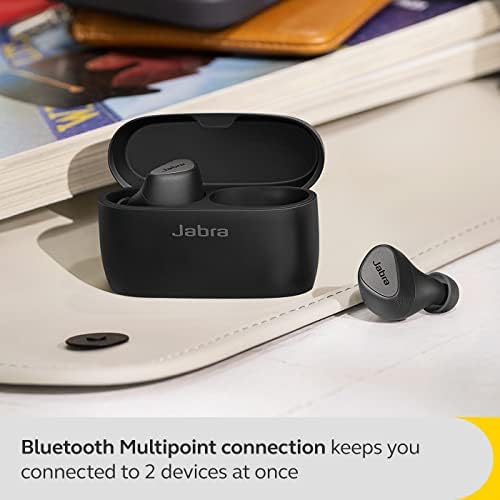
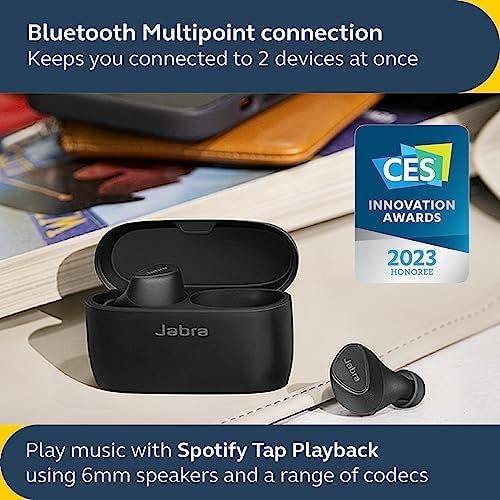
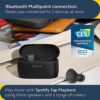
The specification block lists Bluetooth 5.2 with a quoted range of 10 meters. A version number is not a sound quality figure. What 5.2 changes is connection housekeeping: power behavior, stability and the groundwork for newer audio standards. It does not by itself make the drivers sound better. The genuinely useful connectivity feature is Bluetooth Multipoint, which lets the buds hold two devices at once so a laptop call can interrupt phone audio without a manual repair. Google Fast Pair and Microsoft Swift Pair are both listed, which shortens the initial setup on Android and Windows respectively. Voice assistant support covers Alexa, Siri and Google Assistant, with Google Assistant gated behind Android 6.0 or higher. Spotify Tap playback is a tap gesture that resumes Spotify, and it is only useful if Spotify is your service.
Battery: the two numbers, and where they conflict
Jabra rates each bud at up to 7 hours and the total with the Qi certified charging case at 28 hours. Those are two separate things and listings routinely blur them. Seven hours is what you get in your ears before a case visit. Twenty eight is the total across roughly three case top ups. A quick charge function is quoted at 1 hour of playback from 10 minutes in the case, and Mono Mode lets one bud run while the other charges, which is a practical trick for long call days.
Here is the contradiction we are not going to smooth over. The description says 28 hours with the case, but the structured specification field on this listing reads “Carrying Case Battery Average Life = 7 Hours”. Those two cannot both be right. The Titanium Black listing for the same model publishes 28 hours in that same field, which suggests the 7 hour entry here is a data entry error rather than a different case. Treat 28 hours as the manufacturer claim and treat the specification table on this page as unreliable. Also note what the 7 hour bud figure assumes. Quoted playtime is a best case at moderate volume, and hybrid ANC running continuously will pull it down. Jabra does not publish a separate ANC on figure, so the gap is unquantified.
Fit, seal, controls and what IP55 covers
The box includes EarGels in three sizes. Three is the common count and it is enough for most ears, but it is fewer than the five size sets that some competitors ship, and seal is the single biggest driver of perceived bass. A loose tip makes any sealed earbud sound thin and also degrades how well the noise cancellation performs, because ANC is layered on top of whatever passive isolation the tip achieves. If you have historically struggled to get a seal, that three size range is a real limitation and is worth weighing against something like the five size range we describe in our Soundcore Space A40 review.
The rating is IP55. The first digit, 5, is dust protection. The second digit, 5, covers low pressure water jets from any direction. That is sweat, rain and a splash at the sink. It is not immersion, it is not a swim rating, and this product should never be described as waterproof. No IP rating covers seawater or high pressure water, and the seals degrade with age and with repeated sweat exposure. Because this is a sealed in ear design with active noise cancellation, it is also the wrong choice for cycling or for running on open roads, where you need to hear traffic. If awareness is the requirement, an open design is the correct category, and our open fit headphone listings are the place to start rather than this.
Controls are physical taps on the buds. The listing is inconsistent about how they work: one field describes the control method as App and another describes control type as Media Control. Jabra Sound+ handles equalizer adjustment and ANC level, so both are partly true, but the tables are not a reliable guide to on bud gesture mapping.
What the listing does not publish, and where to look instead
Several things are simply absent. There is no wear detection claim, so do not assume music pauses when you remove a bud. There is no transparency mode decibel figure, only the HearThrough name. There is no ANC attenuation figure at all, which is arguably more honest than a headline percentage but leaves you nothing to compare. The 6mm dynamic drivers and the 20 Hz to 20,000 Hz frequency range are published, though a frequency range with no tolerance figure tells you very little about tuning.
The listing also carries figures that cannot all be true. Item weight appears as 4.6 ounces in one field while the included components line says 5g, which is 0.176 ounces. The 4.6 ounce figure is almost certainly the shipping weight of the whole package. Product dimensions of 6.26 by 4.53 by 1.22 inches are the retail box, not the buds. A field labeled “Headphones Jack = usb” is meaningless on a set with no jack. Jabra also cites a satisfaction figure of nine out of ten users, sourced to its own quantitative research with 667 Jabra Elite owners in December 2022. That is a manufacturer survey of existing customers, not independent testing, and it is attributed here rather than repeated as fact.
Customer feedback on this listing sits at 4.3 out of 5 across 237 ratings, and Amazon places it around 25,655th in Electronics and 2,054th in earbud and in ear headphones. If the call microphone array is what draws you but you want a more current sealed sports design, the Jabra Elite 8 Active review covers the more rugged option in the same family. If you want the same house sound at a lower specification and can live without hybrid ANC, look at our Jabra Elite 3 review. For a more feature dense Jabra with a longer options list, the Jabra Elite 7 Pro review is the closer comparison. Broader alternatives across brands sit in our wireless earbud listings.
Who should buy it and who should skip it
Buy it if calls are the job, you are on Android and want multipoint plus a genuine aptX path, and you value a small housing over a large battery number. Skip it if you need immersion rated protection, if you want situational awareness for road use, if you need more than three ear tip sizes to get a seal, or if you are on an iPhone and were buying specifically for the aptX line, because that codec will not engage. Before ordering, confirm the case runtime with Jabra directly, since this page publishes two different answers.