

Description
Who this Titanium Black Elite 5 suits
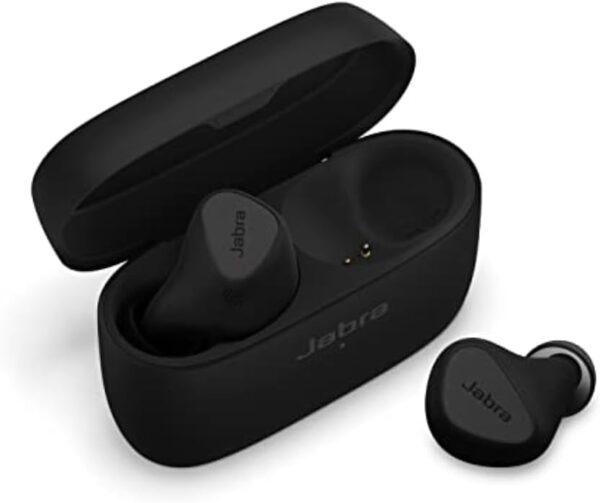
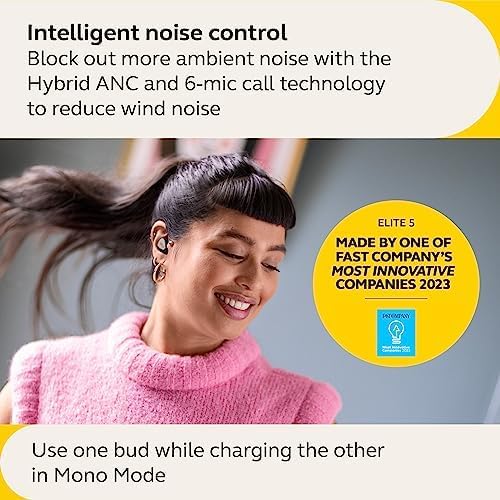
This is the standard retail colorway of the Jabra Elite 5, a mid tier sealed true wireless set built around call handling. The pitch is six microphones, hybrid active noise cancellation and a deliberately small housing. Jabra spells out how the microphone array behaves: the external microphones stay live during calls, and the internal microphones switch in when wind is detected. That is a call engineering decision, not a music one, and it tells you who the product is for. Someone who takes several calls a day from a kitchen, a co working space or a street corner gets more from this design than someone buying purely for a train commute playlist.
Before anything else, a housekeeping note. Wireless Emporium also stocks the black Amazon exclusive version of the same model, covered in our Jabra Elite 5 Amazon exclusive review. Same model name, same driver size, same feature list, different color and different item number. The two listings publish specifications that disagree with each other in several places, and we go through those disagreements below rather than picking a winner. If you are comparing the two pages and finding different numbers, the difference is in the data, not in the hardware.
Connection: three codecs, and only one of them is universal
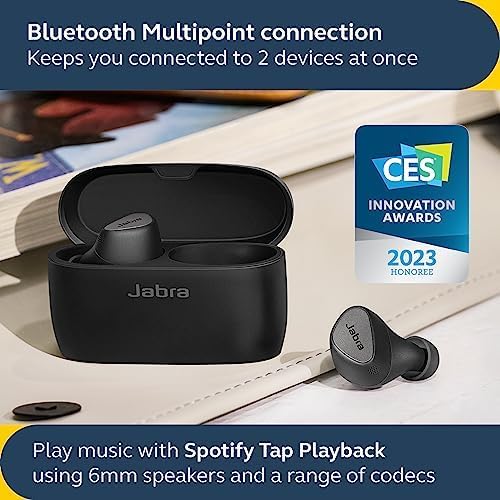
Jabra publishes SBC, AAC and Qualcomm aptX. SBC is the baseline that every Bluetooth device on earth supports and is what you fall back to when nothing else is negotiated. AAC is the relevant codec on Apple hardware, and the listing confirms Made for iPhone status. aptX is the one that gets oversold. It requires the source device to support aptX as well, and it is a Qualcomm licensed technology, so it appears on many Android phones with Qualcomm silicon and on very few iPhones. If you are an iPhone owner buying these because the box says aptX, that line will not do anything for you. No aptX variant is named, no bit depth is published and no sample rate is published, so there is no basis on this listing for describing the Elite 5 as a high resolution or lossless product.
The Bluetooth version disagreement
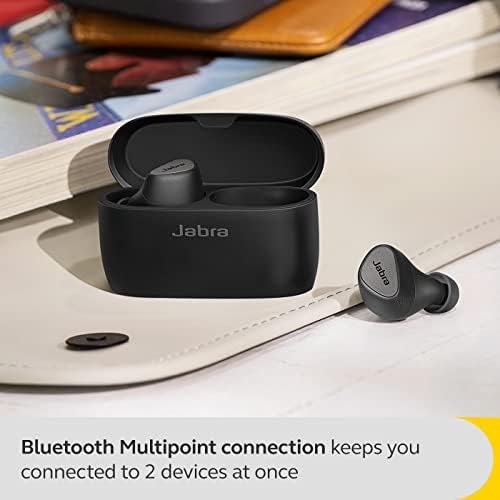
This is the clearest example of the data problem. This listing’s specification block says Bluetooth 5.0. The Amazon exclusive listing for the same model says Bluetooth 5.2. Both cannot describe the same hardware. We are naming the contradiction rather than resolving it, because there is nothing in either listing that settles it. In practical terms the difference is small, since a Bluetooth version number is not a measure of sound quality or of range in any meaningful sense. What version changes is connection housekeeping, power behavior and support for newer standards. Neither 5.0 nor 5.2 makes a 6mm driver sound different. The feature that does change your day is Bluetooth Multipoint, which is published on both listings and lets the buds hold two devices at once, so a laptop meeting can take over from phone audio without repairing. Google Fast Pair and Microsoft Swift Pair are both listed for faster first time setup on Android and Windows.
Battery, and what the quoted figures leave out
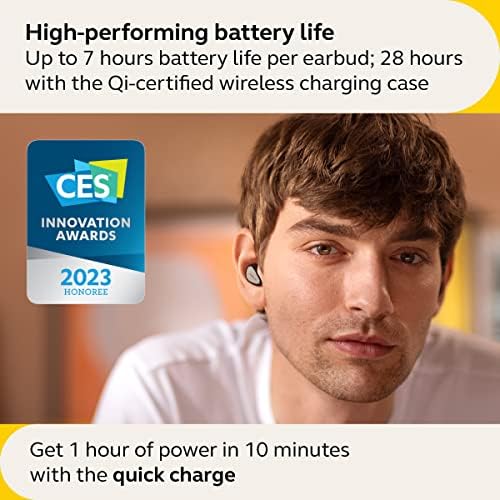
Jabra rates each bud at up to 7 hours. The Qi certified charging case brings the quoted total to 28 hours. Those are two different measurements and they should never be treated as one. Seven hours is the in ear session length. Twenty eight is what the whole package delivers between wall charges, across roughly three case refills. This listing’s structured field for case life correctly reads 28 hours, which is one point where it is more trustworthy than the Amazon exclusive page, where the same field reads 7 hours.
What the 7 hour figure omits is the usual omission across the category. Quoted playtime assumes moderate volume, and hybrid noise cancellation running continuously will shorten it. Jabra publishes no separate ANC on figure, so the size of that reduction is unstated. There is a fast charge claim of 1 hour of playback from 10 minutes in the case, and a Mono Mode that runs one bud while the other charges, which is genuinely useful on a heavy call day. A separate field on this page reads “Charging Time = 7 Hours”, which is almost certainly the battery life figure landing in the wrong column rather than a real seven hour recharge.
Fit, seal, controls and the meaning of IP55
Three EarGel sizes ship in the box, listed as small, medium and large. Seal is the specification that quietly decides everything else on a sealed earbud. A poor seal thins out the bass, and it also caps how much the active noise cancellation can achieve, because ANC works on top of whatever passive isolation the tip already provides. Three sizes covers most ears but is a narrower range than the five size sets some rivals ship, so if you have historically had trouble getting a seal, weigh that. The buds themselves are listed at 5 grams, or 0.176 ounces, which is consistent between two fields on this page.
The rating is IP55. Five for dust ingress, five for low pressure water jets from any direction. That covers sweat, rain and a splash. It does not cover immersion, it does not cover swimming, and this product should not be described as waterproof. No IP rating covers seawater or high pressure water, and seals lose performance over time, particularly with repeated sweat exposure. Because this is a closed design with active noise cancellation, it is also the wrong tool for road cycling or outdoor running where hearing traffic matters. HearThrough exists, but a transparency mode is a processed approximation of the outside world, not the outside world. For genuine situational awareness, look at our open fit headphone listings instead.
The fields that cannot be right, and where else to look
Several published values on this page are not usable. Impedance is listed at 140 ohms, which is not a plausible figure for a 6mm dynamic driver in a battery powered true wireless earbud and looks inherited from another product. Form factor is listed twice, once as Headphones and once as On Ear, on a product that is unambiguously in ear. “Headphones Jack = usb” is meaningless on a set with no jack. Control type appears as Noise Control on this page and as Media Control on the sibling listing, and control method appears as Touch here and App there. The Jabra Sound+ app does handle equalizer and ANC level, so both partly describe reality, but neither table is a reliable guide to what the on bud gestures actually do.
Nothing in the listing mentions wear detection, so do not assume playback pauses when a bud comes out. No ANC attenuation figure is published, which avoids an unsupported decibel headline but leaves nothing to compare. The 20 Hz to 20,000 Hz frequency range carries no tolerance figure and tells you very little. Jabra also cites a comfort satisfaction figure of nine out of ten, sourced to its own survey of 667 Elite owners in December 2022; that is manufacturer research among existing customers, not independent measurement.
Customer feedback on this listing is 4.0 out of 5 across 420 ratings, with Amazon placing it around 16,605th in Electronics and 1,528th in earbud and in ear headphones. If you want the same family with a longer track record, the Jabra Elite 75t review is the closest older sibling. If calls are the entire job and you would consider a set built explicitly for conferencing, the Jabra Evolve2 earbud review is the better fit. To spend less within the same house sound, see our Jabra Elite 3 review. Cross brand alternatives sit in our earbud headphone listings.
Buy or skip
Buy it if call clarity is the priority, you are on Android and can actually use aptX, and multipoint across a phone and a laptop is part of your day. Skip it if you need an immersion rating, if you want a set for road running or cycling, if three tip sizes historically has not been enough for you, or if you are on an iPhone and were paying for the aptX line. Given how much of this page’s specification block contradicts itself, confirm Bluetooth version and control behavior with Jabra before ordering if either matters to you.