

Description
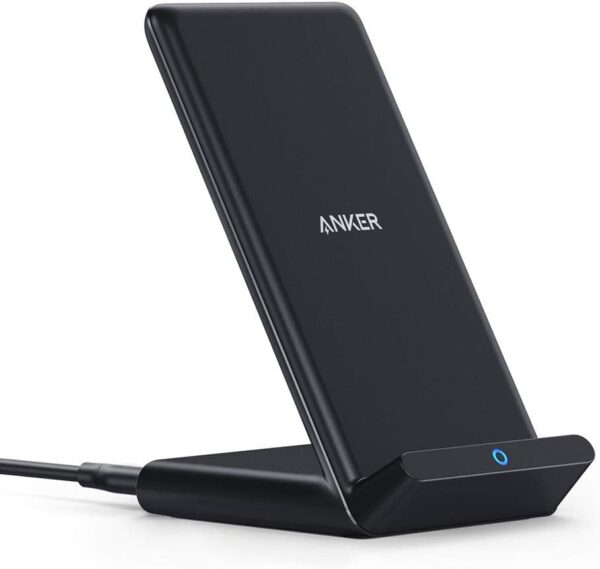
The Anker 313 Wireless Charging Stand, model A2524 and also sold as the PowerWave Stand, is an upright Qi charger that has been on sale since May 23, 2018. It carries a 4.5 star average across 101,995 ratings, ranked 204th in Cell Phones and Accessories and 9th in Cell Phone Wireless Chargers in the captured listing data. That is by a wide margin the largest review base of any product covered in this batch, and it reflects a product that has been in the market for a long time rather than a new release.
Its age also explains the two things most likely to matter to a buyer today: the cable in the box is Micro USB rather than USB-C, and no wall adapter is included at all.
Who this suits
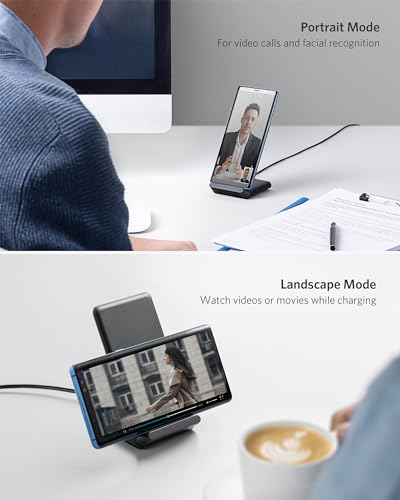
This is a desk and bedside stand, not a flat pad. Anker’s own framing is the useful one: the phone can sit in landscape while you watch something, or in portrait for messages and face unlock. That upright angle is the entire reason to choose a stand over a pad, since it keeps the screen readable while charging instead of face down on a desk.
It suits someone who wants a permanent parking spot for a phone rather than the fastest possible refill. Wireless charging is inherently slower and less efficient than a cable, because energy is lost as heat in the transfer, and no wireless charger changes that. If speed is the priority, a cable is the answer.
The speeds, and which one applies to you
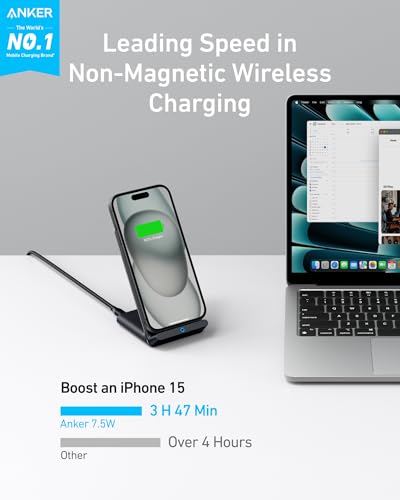
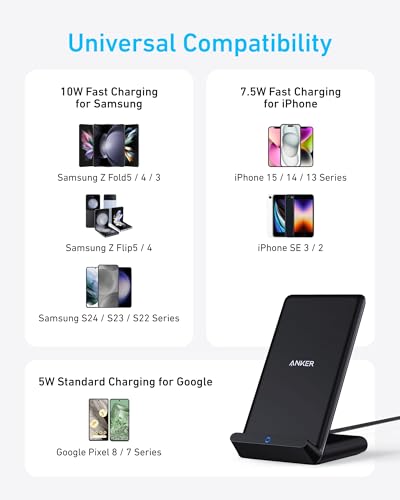
Anker publishes two figures and attaches each to a platform. 10W high-speed charging for Samsung Galaxy phones, and 5W for iPhones, the latter described as “a boosted 5W charge at 10% faster than other wireless chargers.”
Read the iPhone number carefully, because it is the one most buyers will be on. Five watts is the base Qi rate. The “10% faster than other wireless chargers” claim names no competing charger, no phone model and no test method, so it cannot be checked. What it does not claim, and what buyers should not assume, is 7.5W, which is the higher rate some iPhone-oriented chargers advertise. If you own an iPhone and the charging rate is your reason for buying, this listing puts you at 5W.
The adapter is not included, and the figures depend on it
The box contains the charger, a 3 foot Micro USB cable, a welcome guide and an 18-month warranty. There is no AC adapter, which the product title states plainly, and that is the single most important practical detail. A wireless charger’s output is capped by what feeds it, and the 10W Samsung rate in particular requires a wall adapter capable of supplying more than a basic 5 volt supply. Plugging this into an old phone charger from a drawer will not produce the advertised speed.
The specification block lists “Input Voltage = 5 Volts,” which sits awkwardly beside a 10W output claim once transfer losses are accounted for. It also lists “Amperage = 84 Milliamps,” which is not a plausible figure for anything in this device: 84 milliamps at 5 volts is well under half a watt, which would not charge a phone at any rate. We are flagging that field rather than correcting it. The listing does not state the required adapter wattage anywhere.
The Micro USB cable is the other consequence of the 2018 design date. Most people no longer carry Micro USB cables, and if the supplied one is lost or fails, it is a connector you will have to go looking for.
Cases, coils and the limits Anker actually publishes
This is where the listing is better than most. Anker states the charger works through cases, and then gives the conditions: rubber, plastic or TPU cases less than 5mm thick only, and magnetic or metal attachments or cards will prevent charging.
Both halves of that are genuinely useful. A stated thickness limit lets you check your case rather than guess, and the warning about metal and magnets is the correct one: a wireless charger transfers power through an alternating magnetic field, and a metal plate for a car mount or a card in a wallet case sits directly in that field. The competing INIU charging stand in this catalog publishes no case thickness limit at all, which makes Anker’s disclosure the better one on this point.
The stand is small, at 3.15 by 2.68 by 4.49 inches and 3.9 ounces. The listing does not state how many charging coils it uses, which matters on a stand, because a two-coil arrangement is what allows both portrait and landscape charging without hunting for the sweet spot. Anker describes both orientations working, so more than one coil is implied, but it is not stated.
What the marketing does not tell you
The opening bullet, “Join the 55+ million powered by our leading technology,” is a sales figure rather than a product specification and tells you nothing about how this charger performs. Similarly, “high-efficiency chipset” names no chipset and gives no efficiency figure.
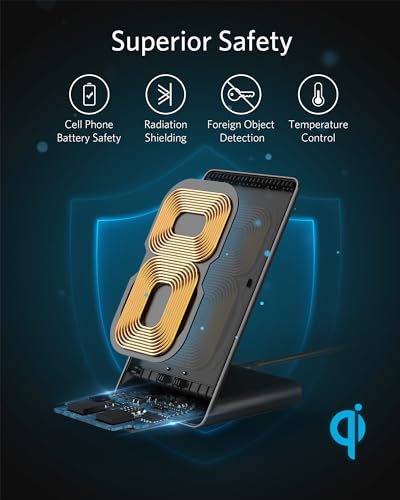
Missing from the record: required input wattage, coil count, Qi version, foreign object detection, temperature management behavior, whether there is a status LED and whether it can be dimmed for bedside use, and any noise specification. That last group matters more than it sounds on a bedside charger: a bright always-on indicator light is a common complaint about chargers of this type, and this listing says nothing about one. The INIU stand does publish a self-dimming LED, which is the clearest functional difference between the two.
Two fields in the specification block, “Compatible Devices” and “Compatible Phone Models,” contain raw JavaScript instead of data. Those are scraping artifacts from the source page and mean the compatibility list is effectively unpublished in the imported record, even though the product title names iPhone and Galaxy models.
Where else to look
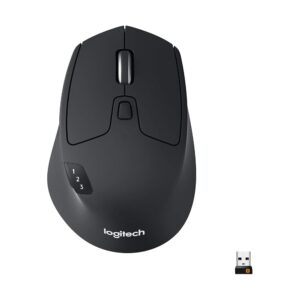
The Nelko P21 label maker, the Logitech M185 mouse and the Logitech M720 Triathlon are the other wireless desk accessories in this part of the catalog, and the full selection sits in this section.
Who should buy it
Buy the Anker 313 if you want a small upright stand with a published case thickness limit, both charging orientations, and a very large body of customer feedback behind it, and you already own a suitable wall adapter. Skip it if you want USB-C rather than Micro USB, if you need more than 5W on an iPhone, or if you need a charger that publishes its input requirement, because this one does not and the amperage figure it does publish is not credible.