





Description
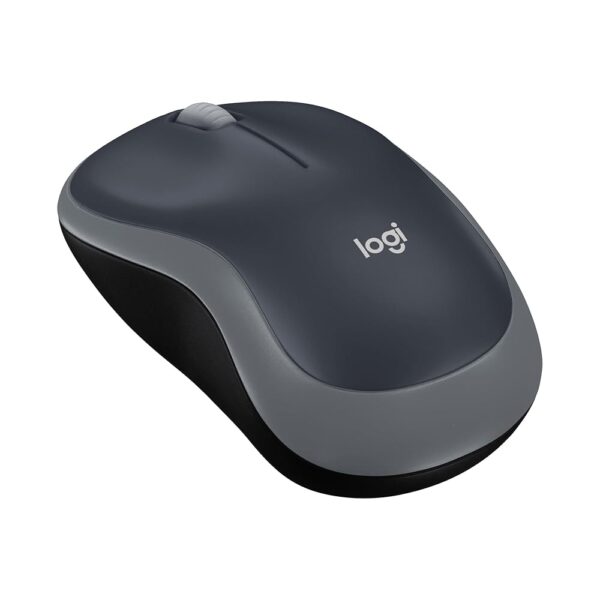
The Logitech M185 is a compact wireless mouse in Swift Gray, and the first thing to be clear about is how it connects. It is not a Bluetooth device. It uses a 2.4GHz radio link through a small USB receiver that plugs into the computer, and the specification field records the connectivity technology as “USB.” That distinction decides whether this mouse will work with your machine at all, and the sections below start there rather than with the ergonomics.
Logitech publishes a 1000 DPI optical sensor, an ambidextrous shape, a line-by-line scroll wheel, up to 12 months of battery from a single included AA cell, and a working range of up to 33 feet, or 10 meters. The imported specification block contains five fields in total: brand, color, connectivity technology, special feature and movement detection technology. Everything else on this page comes from the marketing bullets.
Who this suits
This is a laptop and travel mouse. It is aimed at someone who has been using a trackpad, wants a physical mouse for spreadsheets, editing or long working sessions, and does not want to think about the setup. Plug the receiver in and it works, with no pairing menu, no operating system dialog and no account.
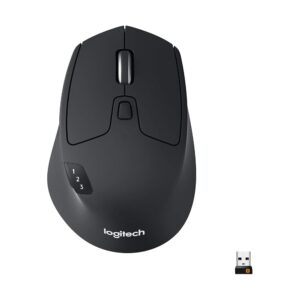
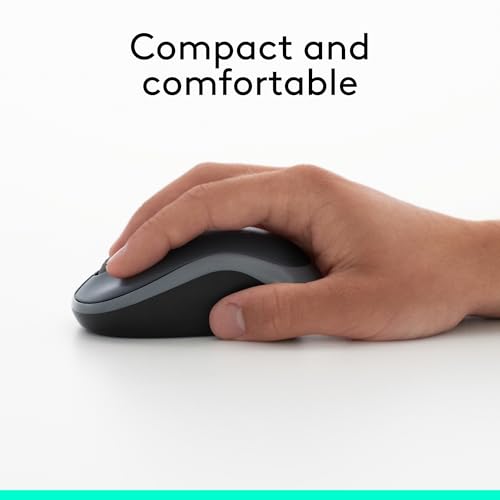
Logitech names Windows PCs, Macs and laptops. It also describes the shape as suiting small to medium hands and tight workspaces, which is honest sizing information and worth taking seriously: this is a small mouse. Anyone with large hands who works at a desk all day will likely find a full-size mouse more comfortable, and the Logitech M720 Triathlon in this catalog is the larger, more featured option in the same family.
The connection, and the port it needs
A 2.4GHz receiver link has real advantages over Bluetooth. It does not depend on the computer’s Bluetooth stack, it works during startup and in system firmware menus where Bluetooth often does not, and it avoids the pairing problems that Bluetooth peripherals are prone to. Logitech quotes up to 33 feet of range, which is far more than anyone needs at a desk and mainly indicates a robust link rather than a useful distance.
The cost is a USB-A port, permanently. The receiver is small, but it occupies a port for as long as you use the mouse, and a growing number of laptops ship with USB-C only. If your machine has no USB-A socket you will need an adapter or a hub, and that adapter then travels with the mouse. It is also a small item to lose: if the receiver goes missing, the mouse is not usable, and the listing says nothing about whether a replacement receiver can be paired or purchased separately.
The listing does not state whether the receiver works with other Logitech devices, does not name a receiver technology, does not publish a polling rate, and does not say whether the mouse can also connect by Bluetooth as a fallback. Where a listing is silent, assume the feature is absent.
Battery: 12 months, from a cell you can replace
Logitech quotes up to 1 year of battery life, attributed in the copy to a smart sleep mode, and an AA battery is included in the box. That is a meaningfully different arrangement from a rechargeable device, and the difference works in the M185’s favor over a long life. A rechargeable mouse eventually reaches a point where the internal cell no longer holds charge and the product is finished. This one takes a new AA and continues.
The 12 month figure carries no stated usage assumption, no hours per day and no test condition, and quoted battery figures are always a best case. Heavy daily use will not reach the same number as occasional use. What the listing does not publish is how the mouse behaves as the cell runs down, whether there is a low battery indicator, or whether there is a physical power switch to save charge in a bag. On a travel mouse, a power switch is the specification most worth knowing about, and it is not mentioned.
Tracking, shape and controls
The sensor is optical at 1000 DPI. That is a standard office resolution and it is fine for documents, browsing and general work. It is on the low side for high resolution displays, where a higher DPI reduces how far you have to move the mouse to cross the screen, and it is not aimed at gaming. There is no adjustable DPI button mentioned, so 1000 DPI is what you get, and pointer speed will have to be handled in the operating system settings.
Optical tracking also has a known limitation the listing does not mention: it struggles on glass and on highly reflective surfaces. A mouse mat or any matte surface solves it, but it is worth knowing before you set one up on a glass desk.
The shape is ambidextrous and contoured, with a line-by-line scroll wheel, meaning a ratcheted wheel that clicks through steps rather than spinning freely. The listing publishes no weight, no dimensions, no button count, no grip material and no scroll wheel tilt function. For a product where the physical size is the main selling point, the absence of dimensions is a real gap.
Two claims that need their sources named
Logitech states that “according to a recent study, laptop users who chose this mouse over a touchpad were 50% more productive and worked 30% faster.” Both figures carry footnote markers in the original listing, but no study is named, no methodology is given and no publication is cited. A vendor citing an unnamed study about its own product is marketing, not evidence, and the same bullet also describes the mouse as “far superior to a touchpad,” which is an opinion rather than a measurement. Buy a mouse because you prefer using a mouse, not because of those numbers.
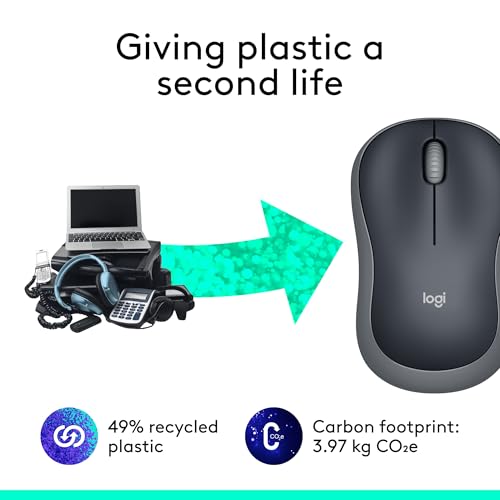
The sustainability figures are more specific and more checkable: the plastic parts are stated to include 77 percent certified post consumer recycled plastic in the black version and 49 percent in the Charcoal, Grey and glossy variants, with a product carbon footprint of 3.97 kg CO2e. Those are unusually concrete disclosures for an accessory listing.
What is missing, and where else to look
Not published: weight, dimensions, button count, polling rate, receiver technology, whether a spare receiver can be paired, whether there is a power switch or a battery indicator, or the customer rating and sales rank that most products in this catalog carry. Anyone comparing on specification rather than on brand will find very little here to compare with.
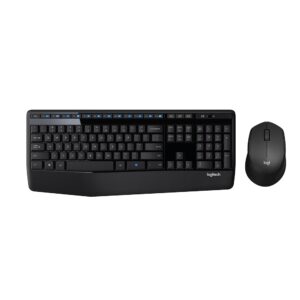
For alternatives in the same accessories part of this catalog, the Logitech MK345 pairs a mouse with a full size keyboard on a single receiver, and the Logitech K400 Plus combines a keyboard and a trackpad in one unit for anyone working from a sofa rather than a desk. The Nelko P21 label maker is another wireless desk accessory in the same part of the catalog. The full selection of wireless accessories sits in this section of the catalog.
Who should buy it
Buy the M185 if you want a small, simple, replaceable-battery mouse for a laptop, you have a USB-A port to give up, and 1000 DPI optical tracking covers your work. Skip it if your machine is USB-C only, if you want Bluetooth so you do not lose a receiver, if you need adjustable DPI or extra buttons, or if you have large hands, because this is explicitly a small to medium hand design.