






Description
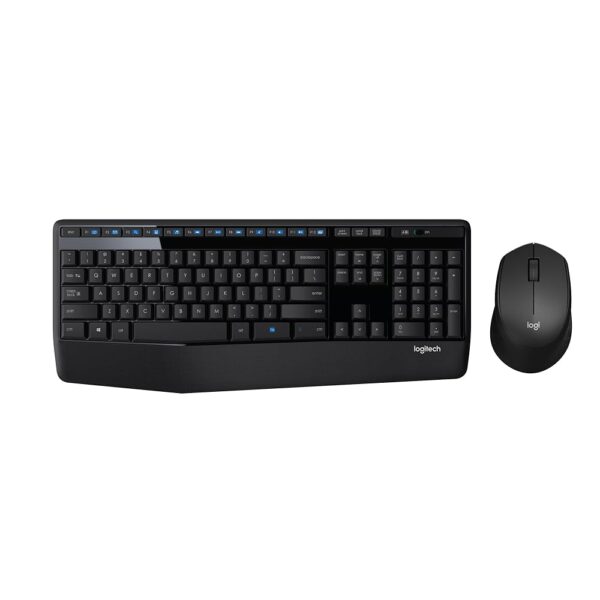
The Logitech MK345, model 920-006481, is a full size wireless keyboard with an integrated palm rest paired with a right handed mouse, both running on a single 2.4GHz USB receiver. It has been on sale since December 14, 2014, carries a 4.5 star average across 39,521 ratings, and is ranked 3rd in Computer Keyboard and Mouse Combos in the captured listing data. Logitech quotes up to 3 years of keyboard battery and 18 months of mouse battery, with batteries included.
Who this suits
This is a desk set for someone who types. The full size layout keeps the number pad, which matters for accounting, data entry and anything involving figures, and the fixed palm rest supports the heel of the hand at the keyboard’s own height. Media keys for mute, volume and playback are on the deck rather than hidden behind a function layer.
It is a right handed mouse, stated plainly, so left handed users are excluded by design. The mouse is described as contoured with smooth tracking and scrolling, and nothing more: no DPI figure, no button count and no sensor detail are published anywhere. That is a meaningful gap in a combo where the mouse is half the product, and it means you cannot compare it against a standalone mouse such as the Logitech M185, which at least publishes 1000 DPI optical tracking.
The connection: one receiver, one USB-A port
This is not a Bluetooth set. Both devices connect through a 2.4GHz USB receiver, and Logitech quotes a range of up to 10 meters, or 33 feet, with a footnote noting that range varies with the environment. The obvious advantage of a combo is that both halves share one receiver, so a keyboard and mouse occupy a single port between them.
Note what the listing does not say. It calls this a “2.4 GHz wireless USB receiver” and never names Logitech’s Unifying technology, which other products in this catalog do state explicitly. The Logitech K400 Plus names a Unifying receiver, and the Logitech M720 Triathlon states that its Unifying receiver can carry up to six devices. If you were hoping to consolidate this combo onto an existing receiver, the listing gives you no basis for that, and a receiver of this type is generally paired to its own devices at the factory.
The receiver also occupies a USB-A port permanently. On a machine with USB-C only, an adapter or hub is required, and the receiver is a small item to lose. The listing says nothing about whether a replacement can be paired.
The compatibility list contradicts itself
A feature bullet says the MK345 “works seamlessly with Windows, macOS, and ChromeOS.” The specification block, in the same record, gives “Operating System = Windows 10, 11 or later, Chrome OS,” with macOS absent. Those cannot both be complete. We are naming the contradiction rather than resolving it, and Mac users should confirm before buying, because a keyboard designed around a Windows layout also brings its own key mapping questions on macOS regardless of whether it connects.
Battery: two long figures, and a field that cannot be right
Logitech quotes up to 3 years for the keyboard and up to 18 months for the mouse, with batteries included and an on and off switch mentioned in the description. Those are long figures and they are the practical selling point: a set you can install and largely forget.
Both numbers carry a footnote marker in the original listing, but the assumption behind them is not printed in the imported record. On the K400 Plus listing Logitech states its assumption openly, at up to two hours of typing per day. Here the condition is missing, so treat 3 years and 18 months as best cases scaled to light use.
The battery field is where it falls apart. “Batteries = 2 AAA batteries required. (included)” is not a plausible description of a full size keyboard and a mouse. Two AAA cells cannot power two separate devices with independent battery lives of three years and eighteen months, and the listing never states which cells each device takes or how many. A second field reads “Average Battery Life (in hours) = 3 years,” which is a runtime figure in a field asking for hours, and it covers only the keyboard.
Build, comfort and the fields that came from elsewhere
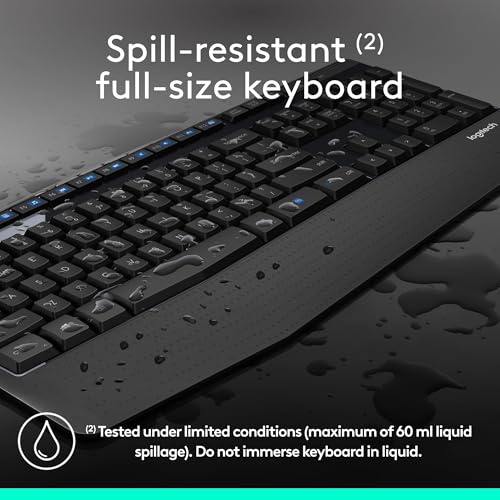
The set weighs 1.1 pounds and the keyboard measures 17.6 by 7.35 by 0.84 inches, which is a standard full size footprint with the palm rest adding depth. Keys are described as comfortable and quiet, and the chassis as spill resistant with a footnote and no rating, no liquid volume and no test standard attached. There is no IP code of any kind, so read spill resistance as a design intent rather than a specification.
The listing publishes no key travel, no switch type, no palm rest material and no keyboard tilt or leg information. For a product whose entire pitch is typing comfort, those omissions matter, and they are the details that decide whether a keyboard suits your hands.
One specification field belongs to a completely different product category: “Computer Memory Type = L2 cache.” A keyboard and mouse set has no processor cache. It is inherited from a computer listing, and it is a useful reminder that this record was assembled automatically rather than checked. The customer reviews field similarly contains the star rating followed by a block of raw page script.
What is published that most listings omit
Logitech states that the plastic parts include certified post-consumer recycled plastic at 76 percent for the mouse and 28 percent for the keyboard, with a product carbon footprint of 8.72 kg CO2e. Those are specific, checkable disclosures of a kind almost no accessory listing includes, and the same brand publishes comparable figures across its range in this catalog.
Not published: mouse DPI, mouse button count, key switch type, key travel, whether the keyboard has adjustable feet, receiver technology, or whether a replacement receiver can be paired. Other wireless desk accessories here include the Nelko P21 label maker, and the full selection sits in this section of the catalog.
Who should buy it
Buy the MK345 if you want a full size keyboard with a number pad and a built-in palm rest, a matching mouse on one receiver, and battery figures measured in years rather than weeks. Skip it if you are left handed, if you need Bluetooth rather than a USB-A receiver, if you want to know the mouse’s DPI or button count before buying, or if you are on a Mac, because the listing contradicts itself on whether macOS is supported.