Description
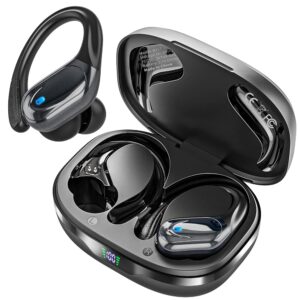
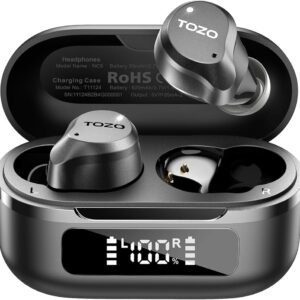
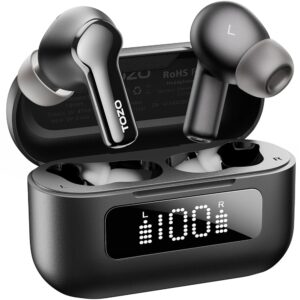
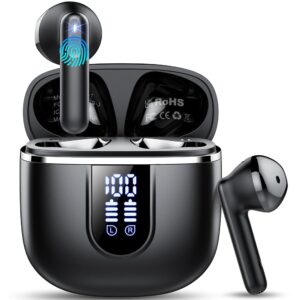
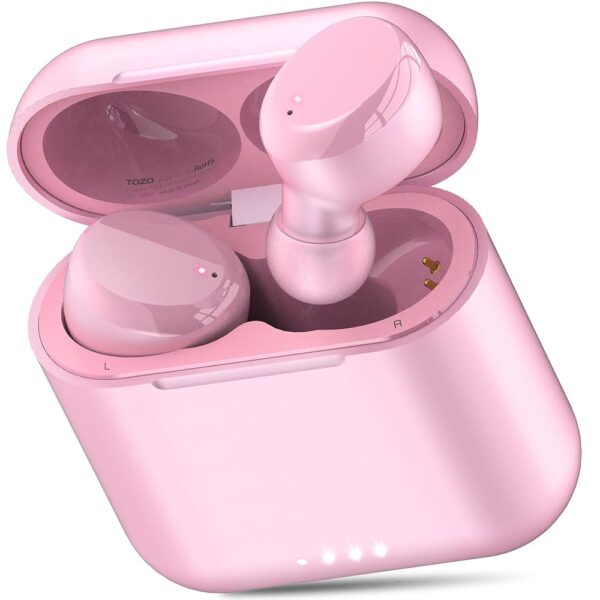
The TOZO T6 has been on sale since October 22, 2019 and has accumulated 57,631 ratings averaging 4.4 out of 5, which makes it one of the most reviewed products in this entire catalog. At the point this data was captured it was ranked 5,722nd in Electronics and 724th in Earbud and In-Ear Headphones. Six years of continuous availability in a category that turns over annually is itself a data point. The specification behind it is unusually complete for the money: six pairs of ear tips from XS to XXL, an IPX8 rating, a case that charges over a cable or on a Qi pad, a companion app with 32 preset equalizer modes, a published latency figure, and 12 hours of quoted playtime from the buds themselves. This is a new unit, not a renewed or refurbished one.
Who this suits
The T6 is the default recommendation for someone who wants a sealed earbud that works, has an app, survives sweat and rain, and does not cost much. It is not a noise cancelling product. The specification lists noise control as sound isolation, meaning the ear tip does all the blocking, and no active cancellation is claimed anywhere. On a train or a plane, engine drone will come through. Against that, TOZO supplies six tip sizes, which is more than most premium sets include and is the single most effective thing a manufacturer can do about isolation without adding electronics.
The app is the other differentiator at this level. Thirty two preset equalizer modes will not turn a small dynamic driver into something it is not, but it does let you pull back a bass tuning that many budget sets bake in permanently, and it gives the product a firmware path.
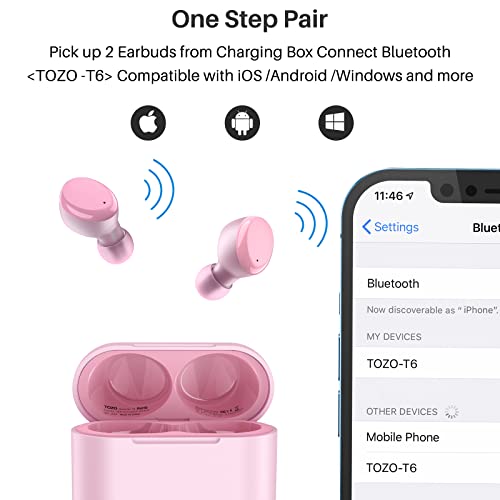
Connection: Bluetooth 5.3, a real latency figure, no codec
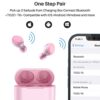
TOZO states Bluetooth 5.3 with a 15 meter range. As always, that version governs connection stability and power draw rather than sound. What is genuinely useful here is that the specification publishes an audio latency figure of 90 milliseconds, which almost no listing in this catalog does. Ninety milliseconds is fine for video, where players compensate, and it is too high for competitive gaming, where you feel anything above roughly 60. Publishing the number at all lets you make that judgment, which is more than a vague “low latency” claim allows.
The codec is still not named
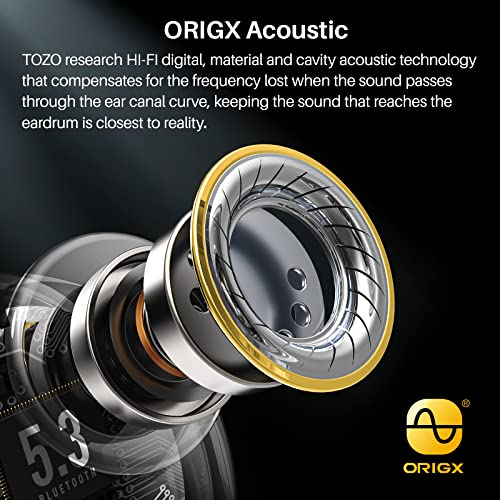
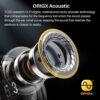
No codec appears anywhere on this page. SBC is the universal baseline and is what you should assume. AAC, which matters on iPhones, is not stated. aptX and LDAC are not stated either, and both require the phone and the earbuds to support them before they change anything. The bullets describe an “OrigX” acoustic technology and claim bass extension down to 18Hz, which sits below the 20Hz lower bound the same specification table gives as the frequency range. Those two figures do not agree, and neither is a measurement you should weight heavily: frequency extension claims on earbuds are quoted without a tolerance, so a number in the teens tells you the manufacturer wanted a low number rather than that you will hear anything there.
Battery: twelve hours in the bud, and one absurd field
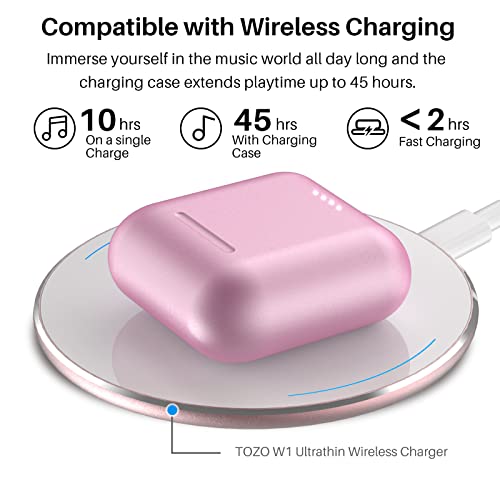
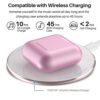
TOZO quotes up to 12 hours of playtime from a single bud charge and 50 hours in total with the case, which is a strong bud figure and is stated separately rather than folded into the headline. Charging is quoted at about 55 minutes over the supplied cable or under two hours on a Qi pad, and wireless charging is genuinely confirmed here rather than implied, because the listing describes both paths explicitly.
The specification table then undermines itself. It gives “Carrying Case Battery Average Life = 38 Hours” where the bullets say 50 in total, and it gives “Battery Life = 20000 Hours”, which is the 20,000Hz frequency figure dropped into the battery row. We are naming those rather than resolving them. Plan around 12 hours per bud, treat the case total as somewhere between 38 and 50 hours, and remember every quoted playtime assumes moderate volume on a new cell. One further oddity: the supplied cable is described as USB-A to Micro USB, which on a 2019 design is consistent but is now behind the times, so check what connector arrives before assuming USB-C.
Fit, seal, controls and IPX8
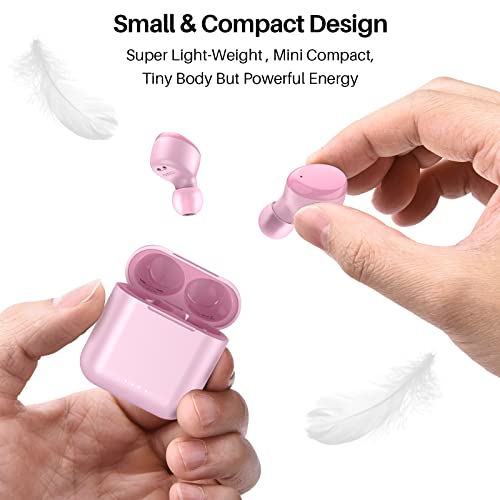
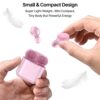
Six pairs of ear tips, XS through XXL, is the headline fit specification and the reason this model suits people who have failed to get a seal from three size sets. The driver is listed at 8mm, each bud at 4.5 grams, and impedance at 16 ohms. Sensitivity is given as 112 dB with no reference condition attached, which makes it uninterpretable rather than impressive. Controls are described precisely for once: tap to play or pause, double tap to skip, hold to change volume.
IPX8 is the water rating, and the listing goes as far as suggesting use in a bathtub. IPX8 means continuous immersion beyond one meter under conditions the manufacturer states, and no depth or duration is published here, which is the same gap that affects most IPX8 claims in this category. Read it as strong protection against sweat, rain and accidental submersion rather than as a swimming specification. No IP rating covers seawater, chlorinated pools or pressurized water, ratings do not extend to the charging case unless stated, and seals degrade with age and heat. A six year old design bought today has new seals, but the rating is still a laboratory result rather than a warranty.
What to compare it against
This catalog carries a second write up of the TOZO T6 at our other TOZO T6 page, covering the same model from a separate listing, and the two specifications are worth reading side by side before ordering. Within the brand, the TOZO T10, the other long serving budget model in the range is the closest sibling, the TOZO T12, which moves to a stemmed housing suits people who dislike the bulbous shape, and the TOZO NC2, which adds hybrid active noise cancellation is where to go if isolation from tips alone is not enough. Our wider coverage sits under wireless earbuds and earbud headphones.
Who should buy it and who should not
Buy the T6 if you want a cheap sealed earbud with a real 12 hour bud runtime, six tip sizes, an app with usable equalizer presets, wireless charging and a water rating strong enough to stop worrying about rain. Do not buy it if you need active noise cancellation, if you need a codec named before you accept a sound quality claim, if 90 milliseconds of latency is too much for the games you play, or if you specifically want USB-C on the case. And do not treat IPX8 as a swimming rating when the listing publishes no depth or duration.