



Description
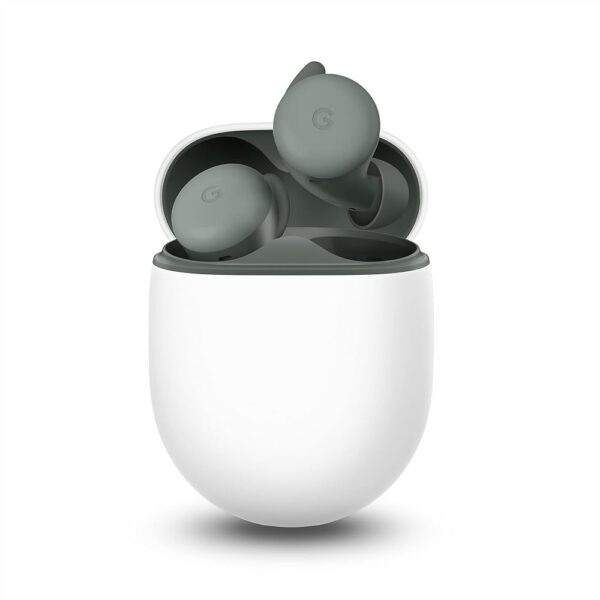
This is a renewed unit, in Dark Olive, and it is the second Pixel Buds A-Series listing in this catalog. The title says “(Renewed)” and the manufacturer description field contains nothing about the earbuds: it is entirely Amazon’s standard renewed program text about how returned products are inspected and resold. That matters more here than usual, and for a reason that has nothing to do with battery health, which we come to below. Everything else is drawn from the published listing. We do not wear or measure the products covered on this site.
The disclaimers that are no longer there
Every substantive bullet on this listing ends with a bracketed number. The battery claim carries a one, the Google Assistant claim a two, the pairing claim a three and a four, the water resistance claim a five, Adaptive Sound a six, the microphone claim a seven and the find my earbuds feature an eight.
The final bullet then explains what those numbers point to: “Please refer to the product description section below for all applicable legal disclaimers denoted by the bracketed numbers in the preceding bullet points.”
The product description section on this listing is the renewed program boilerplate. The disclaimers are not there. Eight qualified claims have had their qualifications removed, and the page itself tells you where to look for text that no longer exists. Read every bullet below with that in mind: each one is a claim whose conditions a buyer cannot see.
Who this is for, and the age range field
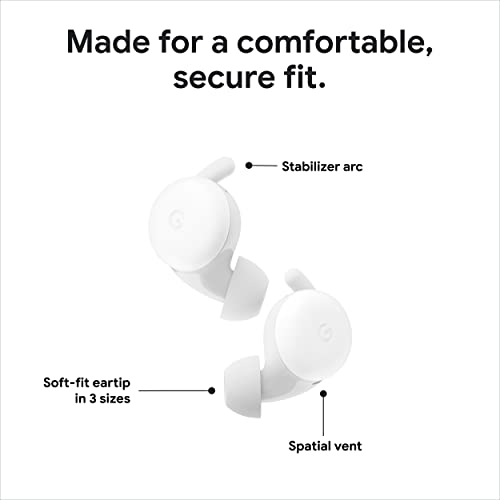
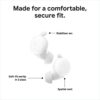
These are sealed in-ear buds with custom 12 millimeter dynamic drivers, three ear tip sizes and a stabilizer arc, supplied with a charging case and a cable. Google describes “a flush-to-ear design, three eartip sizes, and a stabilizer arc” that “create a gentle seal.” The specific use is listed as sports and exercise.
The age range field on this listing reads “Kid.” No volume limit is published anywhere on the page, in any bullet, field or description. If you are buying headphones for a child, a stated volume limit is the specification to look for, and even a stated limit only means something if the child cannot switch it off in an app or bypass it by pairing to another device. This listing states no limit at all, so it offers nothing to rely on, and we will not describe this or any other product here as safe for a child’s hearing. Keep listening levels low enough that a normal speaking voice nearby stays audible, and take breaks. Our JLab Epic Lab Edition review covers a product that at least names a volume limiting feature.
Noise cancellation: two listings, two answers
The specification table here records “Noise Control: Adaptive Noise Cancellation.” The listing for the same product in a different color, covered in our other Pixel Buds A-Series review, records “Noise Control: None.”
Those cannot both describe the same hardware. Nothing in the bullets on this page claims active cancellation either. What the bullets do describe is Adaptive Sound, which “adjusts the volume as you move between quiet and noisy environments.” That is automatic volume adjustment, not noise cancellation: it makes the music louder when the room gets louder, which is the opposite of reducing what reaches your ear, and it is worth knowing if you are trying to limit how loud you listen. Treat the cancellation field as an import error and do not buy these expecting a quiet flight.
Connection, latency and codecs
No Bluetooth version is stated for the product itself. The pairing bullet refers to connecting to “iOS or any other Bluetooth 4.0+ device,” which is a compatibility floor rather than the buds’ own radio. The range is given as 10 meters. Pairing to a Pixel or another Android device is described as a single tap; iOS works but without that.
No codec is named anywhere, so there is no basis on this page for any high resolution or lossless claim, and none is made. Multipoint pairing is not mentioned. Wear detection is not mentioned.
One figure here is published that almost no listing gives: “Audio Latency: 100 Milliseconds.” A tenth of a second is enough to show as lip sync error on video unless the app compensates, and far too much for gaming. Publishing the number is to the listing credit, and it tells you what this product is not for.
Battery: correct in the bullet, wrong in the table
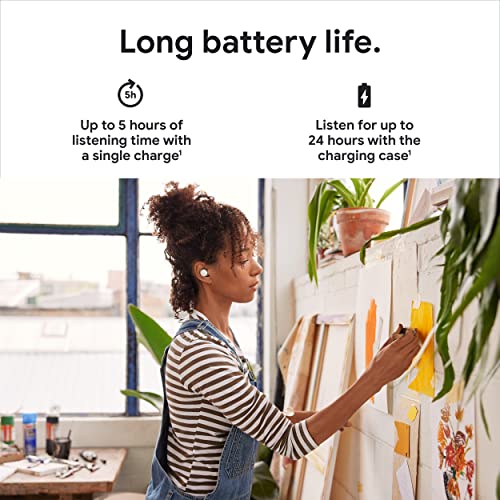
The bullet gives the useful version: “Get up to 5 hours of listening time or 2.5 hours of talk time with a single charge, or listen for up to 24 hours with the charging case.” Publishing talk time separately from listening time is rare and worth having, because calls run the microphones continuously and cost roughly double.
So bud runtime is five hours of music, two and a half hours of calls, and twenty four hours in total with the case. Two specification rows contradict that and should be ignored. “Battery Life: 24 Hours” is the total including the case rather than a single charge, and read alone it overstates bud runtime nearly fivefold. “Charging Time: 5 Hours” is the listening time figure copied into the wrong field; no genuine charge time is published.
On a renewed unit these figures come with an extra caveat. The cells in a returned product have already been through an unknown number of cycles, and no battery health statement is offered beyond the general claim that the item works like new.
Water resistance, and what the missing footnote hid
The specification field reads only “Water Resistance Level: Water Resistant,” with no IP code anywhere on the page. The bullet goes further: “The wireless earbuds are water resistant, so rainy days and sweaty workouts are no problem,” followed by a bracketed five pointing at a disclaimer that is not on this listing.
That is the clearest example of the problem described at the top of this review: a rain and sweat claim, on a product whose specific use is listed as sports and exercise, with its footnote removed and no IP code to fall back on. Treat these as unrated for water until Google or the seller supplies the code in writing. No IP rating covers seawater or pressurized water in any event, and seals degrade with age, which matters more on a unit whose history you do not know.
How it ranks, and the alternatives
Customer feedback sits at 4.1 out of 5 from 159 ratings, a modest sample. The sales rank is given as 31,148th in Electronics and 2,191st in the earbud and in-ear headphone group. The date first available is May 2022, the materials are listed as plastic and rubber, and the weight of 1.9 ounces describes the retail package rather than the buds.
For other renewed name brand options in this catalog, see our Samsung Galaxy Buds Pro review and our Samsung Galaxy Buds FE review, both of which are renewed units with their own specification gaps. For the wider field, start from the true wireless earbud listings or the broader in-ear headphone listings.
Who should buy it and who should not
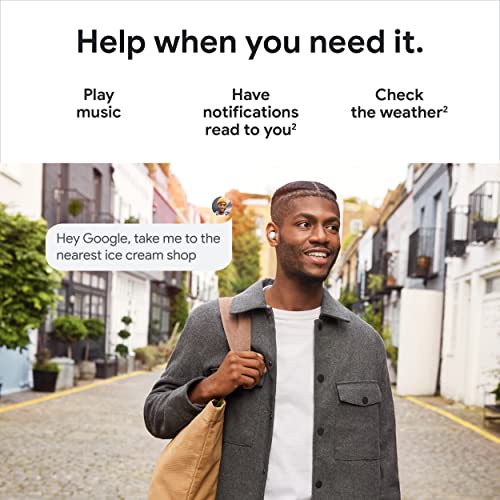
Buy it if you use an Android phone, you want Google Assistant a voice command away, and a renewed unit at a reduced price is an acceptable trade. The 12 millimeter driver, the separated listening and talk times and the published latency figure are the useful parts of this page. Do not buy it expecting noise cancellation, because the spec field claiming it contradicts the other listing for the same product and no bullet supports it. Do not buy it for the gym or for rain, because no IP code is published and the footnote that qualified the claim is missing. Do not use it for video or gaming, given the stated 100 millisecond latency. And if this is for a child, choose a product that publishes a volume limit, because this one does not.