
Description
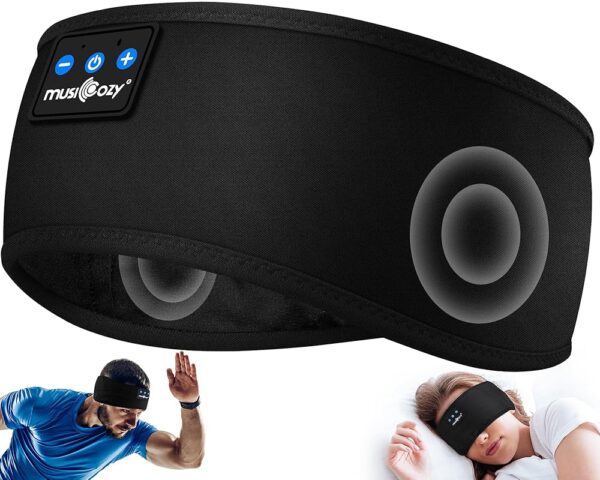
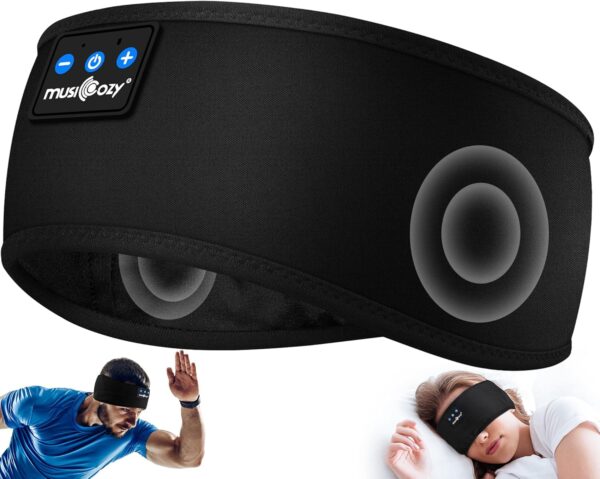
The MUSICOZY sleep headphones are not earbuds or headphones in the usual sense. They are a soft elastic headband with flat speakers and a microphone sewn into it, designed to be worn lying down. That form factor solves one specific problem, which is that side sleepers cannot wear anything with a hard housing, and it creates a set of considerations that no conventional earbud listing raises.
Who this is for, and the safety points that come first
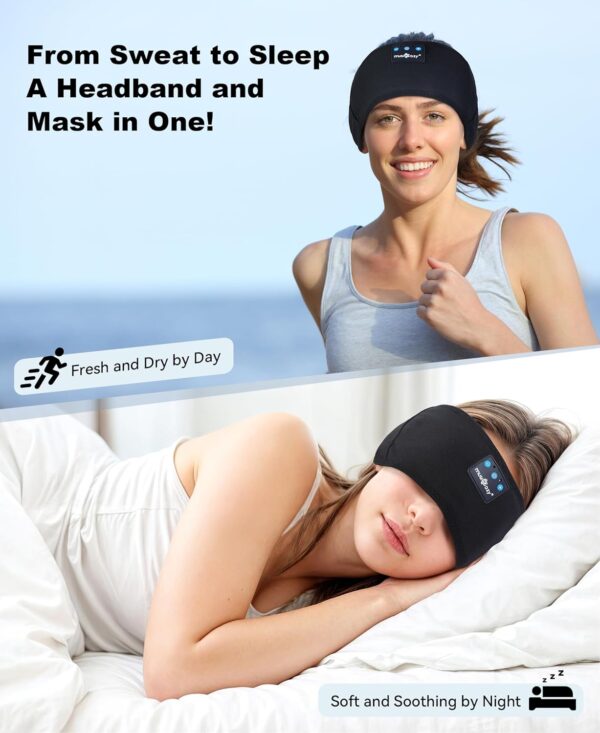
The intended use is sleeping, and the listing also markets it for workouts, yoga, meditation and travel. The band is spandex, nylon and elastic, listed at 2.88 ounces, and the electronics are removable so the fabric can be washed. MUSICOZY describes the material as moisture-wicking and stretchy enough for most head sizes.
Three things need saying before the specifications, because this product is worn while unconscious and is marketed to children.
First, the age range field lists adult, teen and kid. No volume limit is published anywhere on this record, and no limiting feature is described. A volume limit is only meaningful if it cannot be bypassed, and here there is no limit claimed at all. We cannot tell you this is safe for a child’s hearing, because nothing in the specification addresses it.
Second, audio played through the night is a long exposure. Volume that seems modest for twenty minutes is a different proposition over seven hours, and you are asleep and unable to judge it. Set the level before you lie down rather than adjusting it while drowsy.
Third, the recommended uses field lists cycling and running alongside sleep. A band that covers both ears with speakers over them reduces your ability to hear traffic. It is not an open-ear or bone conduction design, so it does not preserve situational awareness the way those do. Treat that field as a keyword list rather than a recommendation, and if awareness while moving is the requirement, an open-ear product such as the TOZO OpenBuds is the category to look at instead.
How it connects
Bluetooth 5.2 is listed, with a range given as 25 meters, which is generous compared with the 10 meters most listings quote. A version number describes connection stability, power draw and available feature sets, and does not make audio better by itself.
No codec is named
No audio codec appears anywhere on this record. There is no AAC entry, no aptX and no LDAC. Where nothing is named, SBC is the only codec that can be assumed, because SBC is the baseline every Bluetooth device supports. Nothing here supports a high resolution claim, and for a sleep product it hardly matters, since the content is generally speech, white noise or quiet music rather than anything demanding.
Noise control is listed as none, which is correct and honest: there is no active cancellation, and the flat speakers sit over the ears rather than sealing them, so this product blocks very little outside sound. If the goal is masking a snoring partner or street noise, understand that you are masking with sound rather than blocking it, which means playing something at a level that competes with the noise. That is the wrong direction for hearing exposure.
The battery figures, which do not agree
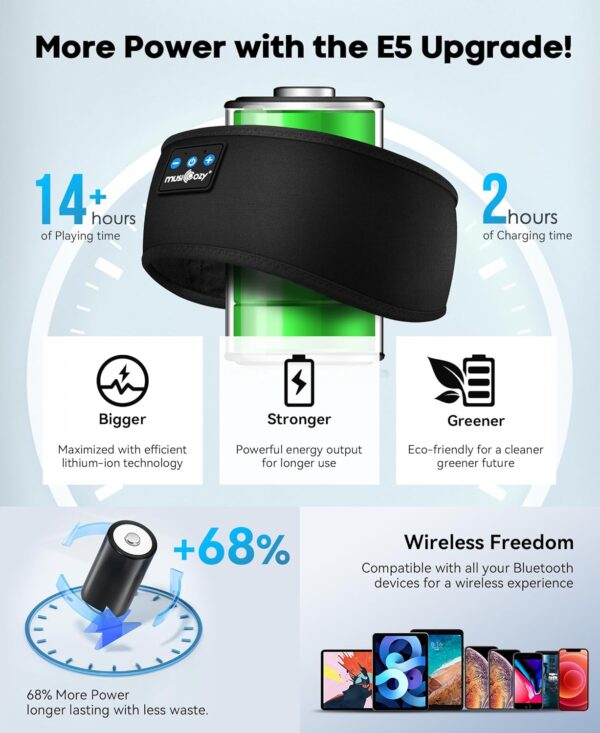
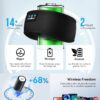
The feature bullets state that a single one to two hour charge provides up to 14 hours of continuous playtime. The attribute block states a battery life of 10 hours. Those are different numbers for the same thing and we are naming the gap rather than picking one. Either figure covers a full night, which is the use case that matters, but a buyer planning multiple nights between charges should treat 10 hours as the conservative reading.
The record also carries “Carrying Case Battery Average Life = 14 Hours,” “Carrying Case Battery Capacity = 240 Milliamp Hours” and “Carrying Case Battery Charging Time = 2 Hours.” There is no carrying case. This is a headband with an internal battery, and those three values appear to be the headband’s own figures placed into fields that belong to true wireless earbuds. The 240 milliamp hour capacity is plausible for the band itself.
One further field is wrong: “1 Lithium Metal batteries required.” Lithium metal cells are not rechargeable, and this product charges over USB-C with an included Type-C cable.
The driver claim does not fit the product
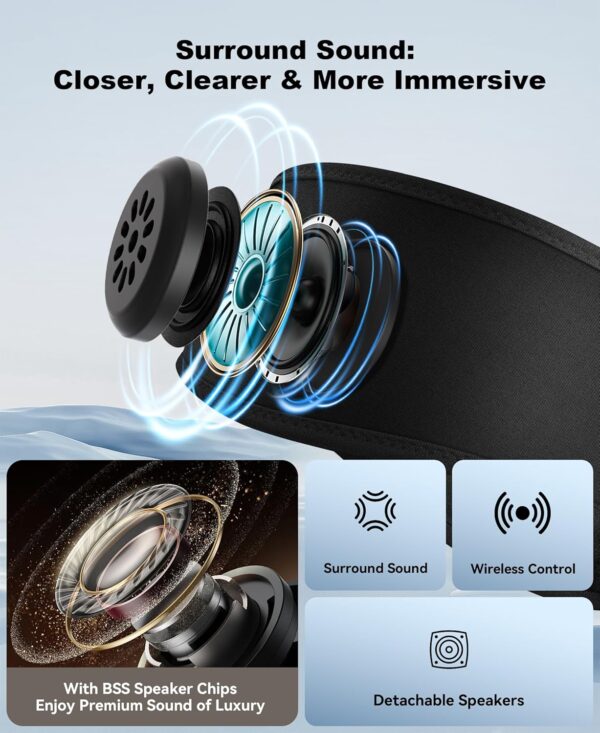
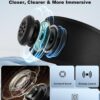
The feature bullets claim 40 millimeter drivers. The marketplace title describes an ultra-thin HD stereo speaker, and the product dimensions are 7.87 by 3.94 by 0.59 inches, with 0.59 inches being the packed thickness. A 40 millimeter driver is a full over-ear headphone size, roughly the same as the ASTRO A20 Gen 2 gaming headset uses, and a driver of that diameter and depth is not what fits inside a fabric band you can sleep on. The two claims cannot both describe the same part. Read the ultra-thin description as the accurate one and treat the 40 millimeter figure as unverified.
Sound quality expectations should be set accordingly. Flat, thin transducers pressed against the ear through fabric do not produce the bass or the detail of a sealed earbud. For audiobooks, podcasts, white noise and quiet music, which is what this is for, that is not a problem. For music listening as the main activity, a conventional headphone such as the JBL Tune 770NC is a different class of device.
Water resistance, and the rest of the record
The listing contradicts itself here as well. The marketplace title says sweat resistant, one bullet calls the band sweatproof, and the attribute block states “Not Water Resistant.” No IP code is published anywhere. Since the electronics are removable for washing, the fabric can clearly be laundered, but that says nothing about the module itself. Treat this as having no published water rating and remove the electronics before washing, as the design intends.
Several attribute fields on this record are junk. The frequency range field holds a block of search keywords about sleep masks and gift ideas rather than any frequency. The theme field lists movie, TV series and fantasy. The department field says “boys.” Compatible devices lists only tablets. The control type is given as “Alexa” while the control method is touch. None of these describe the product, and the frequency range field in particular means no acoustic specification is published at all.
What is missing, and what to compare
Unpublished: any real frequency response, driver type beyond dynamic, impedance, sensitivity, microphone specification, whether the band has physical buttons or a touch panel, and any volume limiting. First availability is listed as October 2021 and the model number is GH01.
For sleep specifically, our catalog also carries dedicated sleep earbuds such as the Soundcore Sleep A20 and the VEKJ L8 Pro sleep buds, which take the opposite approach with tiny sealed housings rather than a band. The wider wireless headphone listings cover conventional designs.
Who should buy it, who should not
Buy this if you sleep on your side, want audio through the night, and are choosing it for spoken content or masking sound rather than music. Skip it if you want real isolation, if you want a published acoustic specification of any kind, if you were buying it for cycling or running, or if you are buying for a child and expected a volume limit. There is none published here.