



Description
The Pixel Buds A-Series is Google’s budget earbud, and the useful thing about this listing is what it does not claim. There is no cancellation, no high resolution language and no spatial audio marketing. The specification table records “Noise Control: None,” which is an unusually plain admission. What it also does not publish is an IP code, a codec or a credible Bluetooth version, and one field contains an editorial placeholder that was never cleaned up. Everything below comes from the published listing. We do not wear or measure the products covered on this site.
Who this is for
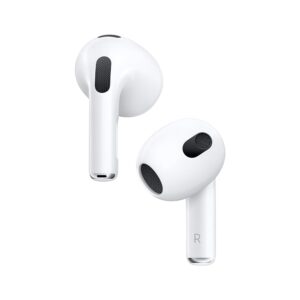
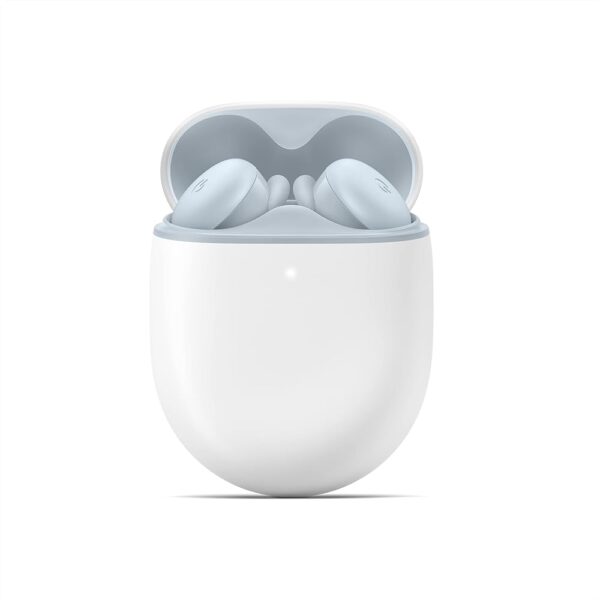
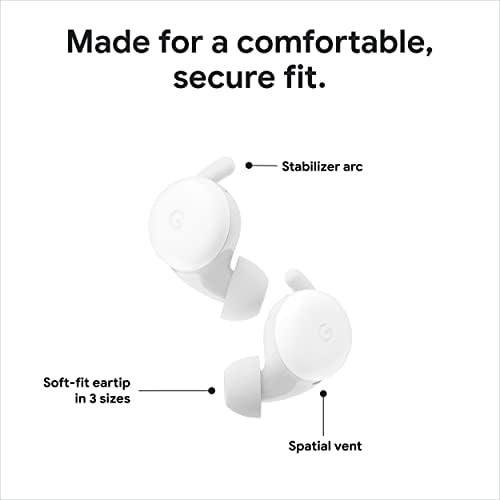
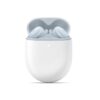
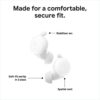
These are sealed in-ear buds in the color Google calls Sea, supplied with a charging case, a cable and ear tips in three size options. Google describes “a flush-to-ear design, three eartip sizes, and a stabilizer arc,” which is the small rubber fin that braces against the ear ridge rather than a full wing. The specific use is listed as music and the recommended use as calling.
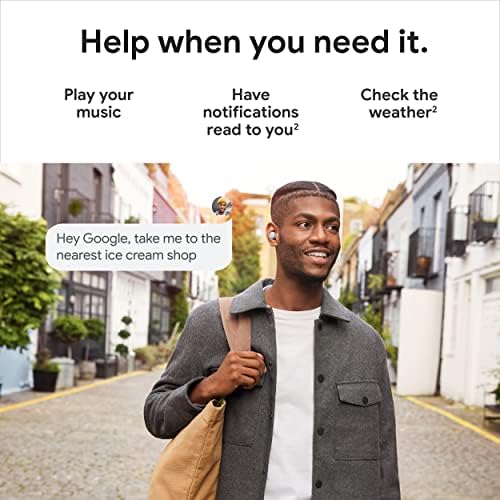
The audience is straightforward: an Android user, ideally a Pixel owner, who wants Google Assistant reachable by voice and does not need cancellation. The listing leans on that: “Play music, get directions, check the weather, or have notifications read to you just by using your voice; or press and hold the earbud to talk to Google.”
Pairing is where the platform split shows. Google says you can pair “with your Pixel or any Android device in just one tap,” and separately that you can “connect to iOS or any other Bluetooth 4.0 plus device.” Both work; only the first is one tap, and the assistant integration is built around Android. If you carry an iPhone, these become an ordinary pair of Bluetooth earbuds.
Connection, and a version number that is not one
The specification table records “Bluetooth Version: 4,” with no decimal and no further detail. That is almost certainly the compatibility floor from the pairing bullet, which refers to connecting to “any other Bluetooth 4.0 plus device,” rather than the version the earbuds themselves implement. A 2021 era product built around one tap Android pairing would not be running a Bluetooth 4 radio. We are not going to substitute a number Google has not published, so the position is: the only version stated is 4, it reads like a minimum device requirement rather than a product specification, and a buyer who cares should confirm it. The stated range is 10 meters.
No codec is named anywhere. The description says the buds “deliver rich, high-quality audio,” which is an adjective rather than a specification, and with no codec published there is no basis for any high resolution or lossless claim. The listing does not make one, which is correct.
Multipoint pairing is not mentioned. Wear detection is not mentioned. There is no companion app named on this page, and no equalizer control is claimed.
No cancellation, and what that means
The specification table says “Noise Control: None.” There is no active cancellation and no transparency mode, because a product with no cancellation does not need one: the seal blocks what it blocks and outside sound reaches you by the normal path, attenuated. That is worth understanding rather than treating as a missing feature. It means the buds will not quiet a plane or a train the way a cancelling model does, and it also means there is no processing between you and the world. For anyone whose main objection to modern earbuds is the pressure sensation cancellation creates, that is a point in favor rather than against.
Battery: three numbers, and one broken field
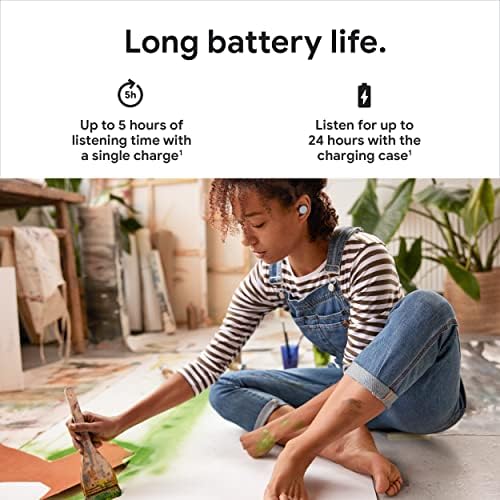
The bullet gives more detail than most: “Get up to 5 hours of listening time or 2.5 hours of talk time with a single charge, or listen for up to 24 hours with the charging case.”
Publishing talk time separately from listening time is rare and useful, because voice calls run the microphones continuously and cost roughly double. So bud runtime is five hours of music or two and a half hours of calls, and twenty four hours is the total including the case, which is nearly four further refills. Five hours is short by current standards, and it is the figure most likely to date this design.
One specification row should be ignored: “Charging Time: 5 Hours.” Five hours is the listening time figure copied into the wrong field. No genuine charge time is published anywhere on this listing.
Fit, and the missing water rating
Three ear tip sizes are supplied and the stabilizer arc is included on the bud itself rather than as a separate part to fit. On a sealed bud the tip decides both how much bass you perceive and how much outside noise is blocked, and three sizes is the ordinary count. No driver size is published on this listing, and no impedance figure appears either.
On water, the specification field reads only “Water Resistance Level: Water Resistant.” No IP code appears anywhere on the page, in any field, bullet or description. That means there is no published protection level to act on. Treat these as unrated: do not assume sweat is covered and do not take them out in rain until Google or the seller supplies a code in writing. No IP rating covers seawater or pressurized water in any event, and seals degrade with age.
Two data fields that were never cleaned up
The compatible devices field reads, literally, “[Broad: Bluetooth-enabled devices]”. The square brackets and the word “Broad” are an editorial placeholder that has survived into the published listing, which tells you the specification table on this page was assembled by hand or by a script rather than supplied by the manufacturer. Treat every soft field on this page with that in mind.
The item model number field reads “G7YPJ; GPQY2; G7T9J”, three different model codes in one row. Those are likely the color variants of the same product, but the listing does not say which one applies to the color you are buying. The item weight of 1.9 ounces describes the retail package rather than a pair of buds; no bud weight is published, although the dimensions of 0.81 by 1.15 by 0.69 inches look like the case.
How it ranks, and the alternatives
Customer feedback sits at 4.4 out of 5 from 7,111 ratings, which is a strong score on a large sample and the most persuasive thing on the page. The sales rank is given as 6,665th in Electronics and 724th in the earbud and in-ear headphone group, and the date first available is May 2023.
This model also appears in this catalog as a refurbished unit, and the two listings disagree with each other on whether the product has noise cancellation at all. Our review of the renewed Pixel Buds A-Series listing sets out that contradiction. For competing budget buds from other ecosystems, see our Samsung Galaxy Buds FE review, our Jabra Elite 3 review, which publishes a real IP55 code, and our JBL Vibe Buds review. For the wider field, start from the true wireless earbud listings or the broader in-ear headphone listings.
Who should buy it and who should not
Buy it if you use an Android phone, you want Google Assistant a voice command away, and you actively do not want cancellation. The listing is honest about having none, which is worth something. Do not buy it for a flight or a commute where blocking noise is the point. Do not buy it for the gym or for rain, because no IP code is published. Do not buy it expecting multipoint, an app or a named codec. And treat the Bluetooth 4 figure as unconfirmed, because it reads like a compatibility floor rather than a specification.