



Description
Where this one sits
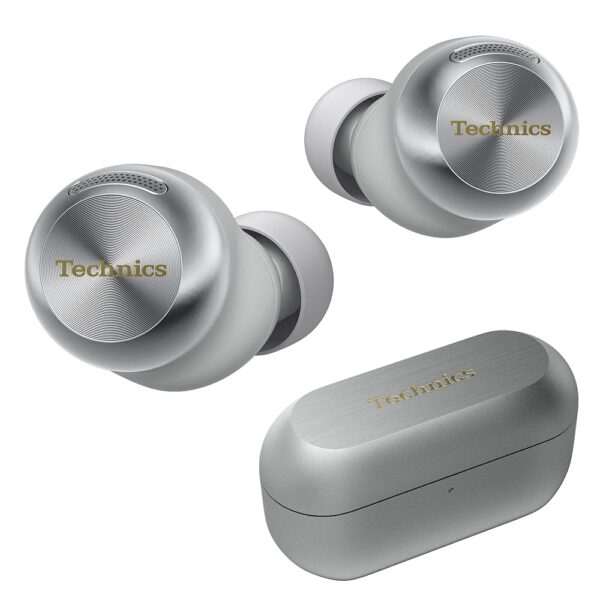
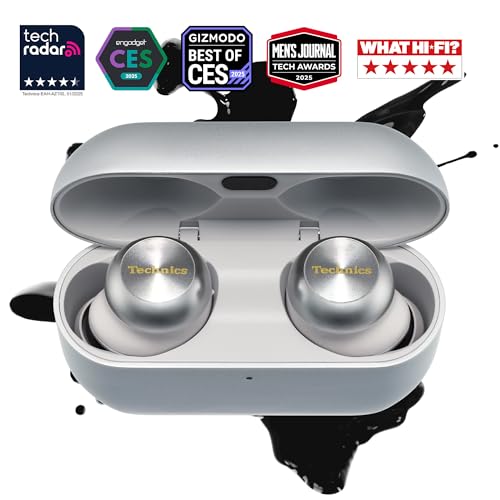
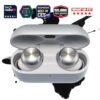
The Technics EAH-AZ100-S is the premium end of this catalog. Technics is Panasonic’s audio brand and this is its flagship true wireless model, listed as reference class, and the specification carries features that genuinely do not appear further down: adaptive noise cancellation, Dolby Atmos with head tracking, a wireless charging case and, most unusually, three device multipoint. It first appeared in January 2025, is manufactured in Malaysia, and carries a 4.6 out of 5 average across 416 ratings, which places it 573rd in the earbud and in-ear headphone category.
This listing covers the silver finish. A separate Technics AZ100 listing in black exists under its own product code, and although these are color variants of the same model, the published specifications on the two pages are not guaranteed to match.
Multipoint, and why three devices matters
Most earbuds that support multipoint at all support two devices. Technics states three, and adds that you can manually prioritize which device wins when several want the connection at once. For anyone running a work laptop, a personal phone and a tablet, that is the difference between the product managing itself and you managing the product. It is stated explicitly in the description and in a feature bullet rather than being left to inference, which is worth noting because so many listings in this catalog leave multipoint unmentioned entirely.
The Hi-Res claim, and why the specification does not support it
This is the most important section of this review. The product title calls these Reference Class Hi-Fi earbuds. The description says high res sound. A feature bullet promises Hi-Res sound from exclusive Technics technologies. Nowhere on this listing is a single audio codec named. Not LDAC, not aptX Adaptive, not aptX HD, not even AAC.
That matters because high resolution audio over Bluetooth is entirely a codec question. SBC, the baseline every device supports, cannot carry it. AAC cannot carry it. Getting anything beyond CD quality across a Bluetooth link requires a codec built for it, and critically it requires the phone or laptop at the other end to support the same codec. An iPhone, for example, supports neither LDAC nor any aptX variant, so on Apple hardware a product’s high resolution capability may simply never engage regardless of what the earbuds contain.
The honest position is therefore this: the Hi-Res claim on this listing is unsupported by the published specification. It may well be accurate, and a product at this level would be unusual not to carry a high bitrate codec, but a buyer cannot verify it from this page and should confirm the exact codec list with Technics before paying for a capability their own phone might not be able to use.
Dolby Atmos and head tracking
Technics claims Dolby Atmos with head tracking, where the soundstage stays fixed in space as you turn your head. This is a real and effective feature, and it is worth understanding that spatial processing of this kind is generally rendered on the source device and the platform rather than inside the earbuds, so what you get depends on the phone, the app and the content as much as on the hardware. No specific platform requirements are listed on this page.
Noise cancellation and battery
The Noise Control field reads Adaptive Noise Cancellation, and the description explains it as adjusting automatically to the surrounding environment. No decibel reduction figure and no test standard are quoted, which is arguably more honest than quoting an unverifiable percentage. What applies to every cancellation system applies here: it works well on constant low frequency sound such as engine drone, cabin noise and road rumble, and poorly on speech and sudden noises. No earbud makes an environment silent. A Voice Focus AI chip handles the call side, which is a separate system.
The battery disclosure is unusually good. Technics quotes up to 10 hours of playback with noise cancellation running, and up to 28 hours with the charging case. Quoting the figure with cancellation on rather than off is the harder and more useful number, because it is the mode most buyers of an ANC product will actually use. The Battery Life field agrees at 28 hours. The case supports wireless charging.
Fit, driver technology and a contradiction worth naming
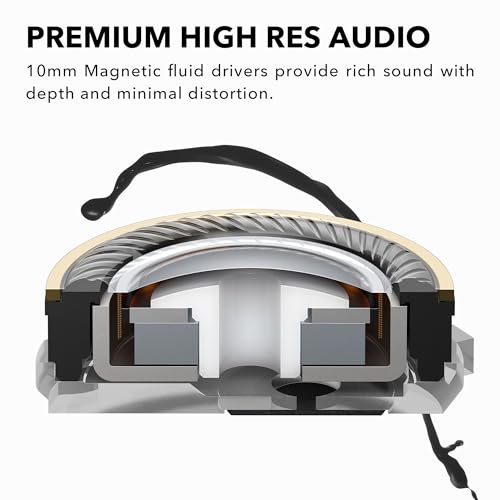
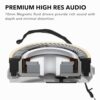
The specification lists the Audio Driver Type as Planar Magnetic Driver. The description says magnetic fluid drivers. Those are not the same thing and not close. A planar magnetic driver is a distinct transducer type using a flat diaphragm suspended in a magnetic field, rare and expensive in earbuds. Magnetic fluid, sometimes called ferrofluid, is a damping liquid placed in the voice coil gap of an otherwise conventional dynamic driver to control heat and resonance. One is a driver architecture, the other is a component inside a different architecture. The listing cannot have both, and it does not resolve which is correct. Given the description uses magnetic fluid twice and the specification table uses planar magnetic once, the description is the more likely to be right, but a buyer paying flagship money deserves better than a guess.
Technics states the earbuds are 10 percent smaller and 16 percent lighter than the previous model, and the included components list mentions ear cushions without saying how many sizes ship in the box. On a product at this level the tip count should be published, and its absence is a genuine gap.
The water rating is a larger gap. The Water Resistance Level field says only Water Resistant, and no IP code appears anywhere on the listing. For a flagship product that is a conspicuous omission, and it means no splash, sweat or waterproof claim can be made here. Confirm the rating with Technics before wearing these to a gym. One further field is an import error: the Batteries entry reads one P76 battery required, which is an obsolete camera cell that has nothing to do with this product.
What else to consider
At this level the comparison set is small and well defined. The Bose QuietComfort Ultra Earbuds is the cancellation benchmark, the Sony WF-1000XM5, which does name LDAC is the direct rival and the one to compare against on the codec question specifically, and the Devialet Gemini II is the alternative from another audio specialist. Browse the true wireless earbud section and the wider in-ear headphone listings for context.
Who should buy it, who should not
Buy it if three device multipoint solves a real problem for you, if you want adaptive cancellation with an honest 10 hour figure quoted in the mode you will actually use, and if spatial audio with head tracking appeals. Skip it if you are buying specifically for the high resolution claim without first confirming which codec is supported and whether your phone supports it too. Skip it if you need a documented IP rating, because this flagship listing publishes none, and note that the driver technology is described two incompatible ways on the same page.