
Description
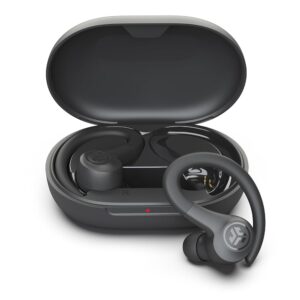
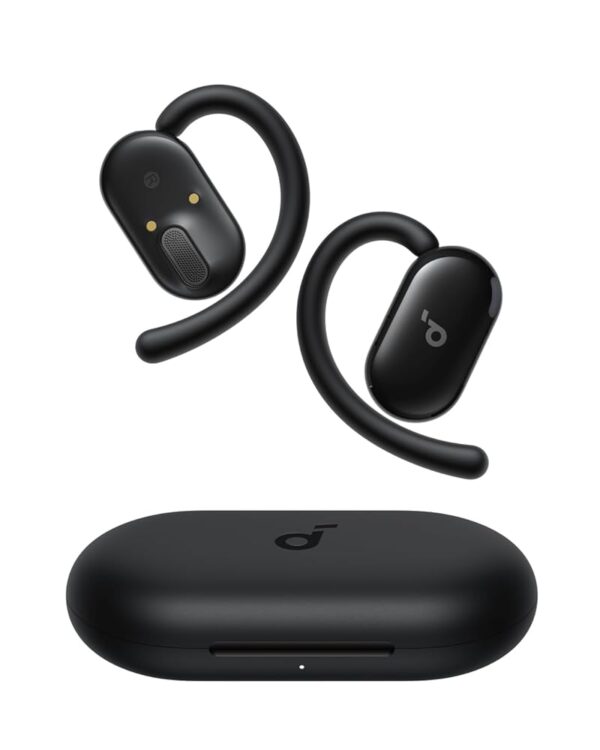
The Soundcore V20i is an open ear hook design from Anker that does something rare in this catalog: it tells you what it does not do. One bullet states plainly that the V20i does not feature active noise cancelling, and the attribute table backs that up with a Noise Control field reading None. That single line of honesty makes the rest of the specification much easier to trust.
Who the V20i is for
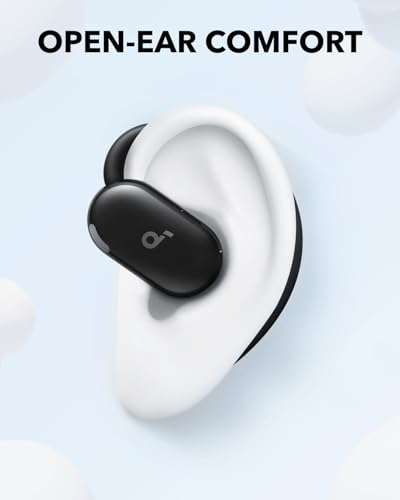
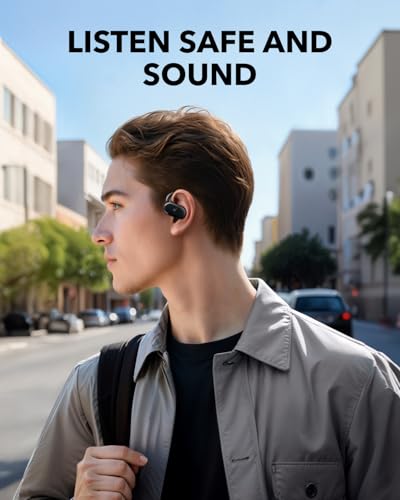
Open ear means the driver sits outside the canal and fires toward it, so the canal itself stays clear. Anker aims this at people who need to stay aware of their surroundings while listening, and names urban life and outdoor activity directly. The attribute table gives the recommended use as running, and unlike most sealing sports earbuds that carry the same advice, an open design is genuinely the right shape for it. Traffic, footsteps and voices reach your ear largely unattenuated.
The hearing safety point is the reverse of the usual one. Because there is no seal and no isolation, ambient noise competes with the music constantly, and the instinct is to raise the volume until the music wins. That is the behavior that damages hearing, and it is more likely on an open design than a sealed one. Anker publishes no volume limit and no listening level warning. If you are raising the volume to hear over a road, the answer is less music rather than more volume. Anyone who instead wants isolation is looking at the wrong product and should consider a sealing set such as the Soundcore Space A40 with adaptive cancellation.
Connection, multipoint and the missing codec
Anker specifies Bluetooth 5.4 in both the title and the attribute table, which is more consistent than most listings manage. Bluetooth 5.4 changes connection stability, power draw and audio profile support. It does not improve sound quality on its own and Anker does not claim it does.
The genuinely useful feature here is multipoint, which Anker names in the product title. Multipoint lets the V20i hold connections to two devices at once, so a laptop call can interrupt music from a phone without a manual repair. It is the single feature that most changes daily use, and most listings in this catalog do not mention it at all, which usually means it is absent. Here it is stated, and that is worth weighing.
No audio codec is named anywhere. There is no SBC, AAC, aptX or LDAC statement in the title, the bullets or the attributes, so SBC is the only transport that can be assumed and no high resolution claim would be supportable. Anker describes the playback as pristine but stops short of a resolution claim, which is the correct restraint. Wear detection is not mentioned. Transparency mode is moot, because an open design is already transparent.
Battery, and which figure belongs where
The attribute table gives Battery Life as 8 hours, which is the bud runtime, and Carrying Case Battery Average Life as 36 hours. The product title quotes 36 hours as the headline playtime. Those two readings of the same number do not agree: either 36 hours is the combined total, in which case the case contributes 28 hours, or the case alone holds 36 hours and the true total is 44. The bullets do not resolve it. The figure a buyer can rely on is the 8 hour bud runtime, and the 36 should be treated as the combined number until Anker states otherwise.
The case is specified at 700 milliamp hours with a 2.5 hour charge time, and the buds charge in 1.5 hours. As always, a quoted playtime assumes a moderate volume, and on this product the LED lights are an additional draw that Anker does not account for separately. Running the tune synced lighting will shorten the 8 hours by an unpublished amount.
Fit, controls and the IP55 rating
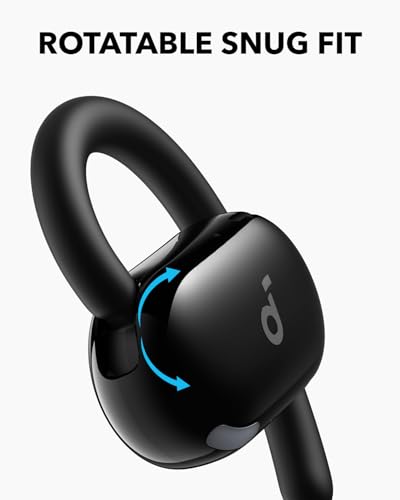
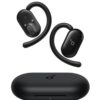
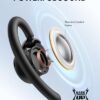
Fit is handled by an ear hook with four adjustable positions, so the driver can be rotated to sit correctly against your ear rather than wherever the hook happens to place it. On an open design this adjustment matters more than tip sizes do on a sealing one, because the distance and angle between the driver and the canal decide how much bass arrives. There are no ear tips, because nothing enters the canal. The buds are made from a PC, ABS and TPU blend, and the case weighs 57.8 grams.
On water, Anker states IP55 in the product title. That is a two position code and it means protected against dust ingress to a limited degree and against low pressure water jets from any direction. In practice it covers sweat and rain. It is not an immersion rating, so the V20i should not be described as waterproof, should not be showered in and should not be swum in. The attribute table then contradicts the title by saying Water Resistance Level: Waterproof with no code, which is the looser and less accurate of the two entries. Trust the IP55. No IP rating covers seawater or high pressure water, and the seals that produce a rating degrade with age.
What the table gets wrong, and the alternatives
Several attribute fields on this listing are import damage rather than specification. Frequency Response reads 20 KHz, a single number where a response is a range, while a separate Frequency Range field correctly reads 20 Hz to 20,000 Hz. Cable Feature reads Detachable on a true wireless product with no cable. The Batteries field claims one C battery is required, which is nonsense for sealed lithium cells. Item Weight is given as 76.4 grams and as 2.69 ounces, both describing the buds and case together rather than a bud, since the case alone is 57.8 grams.
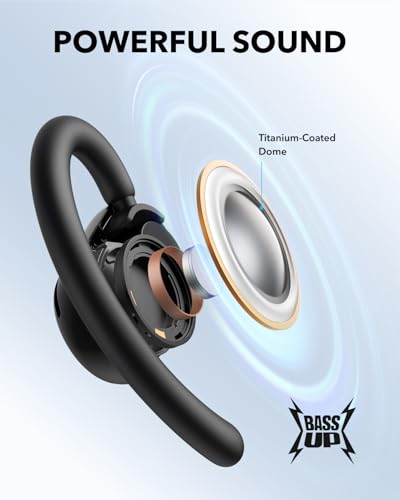
The specifications worth keeping are a 16mm driver with a titanium coated dome, an 11 ohm impedance and Anker’s BassUp processing, which is a tuning mode rather than a hardware claim. The listing showed 4.4 out of 5 from 3,056 ratings, ranked 599th in Electronics and 9th in open ear headphones. For comparison, the King Lucky i121 clip on earbuds take the clip approach instead of the hook, the vnilrgle T15 open ear headphones quote a much longer runtime, and the TOZO open ear model is a lighter alternative. The full group sits in our open ear headphone reviews.
Who should buy it and who should not
Buy the V20i if you want to hear your surroundings while you listen, if multipoint pairing to two devices matters to you, and if 8 hours per charge covers your sessions. The four position hook and the stated IP55 rating are both properly specified, and the listing is unusually honest about the absence of noise cancelling.
Skip it if you want isolation, because there is none by design. Skip it if you need an immersion rating, because IP55 does not provide one. And treat the 36 hour headline with care, because the listing files it as case battery life while the title presents it as total playtime.