


Description
A budget earbud that gets one important thing right
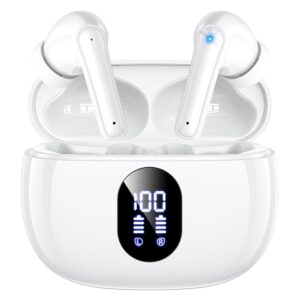
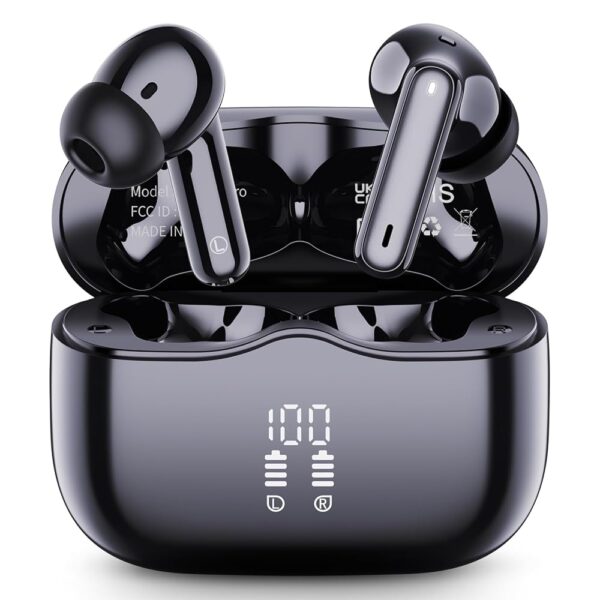
The xinwld A97 Pro is an inexpensive stemmed true wireless earbud with touch controls, three ear tip sizes, four call microphones and a case with separate LED battery displays. Amazon places it around 37th in Electronics and 11th in earbud and in ear headphones, with 4.6 out of 5 across 2,252 ratings, which puts it near the top of this catalog by visibility.
What sets this listing apart from most of its neighbors is small but genuinely useful: xinwld names its codecs, and it states the volume condition attached to its battery figure. Both of those are rare at this price and both make the product easier to evaluate honestly. The rest of the listing has the usual problems, including an IP code that does not exist, and we work through those below.
Connection: the codecs are actually published
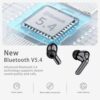
Bluetooth 5.4 is stated, with a claimed working range of 15 meters. The version number itself is not a sound quality specification; it affects connection stability, power behavior and support for newer standards, and xinwld’s own description of it as reducing latency and improving stability is a fair characterization rather than an overreach. Compatibility is quoted back to Bluetooth 4.0 devices.
AAC and SBC, and what that does and does not mean
The second bullet names AAC and SBC. That is more than most listings in this bracket offer and it is worth spelling out. SBC is the mandatory baseline that every stereo Bluetooth device supports, so it is always available. AAC is the codec Apple devices use, so on an iPhone or an iPad you will get AAC rather than falling back to SBC, which is a meaningful difference on Apple hardware. What is not present is aptX, aptX Adaptive, aptX HD or LDAC, which are the codecs associated with higher bitrate transmission on Android. The title’s reference to HiFi stereo therefore has a clear ceiling: AAC and SBC are standard quality codecs and neither delivers high resolution or lossless audio. We are not going to describe this product as high resolution, because the codecs it publishes cannot provide it.
The four microphone ENC system handles calls. ENC is environmental noise cancellation applied to the microphone path, which helps the person you are calling hear you over background noise. It does nothing for what you hear. The structured field correctly lists noise control as Passive Noise Cancellation, confirming there is no active cancellation on this product despite the phrase noise cancelling headphones appearing in the bullets. There is no transparency mode, no companion app, no equalizer, no multipoint and no wear detection.
Battery, quoted with its conditions attached
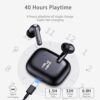
This is the part worth crediting. xinwld quotes up to 8 hours of playback and states the condition: at 80 percent volume. Almost nobody in this catalog does that. A quoted playtime is always a best case, and the variable that moves it most is volume, so a figure with a volume condition attached is far more useful than a bare number. Eight hours at 80 percent is a real specification you can plan around.
The case brings the total to up to 40 hours. Keep the two apart: 8 hours is what you get in your ears before returning the buds to the case, and 40 is the total across roughly four case refills between wall charges. The structured field labeled “Battery Life = 40 Hours” is the combined figure landing in the wrong column rather than a bud runtime. Case charging is quoted at 1 hour over USB-C, and the case carries separated LED battery displays for the case and the buds.
One thing to note about the 80 percent volume condition: it is a useful disclosure, not a recommendation. Eighty percent of maximum on a modern phone is loud, and sustained listening at that level over hours is how hearing damage accumulates. Read the figure as a measurement condition and set your own level lower.
Fit, seal and an IP code that is not a code
Three sizes of silicone ear tips ship in the box, small, medium and large, which is the standard count. Seal decides perceived bass on any sealed earbud and it is the first thing to change if the low end sounds thin. The driver is described as a 13 millimeter vibrating diaphragm, which is large for a true wireless bud, and impedance is published at 32 ohms. Each bud is listed at 2 grams, which is very light if accurate.
The water rating does not exist. The title says IP7 waterproof and the fourth bullet repeats it as an IP7 waterproof grade. IP7 is not a valid IP code. The system uses two digits after the letters, the first for solid particle ingress and the second for water, with an X substituting where a digit was not tested. IPX7 is valid, IP67 is valid, IP7 is not. As published, this product has no water rating at all, and the bullet’s additional claim of being dust proof has nothing behind it either, since a dust rating would require a first digit that has not been provided. The structured field says only “Waterproof”, which is a word rather than a rating.
That leaves you with no protection claim you can rely on. If you intend to train in these, treat them as unrated and ask xinwld for a valid code before buying. As a general matter, no IP rating covers seawater, chlorinated water or pressurized water, and seals degrade with age even when a rating is published properly.
The fields that are wrong, and a use we would rule out
Frequency range is listed as “2.401-2.480 GHz”. That is the radio band Bluetooth operates in, not an audio frequency response, and it has been dropped into a field where a buyer would expect to see something like 20 Hz to 20 kHz. The batteries field says “2 A batteries required”, describing disposable cells that have no place in a rechargeable earbud. The compatible devices field is a long string of iPhone model names padded out to the character limit. The first bullet promises perfect sound quality, which is not a claim any product can support and which we are not repeating. Package dimensions of 4.13 by 3.23 by 1.34 inches describe the shipping box.
On use: this is a sealed in ear design with passive isolation and no transparency mode, so there is no way to admit ambient sound short of taking a bud out. It is not appropriate for cycling or road running where hearing traffic is a safety requirement. If awareness while moving is what you need, our open fit headphone listings are the right category rather than this one.
If you want active noise cancellation and an app at a modest step up, our TOZO NC9 review covers a hybrid cancelling option with six ear tip sizes. For budget alternatives with large feedback samples, see our kurdene S8 review and our TAGRY X08 review. For a longer established option at a similar price, the TOZO T10 review is the sensible comparison. Broader alternatives are in our wireless earbud listings.
Buy or skip
Buy it if you want a cheap earbud where the codec support is actually documented, you are on an Apple device and will benefit from AAC, and 8 hours between case visits fits how you listen. Skip it if you need active noise cancellation, an app or multipoint. Skip it if you need a water rating you can rely on, because IP7 is not a valid code and no valid one is published anywhere on the page. Ask the seller for a proper IP code and a frequency response before ordering if either matters to you.