

Description
Some listings tell you very little. This one tells you almost nothing. The Sony WF-C500 has sold in large numbers and holds a solid customer rating, but the page it sells from carries a one line description, four bullets that are close to content free, and no water rating, no Bluetooth version and no codec anywhere. This review works through what is actually published, names the gaps, and tells you what to confirm before ordering. We do not wear or measure the products covered on this site.
Who this is for
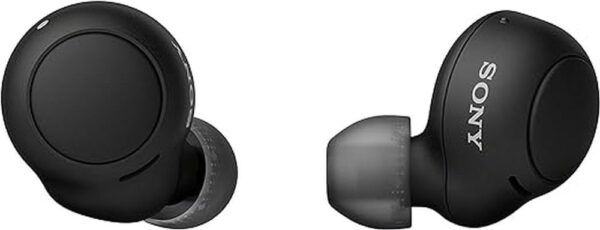
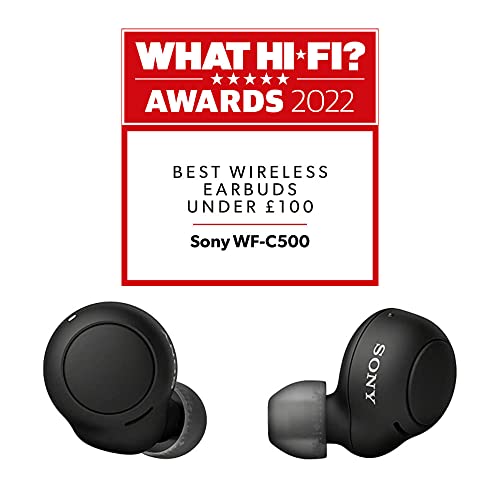
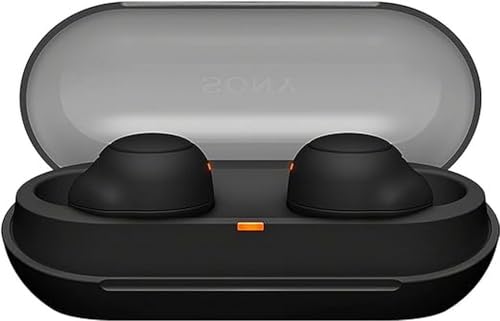
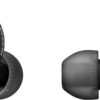
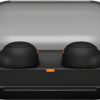
The WF-C500 is a small sealed in-ear bud with no active noise cancellation, supplied with a charging case, hybrid silicone rubber ear tips, a USB cable and printed instructions. Sony records the specific use as music and the recommended use as calling, with an age range of “All Ages.” The controls are touch and voice, and a single press connects to the phone’s voice assistant.
The audience is straightforward: someone who wants a name brand pair of buds for commuting, calls and background listening, and who is not paying for cancellation. On that basis it is a sensible product. What it is not is a specification sheet you can compare against anything, because there is barely a specification sheet here at all.
On the age range field, a note. “All Ages” is a marketplace category value, not a design statement, and no volume limit is published anywhere on this listing. If these are intended for a child, the specification to look for is a stated volume limit, and even then a limit only means something if it cannot be switched off in an app or bypassed by pairing to another device. Nothing here offers that, so we will not describe this product as safe for a child’s hearing. Keep levels low enough that a normal speaking voice nearby stays audible.
What the listing publishes about connection: nothing useful
There is no Bluetooth version stated. There is no codec named. The only connection figure on the entire page is a 10 meter Bluetooth range, which is the ordinary figure for this class of radio and assumes clear line of sight.
That absence has a practical consequence. Sony’s larger models are sold on LDAC, and a shopper moving down the range naturally wonders whether this one carries it. This listing does not say, and we are not going to guess. Because no codec is named, no high resolution or lossless claim can be supported for this product from anything published here, and this listing sensibly makes none. If codec support is your reason for buying, confirm it with Sony before ordering rather than assuming it carries down from the flagship. Our review of the Sony LinkBuds S covers a model with the same omission a tier higher up.
Multipoint pairing is not mentioned. Wear detection is not mentioned. A companion app is not mentioned, which is worth flagging because the short description previously on this page claimed “app support for personalization,” a feature the listing itself never states. If equalizer control through an app is important to you, verify it independently.
Battery: one number in the title, another in the table, and no label
The product title says “Up to 20 Hours Battery.” The specification table says “Battery Life: 10 Hours.” Neither is labelled as bud runtime or as total including the case, and the description does not resolve it, because the description is a single line reading “Stereo (Tws) In-Ear Calls/Music Bluetooth Black.”
The arithmetic points one way: ten hours in the buds and one further full charge from the case gives the twenty hours in the title. That is the most likely reading and it is consistent with a product that carries no cancellation hardware. But the listing does not say it, so treat it as an inference rather than a specification. If the number is decisive for you, ask the seller which figure is the bud runtime.
The one battery figure stated without ambiguity is the charging time: 2.5 hours. Ten hours of bud runtime, if that is what it is, would be a strong figure for a bud this small, and again the absence of cancellation is why. All quoted playtimes are best case numbers at moderate volume and decline as the cells age.
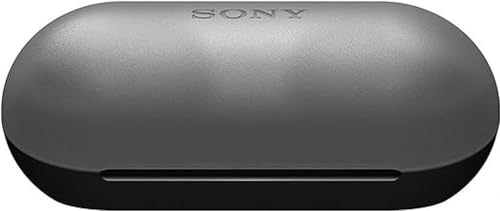
One further claim to verify. The included components field says “Wireless Charging Case,” and one bullet says “Comes in wireless charging case.” Wireless charging is unusual on a case at this level, and it is claimed here without any further detail. If you intend to drop the case on a charging pad, confirm that with Sony first.
Fit, seal and the missing water rating
This is the omission that matters most. There is no IP code anywhere on this listing. No IPX4, no IPX7, no water resistance field in the specification table, no mention of sweat or splashes in the description or in any bullet. That means this page publishes no water protection claim at all, and a buyer should treat these as unrated until Sony says otherwise. Do not exercise in them on the assumption that sweat is covered, because nothing here says it is. If a rating matters to you, buy from a listing that publishes the code.
On fit, the components list names “Hybrid silicone rubber earbuds” but never says how many tip sizes are included. On a sealed bud the tip is what decides both perceived bass and how much outside noise is blocked, so a missing tip count is a real gap. The bullet describing the shape says only “Compact size to fit safely and snugly in ear,” which is an adjective rather than a measurement. No driver size, no impedance and no frequency response figure appears anywhere.
The weight fields are the usual mess: 0.09 kilograms in one row and 3.06 ounces in another are the same quantity, roughly 87 grams, which is the packed weight and not the buds. The 3.15 by 1.97 by 1.97 inch dimensions are the box.
The bullets, and what they are worth
It is worth quoting the full bullet list, because there are only four and one of them is meaningless: “Compact size to fit safely and snugly in ear,” “Comes in wireless charging case,” a third about one press access to the phone voice assistant, and “Can also create or tailor music of choice.” The last of those does not describe anything a headphone does. Taken together the four bullets tell a shopper less than the title does.
What the numbers do say is more encouraging than the copy. Customer feedback sits at 4.2 out of 5 from 20,218 ratings, which is a very large sample and a genuinely good score. The sales rank is given as 14,024th in Electronics and 1,241st in the earbud and in-ear headphone group, the model is WFC500B/BZ, and the date first available is March 2023.
Within Sony’s range, the direct successor is covered in our Sony WF-C510 review, and the cancelling model one step up in our Sony WF-C700N review. If a neckband suits you better than a case, our Sony WI-C100 review covers that shape. For alternatives across brands, start from the true wireless earbud listings or the wider in-ear headphone listings.
Who should buy it and who should not
Buy it if you want a plain pair of name brand buds for calls and commuting, you do not need cancellation, and the twenty thousand ratings behind a 4.2 average carry more weight with you than a specification sheet would. Do not buy it if you need a stated water rating, because none is published. Do not buy it for codec support, because none is named. Do not buy it expecting app control, because the listing never claims any. And before ordering, ask two questions: is the ten hour figure the bud runtime, and does the case really charge wirelessly.