
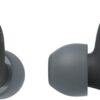


Description
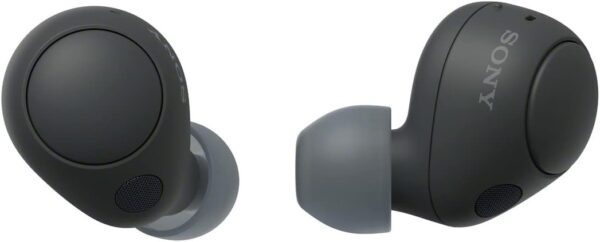
The Sony WF-C700N is the cancelling model in Sony’s entry level true wireless line, sitting above the non cancelling WF-C510 and below the flagship WF-1000 series. Sony states an IPX4 rating and multipoint outright, both of which are genuinely useful and both of which are rare at this level. It also quotes a single battery figure without ever saying whether that figure is the earbuds, the total with the case, or measured with cancellation running, and on a noise cancelling product those three numbers are very different.
Who this pair is for
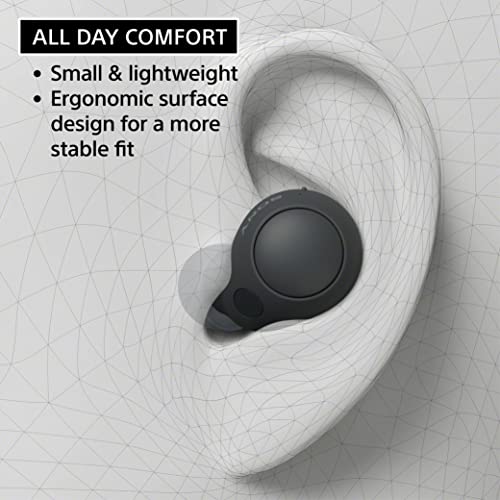
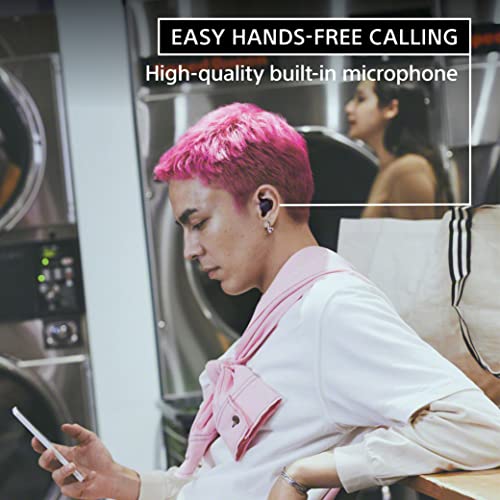
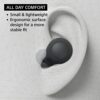
Sony describes small, light earbuds with an ergonomic surface designed for all day comfort, explicitly including smaller ears, which is a real consideration and one most brands ignore. The recommended use is calling and the specific use is music. This is a commuter and office product: active cancellation, ambient sound when you need it, multipoint for a laptop and a phone, and a cylindrical case that fits a pocket.
It is not a training product despite the IPX4 rating, and it is not a road cycling product. A sealing bud running cancellation removes exactly the traffic cues you need outdoors, and Ambient Sound mode reconstructs the world through microphones rather than replacing open ears. If you want the same brand without cancellation, the Sony WF-C510 is the cheaper option, and the Sony WF-C710N is the direct successor.
Connection, and the codec Sony does not name
Bluetooth is given as 5.2. Multipoint connection is stated plainly as quickly switching between two devices at once, which is the feature that changes daily use more than almost anything else on a specification sheet and which most listings in this catalog never mention.
No codec is named anywhere on this page. Not SBC, not AAC, and not LDAC, which is Sony’s own high resolution codec and appears on its more expensive models. Because no codec is stated, SBC is the only safe assumption, and nothing here supports a high resolution or lossless description. This review does not make one.
What Sony advertises instead is DSEE, its Digital Sound Enhancement Engine, described as boosting the quality of compressed music files. DSEE is processing applied inside the earbuds after the signal arrives. It estimates and restores high frequency content that lossy compression discarded. It is not a codec, it does not increase the data crossing the Bluetooth link, and it is not a high resolution claim. Anyone reading DSEE as an equivalent to LDAC is reading it wrong.
The latency figure is not credible
The specification records an audio latency of 10 milliseconds. No Bluetooth audio link achieves that. Even codecs specifically designed for low latency operate in the tens of milliseconds, and standard SBC or AAC paths typically land between 100 and 200. Treat this field as an import error rather than a specification. For a figure that is at least plausible, the EarFun Air Pro 3 publishes 55 milliseconds.
Battery: one number, and no explanation of what it measures
The fifth bullet says up to 15 hours of battery life with quick charging, and the structured battery life field repeats 15 hours. That is the whole disclosure.
On a cancelling earbud that single figure is not enough. It does not say whether 15 hours is the earbuds alone or the total including the charging case, and it does not say whether it was measured with cancellation on or off. Those four possible readings differ by a factor of two or more. Cancellation runs microphones and processing continuously and always costs runtime, so a figure quoted with cancellation off will not survive contact with the way you actually use the product.
This omission is notable because Sony’s own WF-C510 listing, covered elsewhere in this catalog, splits its figures cleanly into 11 hours in the buds and 22 with the case. The same company has done it properly on a cheaper model and not here. Quick charging is quoted at 10 minutes for up to 1 hour of playback. The structured charging time field reads 15 hours, which is the playback figure dropped into the wrong slot and should be ignored.
Cancellation, fit and what IPX4 covers
Sony describes Noise Sensor Technology and, in the bullets, invites you to turn off your surroundings. The description goes further and says block out the world. Neither is achievable. Active cancellation reduces constant low frequency noise such as engine and cabin drone effectively, and does considerably less against speech, keyboard noise or sudden sounds. There is no decibel reduction figure and no named test standard on this page, so there is no number to compare against any competitor.
Ambient Sound mode uses feedforward microphones to pass surrounding sound through, and the physical button switches between cancellation and ambient with a single push. That is a good implementation: a button works with gloves and in the rain in a way a touch panel does not. Note that the structured specification contradicts the bullets here, recording the control method and controller type as touch when the bullets describe button operation.
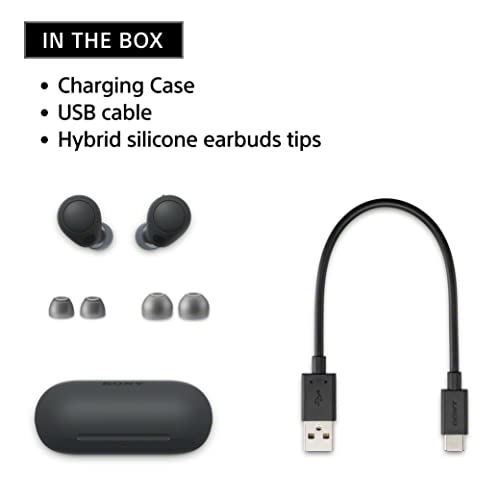
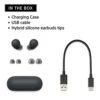
Ear tips are hybrid silicone rubber, and the components list gives the sizes as SS, M and LL, two pairs each. That is an unusual set: the conventional small and large sizes are absent, so the jump between the sizes offered is wider than normal. If you sit between them, seal will suffer, and seal decides both the perceived bass and how much work the cancellation has to do.
The water rating is stated as IPX4, and Sony describes it correctly as splashes and sweat. IPX4 means protection from splashing water from any direction. It is not immersion, it is not a swimming rating, and the X means the dust digit was never tested. IP seals also degrade with age and repeated sweat exposure, and no consumer rating covers seawater or pressurized water.
Specification errors and what else is missing
The frequency response field reads 2.4 GHz, which is the radio band rather than an audio response. The batteries field claims three AAA batteries are required and included, which is nonsense on a rechargeable earbud. Driver size is not published anywhere, which is a real omission on a product whose main competitors all state theirs. Item weight is 1.1 ounces, which is the package. Country of origin is Vietnam.
Wear detection and auto pause are not mentioned. App support is not mentioned in the bullets, so any assumption about equalizer adjustment should be verified before purchase. Sony records the sales position as ranked 1,817th in Electronics and 264th in earbud and in ear headphones, on a 4.1 star average across 3,436 ratings since April 2023. For the step up within Sony’s own range, see the WF-1000XM5, and the older non cancelling WF-C500 sits below. All appear in our true wireless earbud listings and the wider earbud headphones section.
Who should buy it, and who should not
Buy the WF-C700N if you want cancellation, genuine multipoint and a stated IPX4 rating in a small, light housing from a brand with a real track record. It is a sensible commuter pair. Skip it if you need to know how long it runs with cancellation engaged, because Sony publishes one undifferentiated 15 hour figure. Skip it too if you were buying on high resolution audio, because no codec is named on this listing at all.