


Description
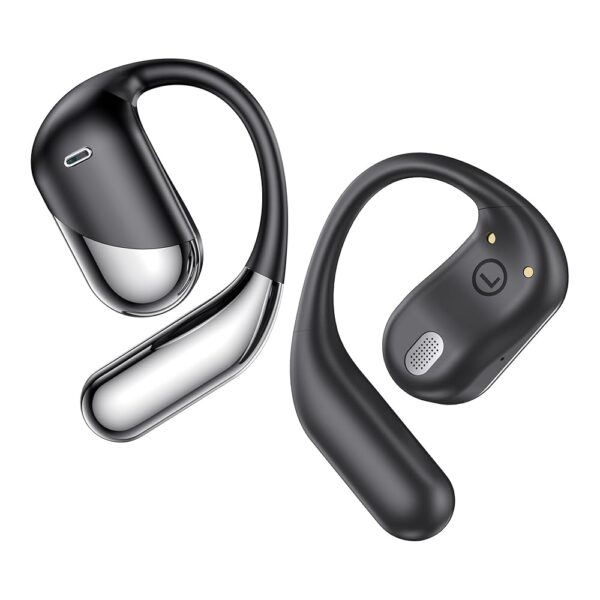
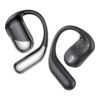
The Paekole YYK-Q16 is a translation device that also plays music, ASIN B0F1TJV5LW, listed since March 2025 in classic black. It ranks 1st in Amazon’s Electronic Foreign Language Translators category and 333rd in Office Products, with a 4.6 star average across 125 ratings. That category placement is the honest description of what this is. It is an open ear, hooked wireless earbud whose main function is real time two way translation through a phone app, and it should be judged first as a translator and second as a pair of earbuds.
What it claims to do, and what to check before relying on it
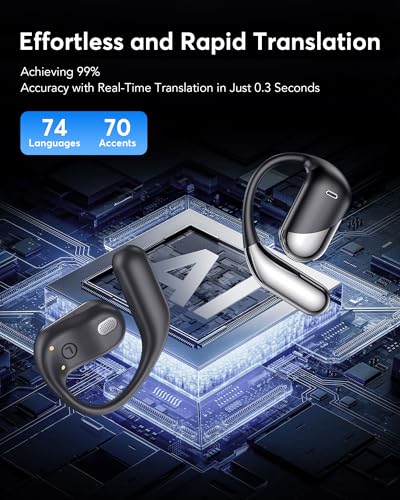
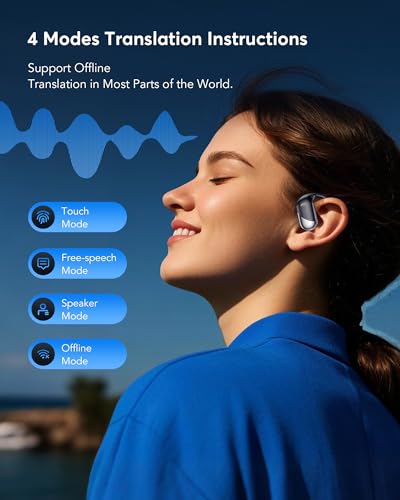
The listing claims real time two way translation across 144 languages and accents, with modes for face to face conversation, simultaneous interpretation, live recording, video calls and voice calls. During a call the app generates an invitation link so the other party can join through a browser. It also advertises an AI assistant, AI chat and AI image generation, which are app features rather than earbud features.
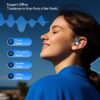
Two things are not stated anywhere on this page and both matter. First, nothing says whether translation runs on the device or in the cloud, and a 144 language model does not run locally on an earbud, so an internet connection is almost certainly required. If you are buying this for travel, ask the seller whether it works offline and what happens without a data connection, because a translator that needs roaming data is a different product than one that does not. Second, nothing states whether translation is free for the life of the product or whether a subscription applies after a period. Neither the listing nor the specification mentions ongoing cost.
Also note the model naming. The specification says YYK-Q16, and the third bullet calls the product “the Q16Pro AI H3”, which is a different designation. Confirm which unit ships.
The open ear design, and what it means
This is an open ear product. The buds hang on soft silicone ear hooks and sit outside the ear canal rather than sealing it, and each weighs 8 grams. That has two direct consequences. You keep your awareness of your surroundings, which is genuinely useful for a translator because you need to hear the person in front of you as well as the translation. And you get less bass and much less isolation than a sealed bud, because nothing is blocking the outside world.
The specification block then lists “Noise Control: Active Noise Cancellation”. That claim does not hold. Active cancellation works by generating an opposing waveform inside a sealed cavity, and an open ear design has no seal to work with. Not one of the seven feature bullets mentions ANC. The bullets describe microphone side noise reduction for voice pickup, which is a call feature and a translation accuracy feature, not cancellation for the listener. Read the ANC field as wrong. If you want an open fit from a listing that describes itself consistently, the TOZO OpenEgo and the HUAWEI FreeClip are the comparisons, and the open ear category collects that shape.
The open fit carries its own listening caution. Because nothing is blocked, you will be tempted to raise the volume in a noisy street or a busy cafe to hear the translation over the room, and that is where the risk sits. Keep the level where a nearby conversation is still audible, and move somewhere quieter rather than turning it up.
Connection and audio hardware
Bluetooth 5.4 is stated with a range of 10 meters, roughly 33 feet. Version 5.4 improves connection stability and power efficiency and adds groundwork for LE Audio; it does not raise sound quality by itself, so the bullet promising “lightning-fast data transfer speeds” is describing the standard rather than this product.
No codec is named anywhere on this page. There is no SBC, AAC, aptX or LDAC claim, so assume SBC only, the baseline every device supports, and treat the “HD Audio Quality” heading in the third bullet as marketing. The drivers are described as a 14.2 millimeter diaphragm speaker with an impedance of 36 ohms, which is on the higher side for an earbud and is one of the few real audio figures published. Four microphones handle voice pickup, which is the specification that matters most here since translation accuracy depends on the microphone hearing you clearly.
Control is listed as App based, with touch controls on the buds for music and calls. Multipoint pairing, transparency mode and wear detection are not mentioned, and on an open design transparency is unnecessary anyway.
Battery: 10 hours per bud, 60 in total
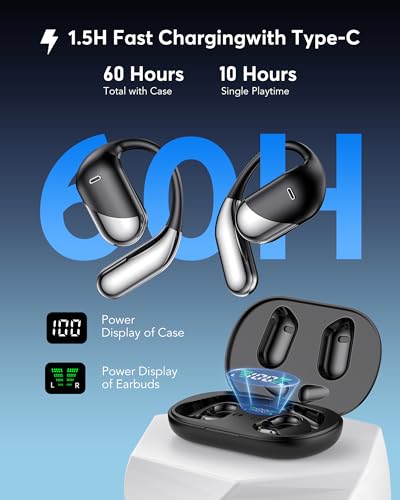
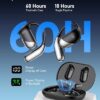
The fifth bullet publishes both halves properly: 10 hours of playtime per charge and an additional 50 hours from the charging case, for 60 hours in total. Ten hours per charge is long, which matters for this product more than for an ordinary earbud, because a translation session on a travel day can run all day and you cannot pause a conversation to charge.
What the listing does not say is whether the 10 hour figure was measured while translating or while playing music. Translation keeps the microphones live and a data connection working, and it will draw materially more power than passive playback. Ask the seller for a translation runtime specifically. Every quoted playtime is a best case at moderate volume, and the “Energy Lock technology” named in the same bullet is a brand phrase with no technical definition behind it.
Water resistance, contents and the fields that conflict
The fourth bullet states IPX7, which is an immersion rating covering fresh water to one meter for thirty minutes under laboratory conditions. The specification field separately says only “Waterproof”, which is a phrase and not a code. IPX7 never covers seawater, chlorinated pool water or pressurized water, seals degrade with age and heat, and the charging case almost never carries the rating that the buds do. It is a strong claim for a device with a microphone array and it is worth confirming.
The box contains the charging case, two earbuds, a USB-C cable and a manual, itemized properly. Package weight is 5.6 ounces. Ear Placement reads “Open Ear” while Form Factor reads “Over Ear” on the same page, which is the usual import confusion rather than a description of an over ear headphone.
As a music product rather than a translator, this is competing outside its class. If music is the main use, sealed sets in the true wireless earbuds section or unsealed ones like the TOZO OpenBuds give more for the money. The PSIER SP06 is the closer open ear comparison on fit.
Who should buy this, and who should not
Buy it if translation is the reason you are shopping, you want the translator and the earbuds to be the same device, and 10 hours per charge with a 50 hour case reserve fits a travel day. Ranking first in Amazon’s translator category with 125 ratings behind it is a meaningful signal for this use.
Do not buy it as a music earbud first, because an open fit with no named codec is not a value proposition against sealed rivals at the same price. Do not believe the Active Noise Cancellation field, which an open ear design cannot deliver. And before ordering, confirm three things with the seller: whether translation works without an internet connection, whether any subscription applies, and what the battery figure is while actually translating.