
Description
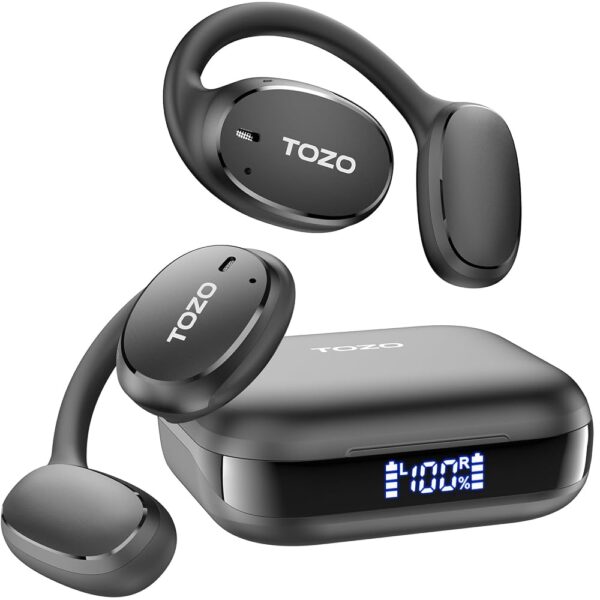
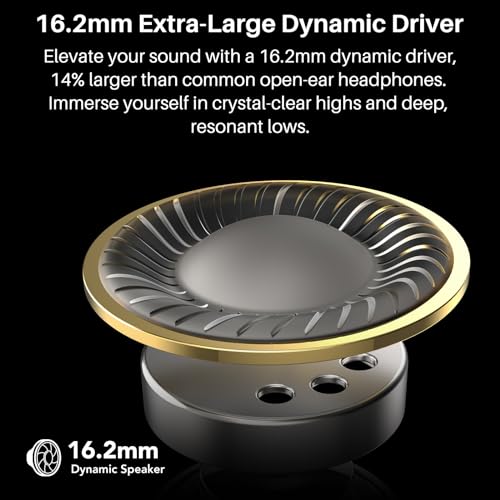
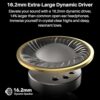
The TOZO OpenEgo is an open ear headphone, and that single design decision governs everything worth saying about it. The earpieces sit outside the ear canal on a hook rather than sealing inside it, which changes what you hear, what you leak to people nearby, and how much bass the 16.2 millimeter driver can actually deliver. TOZO publishes a genuinely useful set of numbers here, including a latency figure and a separate bud runtime, alongside several specification fields that are physically impossible.
What open ear means, and who it suits
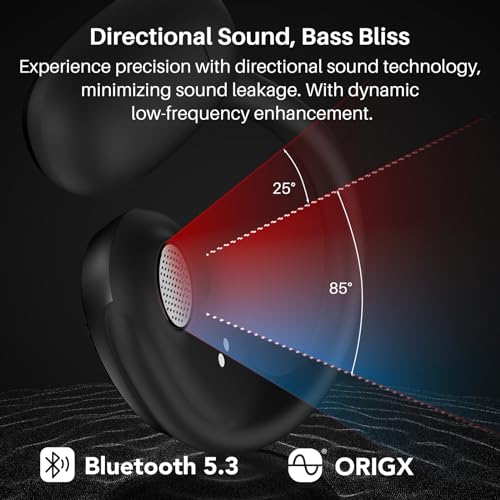
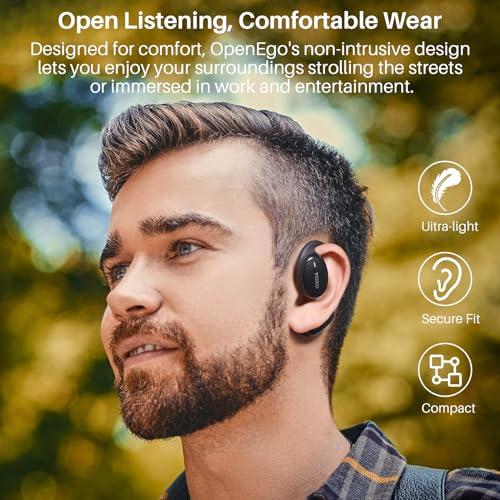
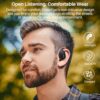
Nothing goes into your ear canal. The driver fires toward the ear from outside, held by a hook over the top of the ear, and TOZO describes the result as being able to sense outside sound at all times. That is accurate and it is the whole point. For a runner on a road or a cyclist on a shared path, keeping ambient sound intact is a safety property that no sealed earbud with a transparency mode fully matches, because transparency is a microphone reconstruction and open ear is simply your own hearing.
The trade is real in both directions. Without a seal you get much less bass and far less isolation, so the OpenEgo will sound thin next to a sealing bud and will be drowned out on a subway. Sound also leaks outward, so people near you can hear your music. The second bullet lists driving among the suitable activities, which is a step too far: wearing headphones while driving is restricted in many places and reduces your ability to hear your own vehicle. The recommended uses field goes further still, listing motorcycling, disc jockey use, radio communication and studio work. None of those are credible for a Bluetooth open ear sport bud, and the studio and monitoring entries are ruled out by wireless latency alone.
Connection, and one number most brands hide
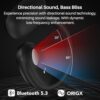
Bluetooth is given as 5.3 with a 10 meter range. More usefully, TOZO publishes an audio latency figure of 45 milliseconds. Almost nothing else in this catalog states latency at all, and 45 milliseconds is low enough that video lip sync should not be obviously wrong. No test method is named, so treat it as a manufacturer figure, but publishing it is still better practice than the vague low latency claims that appear everywhere else.
No codec is named
TOZO does not state a single codec anywhere on this listing. Not SBC, not AAC, not aptX, not LDAC. SBC is therefore the only safe assumption, since it is the mandatory Bluetooth baseline. The first bullet claims high fidelity audio from a driver with a motor coil around 30 percent larger than conventional types, tuned by what TOZO calls OrigX Acoustics. Those are hardware and voicing descriptions, not transmission specifications, and none of them supports a high resolution or lossless claim. On an open ear design the codec matters less than it would elsewhere, because the acoustic limits of an unsealed driver dominate, but the gap in the specification is still a gap.
App support is real and unusually deep for the price. TOZO states 32 EQ modes selectable in its own app, along with custom equalizer adjustment. That is the practical answer to the missing bass on an open ear design, within the limits of what an unsealed driver can produce.
Battery: 15 hours in the buds, 80 with the case
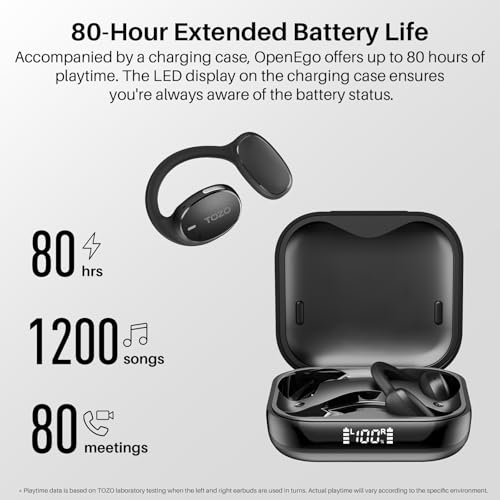
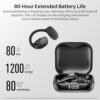
The specification records battery life as 15 hours, which is the earbud figure, and the bullets state that the charging case brings the total to 80 hours. That is a clean split and a strong bud runtime, well above the 8 to 10 hours typical of this bracket. The 80 hour headline still requires you to carry the case.
The structured fields around it are broken. Carrying case battery average life is recorded as 80 hours, which is the combined total copied into a field meant for the case alone. Case battery capacity reads 600 amp hours, which would be a vehicle battery; the intended figure is almost certainly 600 milliamp hours. The case dimensions are recorded as roughly 20 by 34 by 8 millimeters, which is smaller than the earbuds it is meant to hold. Item weight appears as 0.02 grams and 0.001 ounces, both impossible. None of these should be read as product information.
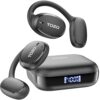
TOZO also frames the 80 hours as about 1,200 songs or 80 one hour meetings, which is a marketing conversion rather than a specification. Charging is over a supplied USB-C cable, and the case has an LED battery display.
Fit, water rating and a hearing note
The OpenEgo ships with a pair of ear supports to improve retention during exercise, and because there is no ear tip, there is no tip size question at all. Fit depends entirely on the shape of your outer ear and the hook, which makes open ear designs less adjustable than sealing ones. There is nothing to swap if the fit is wrong.
Water resistance is stated as IPX5 in the third bullet, described as sweat resistant. IPX5 is a real code covering low pressure water jets from any direction, which comfortably covers sweat and rain. It is not an immersion rating and it is not a swimming rating, so do not take it into water. The structured specification records only water resistant with no code, so the bullet is the only place the rating appears. No consumer IP code covers seawater or pressurized water, and seals degrade with age and sweat exposure.
One hearing related point deserves naming. The age range field reads ALL and no volume limit is published anywhere. Because an open ear design has no seal, background noise is never blocked, and the natural response in a loud environment is to raise the volume until the music wins. That is the exact behavior that damages hearing over time. The honest use of an open ear headphone is at moderate volume in a moderate environment, where you want to hear both the music and the world. It is not a tool for listening loudly in a noisy place, and it should not be treated as suitable for a child on the strength of an age range field alone.
What else the listing does not publish
Multipoint is not mentioned. Wear detection and auto pause are not mentioned. Dual microphone call noise reduction is claimed but no figure or standard is attached. The noise control field reads sound isolation, which is not accurate for an unsealed design, and the ear placement field reads in ear while the form factor field reads open ear, which is the same contradiction stated twice. The frequency response field reads 20 KHz as a single value, which is not a response specification. Sensitivity is 100 dB and impedance is 16 ohms, both plausible. The batteries field claims lithium metal cells, which are non rechargeable and cannot be what is inside a rechargeable earbud.
TOZO records the sales position as ranked 3,470th in Electronics and 55th in open ear headphones, on a 4.3 star average across 3,736 ratings. That is a substantial history for the format. Worth noting as an oddity: the identifier on this listing dates from a much earlier product generation than the January 2024 availability date, which usually means an existing listing was reused.
For alternatives in the same format, see the TOZO OpenBuds and the TOZO OpenEarring from the same brand, the Shokz OpenFit, and the Soundcore AeroFit 2. All sit in our open ear headphones section, and our wider true wireless earbud listings cover the sealing designs this one deliberately avoids.
Who should buy it, and who should not
Buy the TOZO OpenEgo if you train outdoors and want to keep your hearing of traffic intact, you value a published 15 hour bud runtime and a published latency figure, and you accept that an open design cannot produce deep bass. Skip it if you want isolation on a commute, if you need immersion grade water protection, or if you want a confirmed codec, because none is stated. And do not use it as a way to listen louder in a noisy place.