


Description
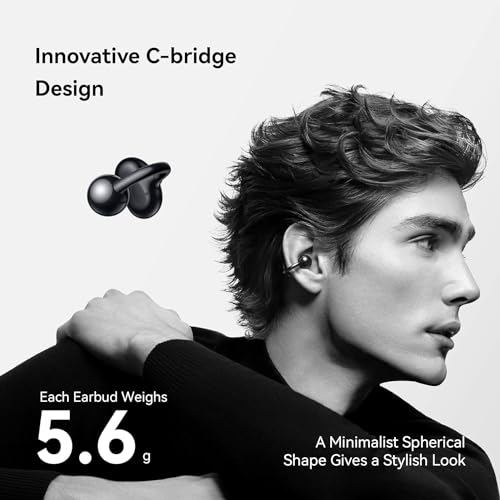
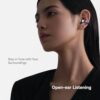
The Huawei FreeClip is a different kind of product from almost everything else in this catalog, and the difference is structural rather than cosmetic. It does not go in your ear canal. A small spherical acoustic ball sits in front of the ear, a comfort bead sits behind it, and a curved bridge made of nickel titanium shape memory alloy clamps the two together over the ridge of your ear. Nothing seals, nothing is inserted, and the ear canal stays open. Everything below comes from the published listing. We do not wear or measure the products covered on this site.
What an open ear design actually changes
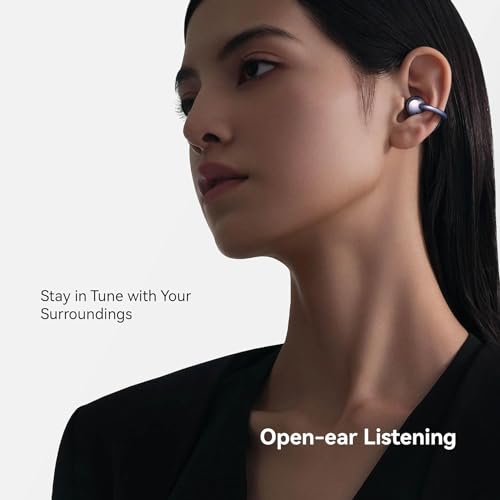
Because nothing blocks the canal, you hear the room at all times without switching a mode on. For walking, running outdoors and cycling, that is the safety argument for this shape: traffic, footsteps behind you and announcements reach your ears by the normal path rather than through microphones and processing that can fail, run out of battery or introduce delay. Huawei’s own bullet puts it as staying “aware of changes in ambient sounds, whether in an office or doing exercise, thanks to the open-ear design.”
Two things you give up. Bass depends on a seal, and there is no seal here, so low frequencies will be thinner than any tipped earbud delivers, and the listing’s own answer to that is a large 10.8 millimeter dual magnet driver rather than any acoustic trick. And an open design leaks: Huawei says leakage is minimized by “a sophisticated reverse sound waves system built inside the acoustic ball,” which is a design claim with no measurement attached. Assume people close to you can hear something, particularly in a quiet office.
There is a hearing point that follows directly. Because these do not block outside noise, the natural response in a noisy street or a train is to turn the volume up until the music wins, which is exactly the wrong instinct. An open design is a reason to listen at lower volume in noisy places, not higher. Keep the level low enough that a normal speaking voice nearby is still audible, and take breaks.
One contradiction on the page should be named rather than smoothed over. The specification table records “Noise Control: Adaptive Noise Cancellation.” Nothing in the title, the description or the bullets claims active noise cancellation, and the entire design premise is that sound is not blocked. A product with no seal has very little for a cancellation circuit to work against. Treat that field as an import error, not as a feature.
Connection and codecs
No Bluetooth version is published anywhere on this listing. The specification table gives a 10 meter range and lists compatibility with cellphones, tablets, laptops and desktops. No codec is named either: no SBC, no AAC, no aptX, nothing.
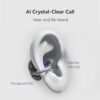
The title advertises “AI Crystal Clear Sound,” which is a marketing phrase rather than a specification, and with no codec published there is no basis on this page for any high resolution or lossless claim. The listing does not attempt one, which is the correct outcome. If codec support matters for your phone, ask Huawei before ordering.
Multipoint pairing is not mentioned. Wear detection is not mentioned. What is published is a genuinely useful convenience: the earbuds are interchangeable, with “self-adaptive left-right audio channels, meaning you can wear either earbud on either ear.” There is no left or right to sort out in the dark.
Battery: a claim with no number behind it
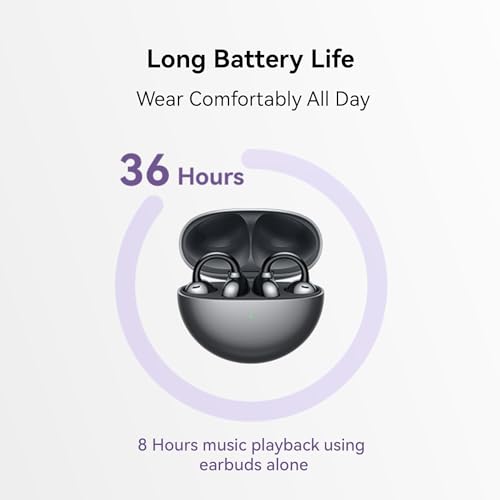
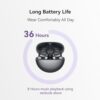
This is the clearest failure on the page. The product title advertises a “Long Lasting Battery.” The listing then publishes no battery figure at all. No bud runtime, no total with the case, no charging time.
The only related number is a specification row reading “Charging Time: 10 minutes,” which is almost certainly a fast charge interval that has been dropped into the wrong field, since nothing charges fully in ten minutes and no fast charge claim appears elsewhere to explain it. A battery claim in a product title with no hours anywhere on the page is not something a buyer can act on. Ask the seller for both figures before ordering, separated: hours in the ear, and hours in total with the case.
Fit, weight and the water rating
The water disclosure here is the best in this catalog and Huawei deserves credit for it. The description reads: “IP54 Charging case: not waterproof. IP54 dust- and water-resistance is only applicable to the earbuds themselves, not the charging case. This device is splash, dust, and water resistant in normal conditions. It was tested under controlled laboratory conditions and got an approved rating of IP54 under IEC standard 60529. Splash, dust, and water resistance are not permanent, and the performance may deteriorate due to daily wear-and-tear. Avoid charging the device in damp environments. Liquid damage is not covered under warranty.”
That paragraph gives the code, names the standard, limits the rating to the buds rather than the case, states that protection degrades with use, and says liquid damage voids the warranty. IP54 means dust protected and resistant to splashing water from any direction. It is sweat and light rain protection. It is not an immersion rating, and no IP code covers seawater or pressurized water in any case.
On fit, there are no ear tips to size because the design does not use them, so fit is a matter of how the bridge sits on your particular ear. Huawei says the bridge is shaped from “10,000+ global human ear data,” which is a design statement rather than a size chart. Each earbud is given as about 5.6 grams, which is a real per bud figure and rare on these pages. The impedance is listed as 7.5 ohms and the frequency range as the boilerplate 20 Hz to 20,000 Hz with no tolerance figure. The item weight of 6.4 ounces and the 4.37 by 3.94 by 1.85 inch dimensions describe the retail package. The components field lists a “Cassette,” which is a translation artifact for the charging case.
How it is ranked, and the alternatives
Customer feedback sits at 4.4 out of 5 from 98 ratings, which is a good score on a small sample. The sales rank is given as 13,219th in Electronics and 260th in On-Ear Headphones, and that second placing is a miscategorization worth noting: the form factor field also says “On Ear,” when this is an open ear clip that touches neither the canal nor the outer ear in the way an on-ear headphone does. The model number is T0017 and the date first available is March 2024.
For alternatives in the same open shape, our SHOKZ OpenFit review covers an ear hook design, our Bose Ultra Open Earbuds review covers a competing clip, our CXK EP03 review covers a cheaper clip on, and our Soundcore AeroFit 2 review covers a hooked sports option. The full shelf is in our open-ear headphone listings, and the sealed alternatives sit in the true wireless earbud listings.
Who should buy it and who should not
Buy it if you want to hear your surroundings while you listen, sealed buds are uncomfortable for you, and a 5.6 gram clip that fits either ear appeals more than a tip you have to push in. The IP54 disclosure and the per bud weight make this one of the more honest pages in this catalog. Do not buy it for bass, because no open design can deliver what a sealed one does. Do not buy it for a quiet plane or train, because there is nothing here to block noise, and disregard the specification row claiming adaptive noise cancellation. Do not put the case anywhere damp, because Huawei says plainly that it is not rated. And ask for the battery figure in hours before ordering, because the title promises a long lasting battery and the page never states one.