


Description
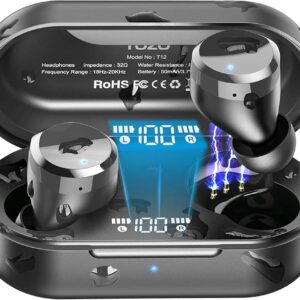
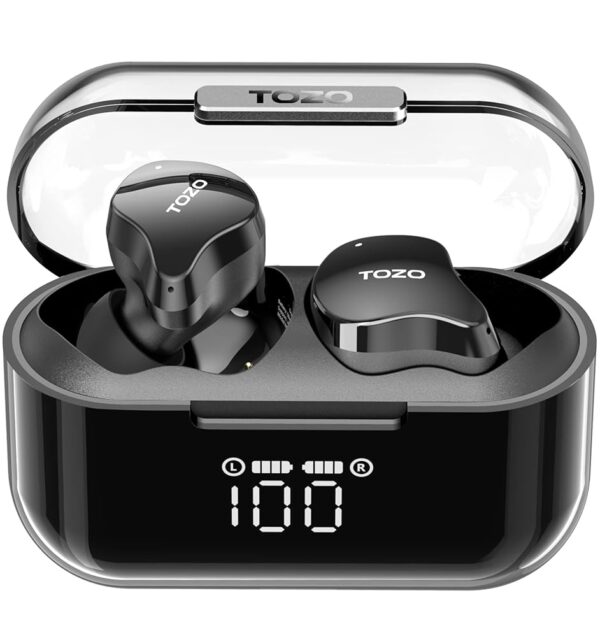
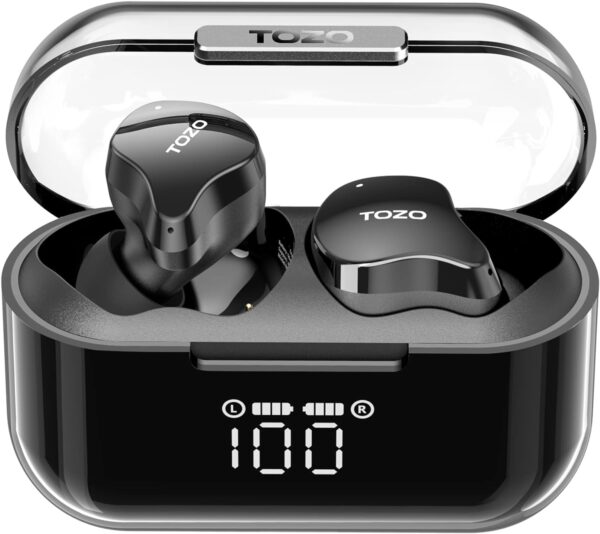
The TOZO T18 is a sealed true wireless earbud with a transparent charging case, an LED battery display, four microphones and a claimed IPX8 water rating. TOZO also refers to it as the Crystal Buds throughout the feature bullets, so the same product carries two names on the same record. It publishes one battery figure with a stated test condition, which is rare enough in this catalog to be worth leading with.
The battery figure, and why the condition matters
TOZO states that the earbuds reach 9 hours on a full charge “while listening volume 50%,” and that the buds and case together achieve total endurance of more than 40 hours.
That volume condition is the useful part. Almost every playtime figure in this catalog is quoted with no listening level attached, which makes it a best case with no way to judge how optimistic. Stating fifty percent volume gives the number a reference point. It also tells you the direction the figure moves: play louder and you get less, and the difference on a small battery is substantial rather than marginal.
Nine hours governs a single sitting. Forty hours is the combined figure across recharges, which is what the case adds rather than what the buds do. Charging is supported both wirelessly and by the supplied USB A to USB C fast charging cable, though no charge time is published for either path.
Who these suit
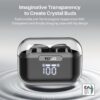
These are for someone who wants a plain sealed bud with deep app-side equalization and a case that shows its remaining charge as a number rather than as indicator lights. The transparent case is a styling choice built around what TOZO calls a panoramic space capsule design, showing the internal contours of the buds and the case.
The app offers 32 preset equalizer settings and a feature TOZO calls the EQ Zone, where users share their own curves with others. Thirty-two presets is a generous count, and a sharing function implies an active app rather than an abandoned one, which is worth checking before purchase on any product whose sound depends on software.
The driver is small, so the seal matters
The driver is a 6 millimeter dynamic unit. That is at the small end for an in-ear, the same size TOZO uses on the T6, and well under the 10 millimeters on the T12. A small driver has less area to move air with, so low frequency output depends heavily on a good seal, and any leak takes the bass with it.
This listing does not state how many ear tip sizes are supplied, which is a real gap on a product whose sound quality is that dependent on fit. No frequency response, impedance or sensitivity figure is published either, so 6 millimeters is the only acoustic number on the record.
There is no active noise cancellation and no transparency mode. Isolation is entirely passive.
How they connect, and the Hi-Fi claim
Bluetooth 5.3 is listed. A version number governs connection stability, power draw and available feature sets, not sound quality, and 5.3 is not audibly superior to 5.2 for that reason alone.
No codec is named
One bullet promises “High-Fidelity Audio” and another says the original sound is recovered exactly. No audio codec appears anywhere on this record. There is no AAC entry, no aptX and no LDAC. Where nothing is named, SBC is the only codec that can be assumed, because SBC is the baseline every Bluetooth device supports.
That means the high fidelity wording is unsupported by the published specification. It is a claim about intent rather than about what reaches your ears, and any genuine high resolution path would require both the earbud and the phone to support the same higher bandwidth codec, which this listing does not establish for either end.
Multipoint and wear detection are not mentioned.
The microphone count contradicts itself
One bullet states the buds are “equipped with 4 microphones to reduce ambient noise through Dual-microphone AI algorithm.” Four microphones and a dual-microphone algorithm are not the same claim, and the sentence contains both. It is possible that four microphones exist with two per side feeding a two-microphone algorithm, but the listing does not say that, and we are naming the inconsistency rather than resolving it.
Whichever count is right, this is call processing. It cleans up the outbound signal so the person on the other end hears less of your background, and it does nothing for what you hear. The listing’s phrasing about reducing ambient noise sits inside a bullet about call quality, but it reads easily as listener-side cancellation. It is not.
The IPX8 rating
TOZO states IPX8 with a waterproof nano coating, describing protection from heavy rain and sweat during intense workouts. IPX8 is the highest code on the water axis and means continuous immersion beyond one meter under conditions the manufacturer specifies. This listing does not specify them, which is normal and worth knowing: unlike IPX7, which has a defined one meter and thirty minute test, IPX8 leaves depth and duration to the maker.
The X in the first position means dust protection was not tested rather than that it is absent. No rating is given for the charging case at all, and on sets that rate both parts the case is normally far weaker.
Three limits apply regardless. No IP rating covers seawater, which corrodes in a way fresh water does not. No IP rating covers pressurized water, so a shower head is outside it even at IPX8. And ingress protection degrades over time as seals age and as sweat residue and debris collect around the mesh and the charging contacts.
What is missing, and what to compare
This record carries no structured attribute data, so there is no weight, no dimensions, no case capacity, no charge time, no latency figure, no included components list and no ear tip count. The source category path degrades into reviewer names, so the category data is unusable. Everything above comes from the manufacturer’s own bullet points.
Within our own listings, the TOZO E2 publishes a 10 millimeter driver, a sensitivity figure and a latency figure, and the TOZO NC2 is the model to look at if active cancellation and wear detection are what you want. The wider wireless earbud listings we track are where battery splits and ingress codes can be compared directly.
Who should buy them, who should not
Buy the T18 if a 9 hour runtime with a stated volume condition, a 32 preset app and a numeric battery display cover what you want, and if the IPX8 rating suits where you use them. Skip them if you need active cancellation, if a 6 millimeter driver is smaller than you had in mind, if you want the tip sizes confirmed before ordering, or if you were reading the high fidelity wording as a specification. It is not one here.