








Description
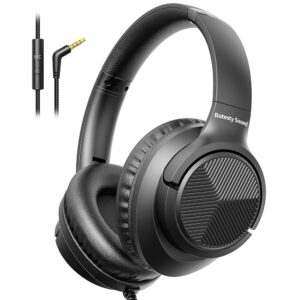
The KVIDIO over-ear Bluetooth headphone is a budget wireless headset built around dual 40mm drivers, a quoted 65 hours of playback, a built-in microphone and a wired fallback over an auxiliary cable. The listing does not publish a model number of any kind, which is the first thing to note: the product is identified only as “KVIDIO Bluetooth Headphones Over Ear,” so if you need to match a replacement part or check a firmware version later, there is no identifier here to work from.
The imported specification block contains five fields in total: brand, color, ear placement, form factor and a 32 ohm impedance. Everything else on this page comes from four marketing bullets. That is a very small evidence base for a purchase, and the sections below separate what is actually stated from what is only implied.
Who this is for
This is a travel and desk headphone for someone who wants very long battery life and a cable option, and who is not buying on brand. KVIDIO names travel, work and cellphone use. The design is a folding over-ear with memory-protein foam earmuffs and an adjustable headband, which is the standard budget formula and a sensible one: over-ear cups seal around the ear rather than pressing on it, so they are more comfortable over long sessions than an on-ear design.
It is not a workout headphone. No IP rating is published and there is no water resistance field in the record at all, so there is no stated protection against rain or sweat and we will not invent one.
Connection, and what “HiFi Stereo” is worth here
KVIDIO lists Bluetooth 5.3. That is a chipset generation, and what a newer version genuinely changes is connection stability, power consumption and eligibility for newer low energy audio features. It is not a sound quality specification, and no listing should be read as implying that it is.
The product title claims “HiFi Stereo Sound” and the first bullet describes “premium sound quality” that replicates “a concert hall-like sound.” No codec is named anywhere in this listing. There is no mention of SBC, AAC, aptX or LDAC. Over Bluetooth, what actually reaches the drivers is decided by the codec both ends negotiate, and with none published, SBC is the only assumption you can safely make. The high fidelity language is therefore unsupported by the published specification. It is worth saying plainly that a codec only functions when the phone and the headphone both support it, and this page tells you nothing about either half of that.
The listing also does not mention multipoint pairing to two devices at once, transparency mode, wear detection, an app or a companion equalizer. Where a listing says nothing about a feature, treat it as absent.
The wired option is the useful part
An auxiliary cable is listed, and KVIDIO states you can “switch to wired mode for uninterrupted music.” That is more valuable than it sounds. Over an analog cable there is no codec, no compression and no latency, so this is the connection to use for video and gaming, and it means the headphone keeps working when the battery is flat. Several wireless headphones in this catalog have no analog input at all, including the JBL Tune 510BT, which goes silent once its battery runs out.
Battery: one number, no conditions and no charging data
KVIDIO quotes up to 65 hours of playtime from the rechargeable battery. As a single headphone with no charging case, that is the whole figure and there is no case total to separate out.
What the listing does not state is anything else. There is no charging time, no battery capacity, no fast charge figure and no charging port type. There is also no volume level or test condition attached to the 65 hours, and quoted playtimes are always measured at a moderate level with any extra processing off. Sixty five hours is plausible for a budget over-ear with no active noise cancellation drawing power, because that circuit is usually the biggest continuous load. Treat it as a best case and expect less at higher volume.
Fit, isolation and what the record does not distinguish
The ear cups use soft memory-protein foam with an adjustable headband and a design KVIDIO calls flexible. The impedance of 32 ohms is easy for a phone or a laptop to drive over the cable. Beyond that the listing publishes no weight, no clamping force, no folded dimensions, no cushion thickness and no headband adjustment range, so there is very little to judge fit on.
The first bullet mentions “noise isolation technology.” That is passive isolation, meaning the pads block sound, and it is not active noise cancellation. There are no microphones described for cancellation, no modes and no decibel figure. Passive isolation from a closed over-ear cup does help with mid and high frequency noise, but it does relatively little against constant low frequency sound such as an aircraft cabin or a bus engine. If cabin drone is what you are trying to remove, this is not the right product and something like the Soundcore Life Q20 is the shape of answer, since it publishes an actual cancellation system.
The microphone is described only as “built-in,” with no count, no placement and no noise reduction claim. For a product sold partly on work use, that is thin.
A near-identical product in the same catalog
Worth flagging rather than smoothing over: this listing overlaps almost exactly with the Glynzak WH207A in this catalog. Both are folding over-ear Bluetooth headphones, both quote 65 hours of playtime, both use 40mm drivers, both list Bluetooth 5.3, both list 32 ohm impedance, both include an auxiliary cable, and both lead on high fidelity stereo language without naming a codec. They are sold under different brand names but the specifications published for them are effectively the same product. Anyone comparing the two should compare what is different, which is mainly the equalizer button and the published battery capacity on the Glynzak listing, rather than assuming they are separate designs.
What is missing, and where else to look
Not published: model number, codec, Bluetooth range, weight, charging time, charging port, battery capacity, microphone count, frequency response, sensitivity, driver material, warranty terms, and the customer rating and sales rank that most products in this catalog carry. That is a long list, and it means a buyer is relying almost entirely on four marketing bullets.
For alternatives with fuller published specifications, the Panasonic RP-HT161-K is the simplest wired option for anyone who does not actually need Bluetooth. Wider comparison across the shape sits in the wireless headphones section.
A note on volume. A headphone with passive isolation only gives you no help against background noise, so a noisy train or a busy office pushes the level up without you noticing. No volume limiter is published on this product. Set the level in a quiet place and use the wired connection where you can, since it removes one variable from the chain.
Who should buy it
Buy this KVIDIO headphone if you want a very long quoted battery, a comfortable folding over-ear shape and a wired fallback, and you accept that almost nothing about it is documented. Skip it if you need active noise cancellation, a named codec, a stated water rating, a model number you can look up, or any charging specification at all, because none of that is published here.