


Description
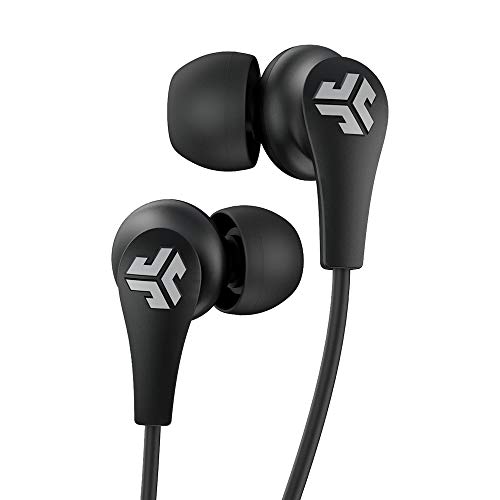
The JLab JBuds Pro is not a true wireless earbud, and understanding that is the single most useful thing you can know before considering it. The two earpieces are joined by a cable carrying an in line remote and microphone, the whole thing runs on Bluetooth 4.1, and it first appeared in May 2017. That age shows up in the connector, the charging behavior and the specification, which quotes two different battery figures. This review covers what the listing states and what the design implies.
Who this pair is for
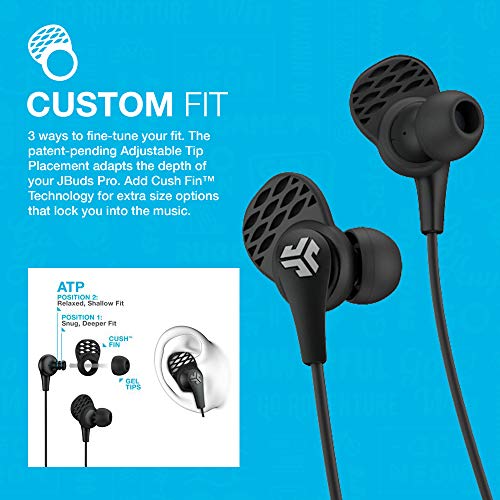
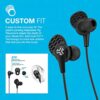
A tethered Bluetooth earbud is an older format that still has a real argument behind it. Because the two buds are wired together, you cannot lose one down a drain, there is no case to charge or carry, and the in line remote gives you physical volume and track controls that work by feel without looking. JLab pairs that with 10 millimeter titanium drivers, three sets of gel tips and two Cush Fins for extra retention.
What you give up is everything the true wireless format brought after 2017. There is no charging case, so the battery you have is the battery you have. There is no independent single bud use. And the cable sits against the back of your neck, which some people never notice and others cannot tolerate. If the tethered format is what appeals, the Cuzabe CBH11 neckband and the Sony WI-C100 take the same approach with newer radios.
Connection: Bluetooth 4.1 in a Bluetooth 5 world
The specification gives Bluetooth 4.1 and a range of 30 feet, which the bullets restate as streaming from up to 30 feet away. Bluetooth 4.1 dates from 2013. In practical terms that means shorter effective range than a current 5.x device, less headroom in congested environments, and no support for any of the low energy audio features introduced later. It does not mean the sound is worse by itself, because a Bluetooth version governs the radio rather than the audio, but it does mean this is old silicon.
No codec is named anywhere on the listing. Not SBC, not AAC, not aptX. SBC is therefore the only safe assumption, and on a 4.1 chipset of this era that is very likely all there is. Nothing here supports a high resolution or lossless description. There is also no mention of multipoint, which is unsurprising for the generation, so do not expect to hold a laptop and a phone at once.
A data feed oddity worth naming
The specification records a cable length of 360 inches. That is 30 feet, which is the same figure the listing gives for Bluetooth range. The cable joining two earbuds around your neck is obviously not 30 feet long. The range figure has been copied into the cable length field, and neither should be read as a physical measurement of the product.
Battery: the listing gives two different numbers
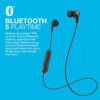
The product name and the second bullet both promise up to 10 hours of Bluetooth playtime. The structured specification records battery life as 6 hours. Those are not close, and JLab has not reconciled them anywhere on the page. We are not going to pick one for you: assume the honest range is somewhere between 6 and 10 hours and ask the seller if the difference matters to your use.
Charging time is recorded as 6 hours, which is implausibly long for a device of this size and may be the battery figure duplicated into the wrong field. What is certain is the connector: the included components list specifies a Micro USB charging cable, not USB-C. In 2026 that is a real inconvenience, since it means carrying a cable you probably do not otherwise own.
The one advantage of this format is that the quoted figure is the whole story. There is no charging case, so there is no split between bud runtime and total with case, and no risk of buying on a combined number and discovering the buds themselves last a fraction of it. Whatever the true figure is, it is the figure you get.
Fit, controls and the missing water rating
Three sets of silicone gel tips ship in the box along with two Cush Fins, which are the soft wings that brace against the ridge of the ear for extra retention. That is a good complement of fit accessories, and it matters, because tip fit governs both perceived bass and how much of the surrounding noise is physically blocked. The noise control field reads sound isolation, confirming there is no active cancellation. Blocking is passive only, so it works best against steady background sound and poorly against speech.
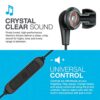
Controls are handled by the in line remote, which the specification records as a media control and a remote control method. Volume, track skip, call answering and voice assistant activation are all listed. On a running or gym product an in line remote is arguably better than a touch panel, since it works with wet fingers and gives tactile feedback.
No IP rating appears anywhere on this listing. Not in the title, not in the bullets, not in the specification. There is no water resistance field at all. This review will therefore not describe the JBuds Pro as sweat resistant, water resistant or rated for anything. If you intend to train in them, ask JLab for a published code first, and note that ratings on any product degrade with age and sweat exposure. A pair with a stated code, at the same kind of money, is easier to defend.
What else to weigh
JLab states a two year limited warranty and a thirty day money back guarantee, which are the company’s own terms and are worth reading directly rather than taking from a bullet. The rating history is substantial: JLab records a 4.2 star average across 13,213 ratings, with a sales position of ranked 1,945th in Electronics and 276th in earbud and in ear headphones. A rating base that size across nine years on sale is more informative than the star average on a product launched last month, though it also reflects a design that has been superseded twice over within JLab’s own range.
The specification carries the usual noise. The connectivity technology field reads Bluetooth while the wireless communication technology field also reads Bluetooth, which is at least consistent, but the item weight appears as both 50 grams and 1.76 ounces, which are the same figure and describe the package rather than the earbuds. The first bullet arrives with a corrupted emoji escape sequence in the source data.
If you want the modern equivalent of this brief from the same brand, the JLab Go Air Tones Plus and the JLab Go Air Pop are both true wireless with charging cases, and the JBuds Air Sport is the training focused option. All three sit in our earbud headphones section.
Who should buy it, and who should not
Buy the JBuds Pro if you specifically want a tethered pair you cannot lose one half of, you like a physical in line remote, and you can live with Micro USB charging. Skip it if you want a charging case, if you want a current Bluetooth radio, or if you need a published water rating, because there is none. Anyone shopping on the 10 hour figure should know the specification on the same page says 6.