

Description
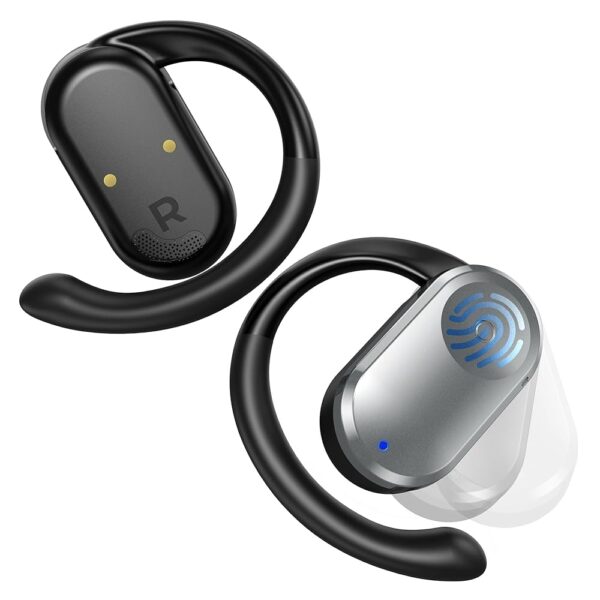
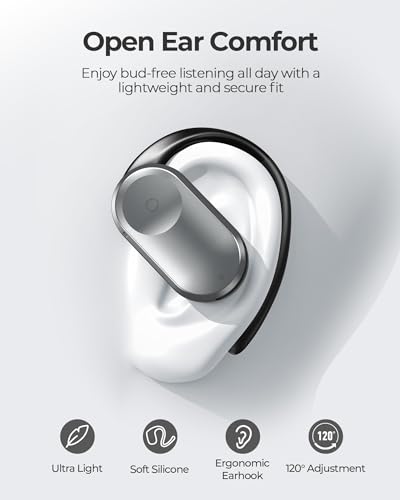
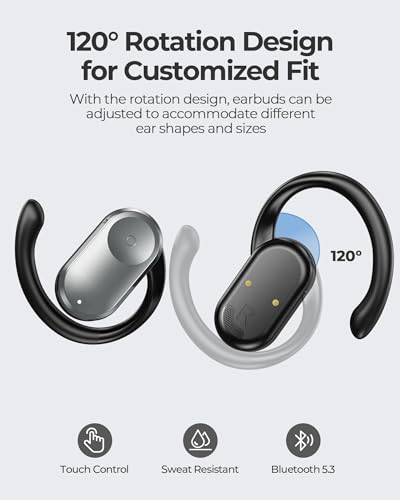
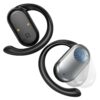
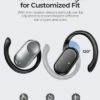
The LeMuna Q2 is an open ear set: a driver housing suspended just outside the ear canal on a flexible silicone hook, with nothing entering or sealing the ear. Its distinguishing feature is a 120 degree rotation adjustment in the hook joint, which lets the wearer aim the driver rather than accept a fixed geometry. That is a more thoughtful fit solution than most open ear designs offer, and it is the strongest reason to consider this one.
Who the open ear format serves
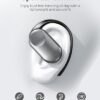
Leaving the canal open means the wearer keeps a normal path to ambient sound. A runner hears a car behind them. Someone at a desk hears a colleague without removing anything. A parent hears a child in another room. LeMuna builds an entire feature bullet around this, describing improved awareness of pedestrians and traffic during exercise and easier interaction with colleagues in an office.
The claim needs a precise qualification, because open ear marketing consistently overstates it. Leaving the canal open improves awareness relative to a sealed earbud. It does not make a listener aware. Volume still masks traffic, and a runner playing music loudly through an open ear set can miss a car as easily as one wearing sealed buds at a moderate level. The format helps and it is the right choice for road use, but it is not a substitute for keeping the level down and looking around. We would not describe any headphone as making a road user safe.
The limits of the format follow from the same physics. Without a seal, low frequency energy escapes into the room rather than pressurizing the ear canal, so bass is structurally thinner than any sealing design can produce. The structured Noise Control field correctly records None: there is no active cancellation and effectively no passive isolation either, so a plane cabin, a subway car or a loud open plan office will simply be audible over the music. Anyone whose priority is blocking noise rather than hearing it should be shopping sealed designs in the true wireless earbud listings.
Connection: two different Bluetooth versions in one listing
This is the clearest contradiction in the record. The structured Bluetooth Version field says 5.2. The product title says Bluetooth 5.3, and the second feature bullet repeats 5.3. Those are different radio generations and the listing gives no way to tell which is correct.
The practical difference is modest. Bluetooth 5.3 improves connection maintenance in crowded radio environments and lowers power draw slightly relative to 5.2, and it carries more of the LE Audio groundwork. Neither version affects sound quality. It matters here mainly as a signal about how carefully the listing was assembled, and buyers who care should confirm with the seller. The published range is 32 feet, which is the standard 10 meters in imperial units.
No codec, and an unquantified sync claim
No codec is named anywhere: not AAC, not aptX, not aptX Adaptive, not LDAC. With nothing named, SBC is the only codec a buyer can rely on, since every Bluetooth audio device supports it, and no high resolution description would be supportable. The second bullet claims audio and video are perfectly synced, which is a latency claim with no figure in milliseconds and no low latency codec behind it, so it should be treated as unquantified. Multipoint pairing, wear detection and app support are all absent from the listing.
Battery: six hours on the hooks, thirty six with the case
The fourth bullet is clear: 6 hours per charge, extending to 36 hours in total when the charging case recharges are counted. Six hours is what a single session gets. Thirty six hours describes the package away from a wall outlet with the case starting full, implying roughly five bud charges in reserve. The product title adds a 1.5 hour fast charging figure.
Both playtime numbers should be read as best case measurements taken at moderate volume, and there is no cancellation circuitry here to drain the reserve. Open ear designs also tend to be driven harder than sealed ones, because the listener is competing with the room, which pulls real runtime down further than the quoted figure suggests. The structured specification table contains no battery fields at all, so both numbers come from marketing copy rather than a data sheet, and no case capacity is published anywhere.
Fit, the rotating hook and the missing water rating
The 120 degree rotation adjustment is the feature worth paying for. Open ear designs live or die on how precisely the driver sits relative to the ear canal opening, and a fixed hook either lines up with a given ear or it does not. Being able to rotate the housing means a wider range of ear shapes can get the driver pointed correctly, which affects both perceived volume and how much bass survives. There are no ear tips to swap on an open ear product, so hook geometry is the entire fit story, and this is a genuinely better answer than most.
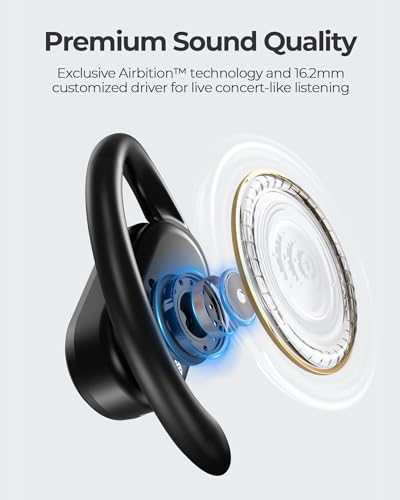
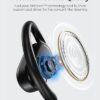
The driver is 16.2 mm, which is large and appropriate; open ear designs need more diaphragm area to compensate for the energy lost to the surrounding air. LeMuna describes it as carrying low frequency vibrations toward the ear without covering it, which is air conduction rather than bone conduction, and buyers looking specifically for bone conduction should note that no transducer is described. The frequency range is the standard 20 Hz to 20,000 Hz span, which conveys nothing about tuning. Controls are touch pads on the housings covering playback and calls.
There is no IP rating anywhere. The product title says sweat resistant and the structured Water Resistance Level field says Water Resistant, both of which are descriptions rather than ratings. We will not state a code the listing does not give. Treat these as tolerant of workout sweat and light rain, and confirm with the seller before any heavier exposure. No IP rating, even when published, covers seawater or high pressure water, and ratings degrade as seals age.
Data notes and alternatives
Ear Placement reads Open Ear while Form Factor reads Over Ear and Earpiece Shape reads around ear; the first is accurate and the second describes a full sized headphone. The included components field lists only a cable, which cannot be complete for a product with a charging case. Item weight of 5.6 ounces describes the shipped package. LeMuna states a 4.2 out of 5 average across 861 ratings and an Amazon rank of 322nd in open ear headphones, which is one of the few products in this catalog filed in the right Amazon category.
Buyers comparing open ear designs should read the Soundcore AeroFit 2 review and the Shokz OpenFit review, both from manufacturers that publish full battery and ingress specifications. The AUBOR H13 review covers a hook design using the same 16.2 mm driver size, and the Baseus Bowie MC1 review covers a clip on alternative. More of the format sits in the open ear headphone category.
Who should buy it and who should not
Buy the LeMuna Q2 if you want to hear your surroundings while you run or work, if the rotating hook solves a fit problem that fixed hooks have not, and if 6 hours per charge covers your sessions. Skip it if you want isolation or deep bass, since the open design cannot deliver either, or if you need a published water rating for heavy training. Ask the seller which Bluetooth version is actually fitted, because the listing states 5.2 and 5.3 in different places.