

Description
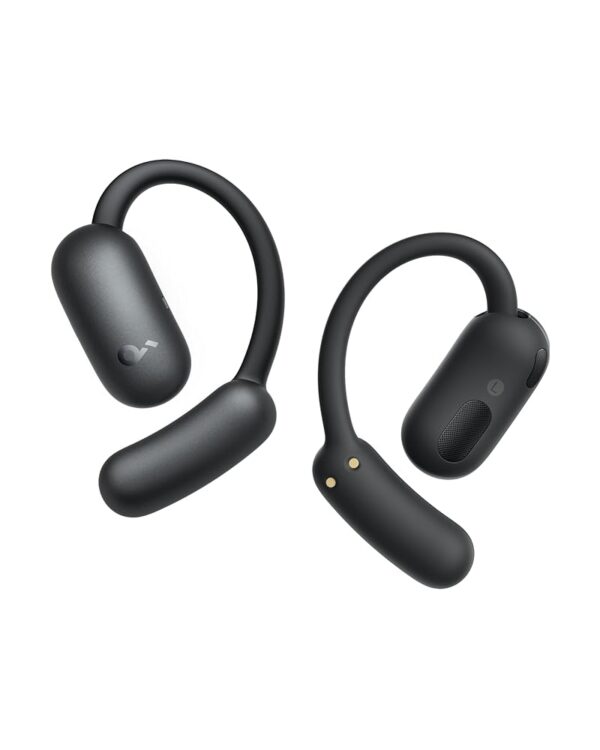
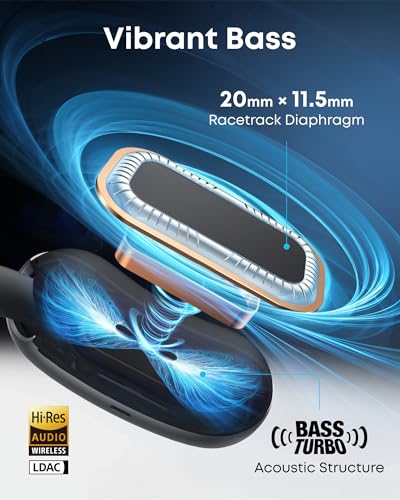
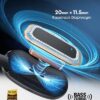
The Soundcore AeroFit 2, model A3874, is Anker’s second generation open ear hook headphone, and it is one of the few products in this catalog that names a Bluetooth codec outright. It also carries a real time translation feature covering a claimed 100 languages, four position adjustable hooks, a wirelessly charging case and racetrack shaped drivers measuring 20mm by 11.5mm. The listing is more disciplined than most in this category, though it still contains a water rating that contradicts itself and a frequency specification that cannot be reconciled.
Who an open ear hook design is for
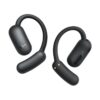
Nothing enters the ear canal. A hook loops over the top of the ear and positions a driver housing just outside the canal opening, firing sound across a small air gap. The consequence is that ambient sound reaches you unimpeded. Anker frames this as staying attuned to the world while listening, and for outdoor exercise, walking near traffic and office use where you need to hear a colleague, it is a genuine advantage over any sealed earbud, because there is no microphone feed and no processing between you and the environment.
The cost is that there is no isolation. The Noise Control field reads None, which is correct rather than an omission. On a plane, a subway or a busy street the ambient noise floor competes directly with the music, and the natural response is to raise the volume. Nothing on this listing describes a volume limiter or publishes a maximum output figure, so nothing restricts how loud it goes. If most of your listening happens in loud places, a sealed model from our wireless earbuds category is the correct tool and an open ear design is not.
The adjustable hook is the meaningful upgrade
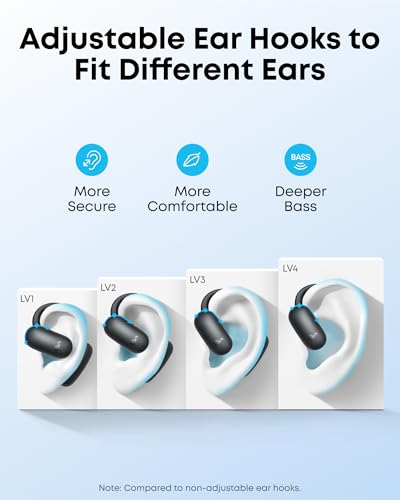
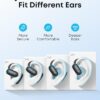
Anker’s four level adjustable ear hook is the structural change over the previous generation and over most rivals. Open ear designs have no ear tips, so there is nothing to swap when the fit is wrong. On a fixed hook or a clip, the product either matches your ear geometry or it does not, with no remedy. Four adjustment positions give a listener a real chance of correcting a poor fit, which is the single biggest failure mode in this category. Anker claims coverage of over 99 percent of ear shapes, which is an unsourced marketing figure, but the mechanism behind it is real.
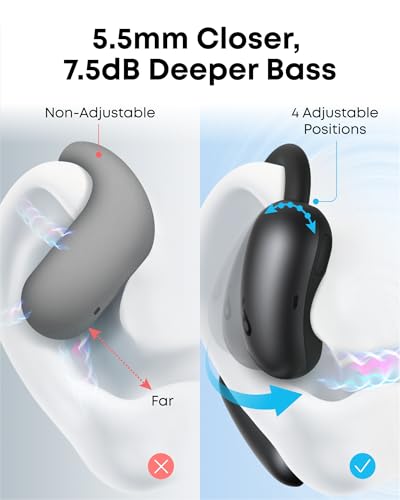
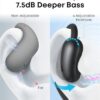
The adjustment also does acoustic work. Anker states that bringing the driver closer to the canal doubles bass output against non adjustable buds, with a maximum boost of 7.5 dB, and attaches the note that the data comes from the soundcore lab. That attribution is unusually honest and should be read for what it is: an in house measurement, not an independent one. The underlying physics is sound, since an open ear driver loses low frequency energy across the air gap and reducing that gap recovers some of it, but no open ear product recovers the bass that a sealed canal produces.
Connection: LDAC named, with the condition that comes with it
This is where the AeroFit 2 separates itself from almost everything else in its category. Anker states Bluetooth 5.4 support and the LDAC codec by name, describing it as delivering high resolution audio transmission. Naming the codec is what makes a resolution claim checkable.
LDAC is a Sony developed codec supported natively in Android. It carries a substantially higher bitrate than SBC, and it is the reason a high resolution description here is not empty. The condition is absolute: both the source device and the headphones must support LDAC for it to be used. Android phones from Sony, Samsung, Google, Nothing and most other major manufacturers support it. No current iPhone does. An iPhone connected to these falls back to AAC and receives none of the advertised benefit. LDAC also negotiates its bitrate downward when the radio environment is congested, so the top figure is a ceiling rather than a constant.
Multipoint is not claimed on this listing. Wear detection is not claimed. The soundcore app is required for the translation feature and by implication carries equalizer settings, which matters on an open ear design because an equalizer is the main tool available to compensate for the missing low end.
The translation feature, and what it depends on
Anker advertises free AI translation across 100 languages with real time response, and attaches two requirements: the soundcore app must be at version 3.8.7 or later and the earbud firmware must be current. That dependency is worth taking seriously. A feature delivered through an app and a cloud service is not the same kind of purchase as a driver or a battery. It can change, it can be restricted, and the listing gives no commitment about how long it will remain free or supported. No accuracy figure is published beyond the phrase high accuracy, and no offline capability is described, so assume an internet connection is required.
The feature is significant enough that the listing’s own category placement reflects it. This product ranks 11th in Electronic Foreign Language Translators and 27th in Open-Ear Headphones, and its primary best seller rank is in Office Products rather than Electronics, which is an unusual placement for a headphone.
Battery, fit and the IP55 conflict
The battery figures are published cleanly and they reconcile. Ten hours of music on a single charge from the headphones themselves, extendable to 42 hours with the case. The specification block agrees, listing Battery Life at 10 hours and Carrying Case Battery Average Life at 42 hours, with a 750 milliamp hour case taking 2 hours to refill and the headphones taking 1 hour. That is roughly three additional charges from the case, which is consistent arithmetic. The case supports wireless charging, which removes the cable entirely for daily top ups.
Ten hours is a strong open ear figure, and the standard caveat applies with extra force here. Quoted playtime assumes moderate volume, and an open ear design in a noisy environment invites higher volume than a sealed one, so real world runtime tends to fall further below the quoted number in this category than in others.
Water resistance is contradictory. The product title claims IP55. The specification field labeled Water Resistance Level reads Waterproof. Those do not agree. IP55 means protection against dust ingress and against low pressure water jets from any direction. It covers sweat and rain during exercise, which is a good rating for the intended use. It does not mean immersion, it will not survive a drop in a sink, and this product should not be called waterproof. No IP rating anywhere covers seawater or pressurized water, and the coatings and gaskets delivering these ratings degrade with age and use.
The specification errors, and the alternatives
Two fields cannot both be right. Frequency Range is listed as 20Hz to 40kHz while Frequency Response is listed as 20 KHz, which is a single number and not a response. The 40 kHz upper figure is in any case beyond human hearing and is a marketing number on a product with no seal. Sensitivity is given as 127.5 dB, far above the 95 to 105 dB range typical for headphones and almost certainly a units error, the same pattern seen on other Anker listings in this catalog. Impedance at 16 Ohm is plausible. Item weight appears as 85 grams and as 3 ounces, which agree and describe the package, with the case listed separately at 65 grams. The Cable Feature field reads Detachable on a wireless product.
Within the same brand, the original Soundcore AeroFit and the cheaper Soundcore V30i are the direct comparisons, with the V30i offering a longer 12 hour runtime but a fixed hook. Outside Anker, the Shokz OpenFit is the reference point most buyers cross shop, and the Bose Ultra Open Earbuds take the clip on route instead of a hook. Everything in the format is collected in our open ear headphones category.
Who should buy it, who should not
Buy it if you want awareness during outdoor exercise, you own an Android phone that supports LDAC, and adjustable hooks solve a fit problem that fixed designs have left you with. This is one of the few open ear products that names its codec, publishes both battery figures honestly, states a real IP code and attributes its own bass measurement to its own lab. Those are marks of a listing written with more care than the category norm, and the rating reflects it at 4.5 out of 5 across 833 ratings.
Do not buy it for flights, subways or open plan offices, since it provides no isolation by design. Do not buy it on the strength of the LDAC support if you use an iPhone, because no iPhone supports LDAC. Do not read the Waterproof field as permission to submerge these, since Anker’s own title says IP55. And treat the translation feature as a service that depends on an app, a firmware version and a network connection rather than as a permanent property of the hardware.