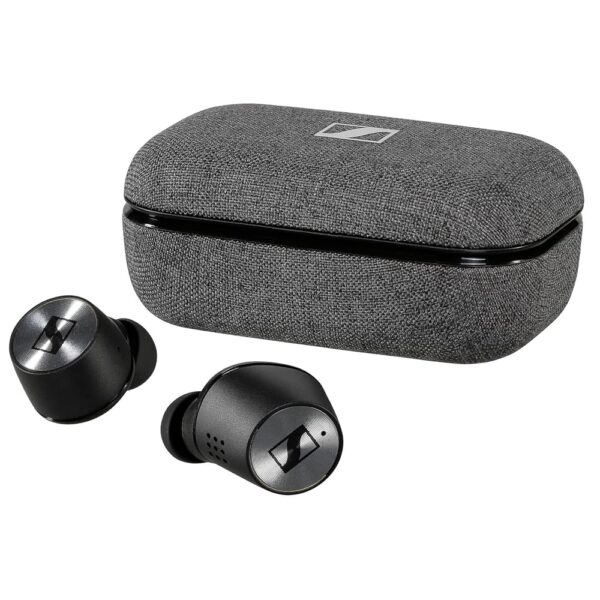
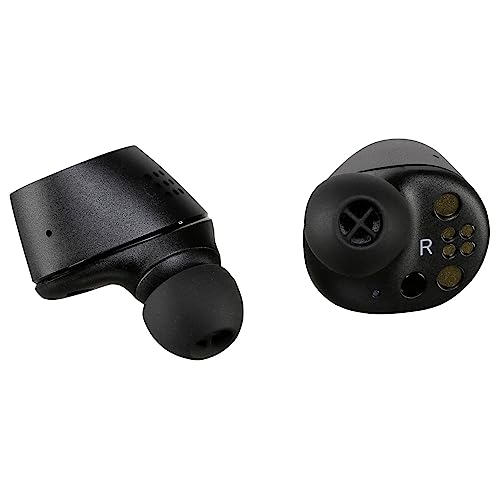
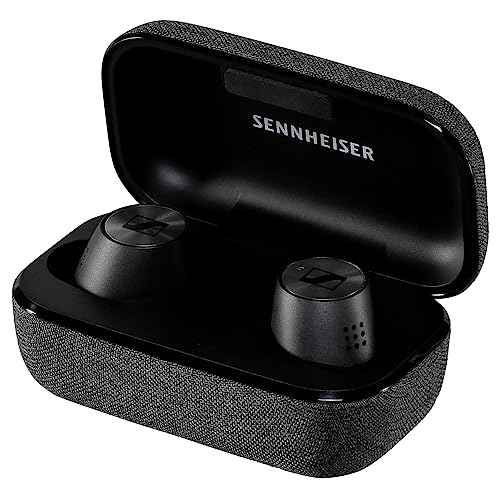
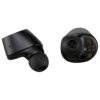
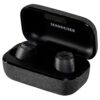
Description
The MOMENTUM True Wireless 2 was Sennheiser’s 2020 flagship in-ear, and it is still listed. The page selling it, however, has almost nothing on it that Sennheiser wrote. The manufacturer description field is empty. Several specification rows contain hedged prose rather than data, including a listed use of “Possibly Sports or Exercise” and a style of “Minimalist, Contemporary, or Modern,” which are not things a manufacturer publishes. Read the specification table here with suspicion. Everything below is drawn from what the page actually says, and we do not wear or measure the products covered on this site.
Who this is for
This is a sealed in-ear bud with active noise cancellation, supplied in black with a charging case. The recommended uses given are travel, commuting and music, which is the correct positioning: a sealed cancelling bud is at its best against constant low frequency noise on a train, a plane or an office floor. It is not a running headphone and it is not a road cycling headphone, and nothing on this page suggests otherwise beyond that one hedged specification field.
Controls are a customizable touchpad on both buds, with voice control also listed. Touchpads are convenient and they are the least reliable control type under a hat, a hood or wet fingers.
Connection: the biggest hole in the listing
No Bluetooth version is published anywhere. Not in the title, not in the bullets, not in the specification table, which gives only a 10 meter range figure.
No codec is named either, and that matters more here than on a budget product, because one of the bullets claims the cancellation provides “high-fidelity sound even in noisy environments.” A fidelity claim with no codec named and no Bluetooth version stated is unsupported by the published specification, and we are not going to repeat it as though it were a measurement. If codec support is the reason you are considering this pair, ask Sennheiser or the seller which codecs the current firmware negotiates, then check whether your phone supports the same one. That question is worth asking of any product making a fidelity claim, and it is the reason we cover named-codec alternatives such as the Technics EAH-AZ100 separately.
Multipoint pairing is not mentioned. Wear detection is not mentioned. Where a feature is not published, we do not assume it is present.
What the cancellation does
Active noise cancellation is confirmed in both the title and the specification table, and no decibel reduction figure is given. That is the honest outcome, because a decibel figure with no named test standard cannot be compared between brands. Cancellation of this class works well on constant low frequency noise such as cabin drone and ventilation hum, and much less well on speech. It will not make an office quiet, and nothing in this catalog will.
Battery: cleanly split, with one absurd field
The bullet gives both halves: “the new 7-hour battery life that can be extended up to 28 hours with the charging case.” So bud runtime is seven hours and twenty eight hours is the total, which is three further refills from the case. The specification table confirms seven hours as the battery life figure and gives a charging time of 1.5 hours.
Seven hours on a cancelling bud is a good figure and better than several current flagships manage. It is, as always, a best case number quoted at moderate volume, and it falls as the cells age. Sennheiser does not state whether the seven hours assumes cancellation on or off, which is the usual omission and a meaningful one on a cancelling product.
One specification row should be ignored outright: “Carrying Case Battery Average Life: 3 Days.” Three days is not a unit any earbud case is measured in, and it cannot be reconciled with the twenty eight hour total in the bullet. It is a data error.
Fit, seal and the missing water rating
There is no IP code anywhere on this listing. The specification field reads “Water Resistance Level: Water Resistant,” which is a phrase and not a rating, and no IPX4, IPX7 or any other code appears in the title, the bullets or the description. That means the page publishes no stated water protection at all. Treat these as unrated: do not exercise in them on the assumption that sweat is covered, and do not take them out in rain without confirming the code with Sennheiser first. No IP rating covers seawater or pressurized water in any event, and seals degrade with age.
On fit, the listing does not say how many ear tip sizes are supplied, and the components field names only a charging case. On a sealed bud the tip is the specification that decides both perceived bass and how much outside noise the seal blocks, so that omission is a real one. The earpiece shape is recorded as a rounded tip and the drivers are given as 7 millimeter dynamic units, which is a real figure and one of the few solid numbers on the page.
The specification fields that do not survive scrutiny
Three rows here should be discounted, and naming them is more useful than quietly dropping them.
The impedance is listed as 140 ohms. That is a figure from the world of wired headphones driven by an external amplifier. A true wireless earbud contains its own amplifier and its impedance is not a number a buyer can act on, and 140 ohms is implausibly high in any case. The frequency range is given as 5 Hz to 21 kHz with no tolerance figure attached, which makes it a marketing range rather than a measurement, and it extends below and above what human hearing covers.
The weight fields are self contradicting: the item weight is given as 70 grams and the carrying case weight is also given as 70 grams, with a separate figure of 2.47 ounces which is the same 70 grams again. A pair of earbuds does not weigh the same as its case, and neither weighs 70 grams. No usable weight is published. The specification table also contains a row reading “Number of USB 2 Ports: 1,” which is a field inherited from an unrelated product category.
How it ranks, and the alternatives
Customer feedback sits at 4.1 out of 5 from 3,147 ratings, which is a decent score on a large sample. The sales rank is given as 141,583rd in Electronics and 6,706th in the earbud and in-ear headphone group, which is deep, and that is what you would expect from a design first listed in March 2020 that has since been replaced twice. The model number is M3IETW2 and the listing states the product is not discontinued by the manufacturer.
The current generation is covered in our Sennheiser MOMENTUM True Wireless 4 review, and the fitness oriented model in our Sennheiser MOMENTUM Sport review, which publishes what this page does not. For a competing flagship that does name its codec, see our Sony WF-1000XM5 review. For the wider field, start from the true wireless earbud listings or the broader in-ear headphone listings.
Who should buy it and who should not
Buy it if you want seven hours of bud runtime from a cancelling design, you commute in constant noise, and you are comfortable buying a 2020 model that has been superseded twice. The 7 millimeter drivers and the clean battery split are the two things this page gets right. Do not buy it on the strength of the fidelity language in the bullets, because no codec and no Bluetooth version are published to support it. Do not buy it for exercise or rain, because no IP code is published at all. And discount the impedance, frequency range and weight rows entirely, because none of them can be correct as written.