Description
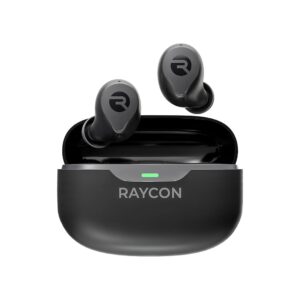
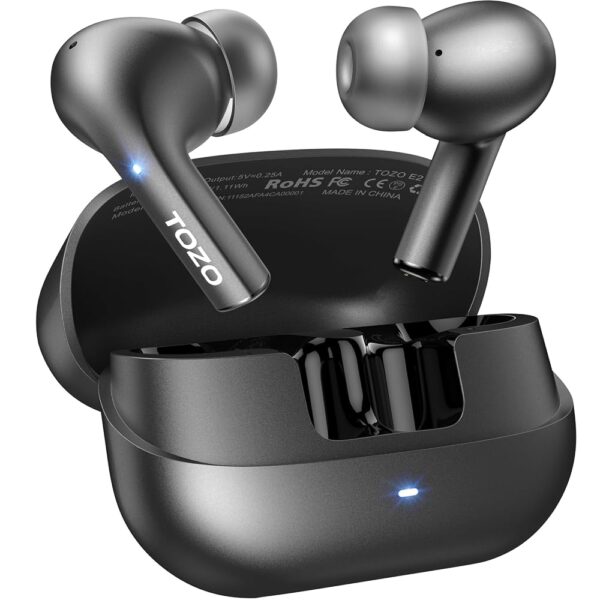
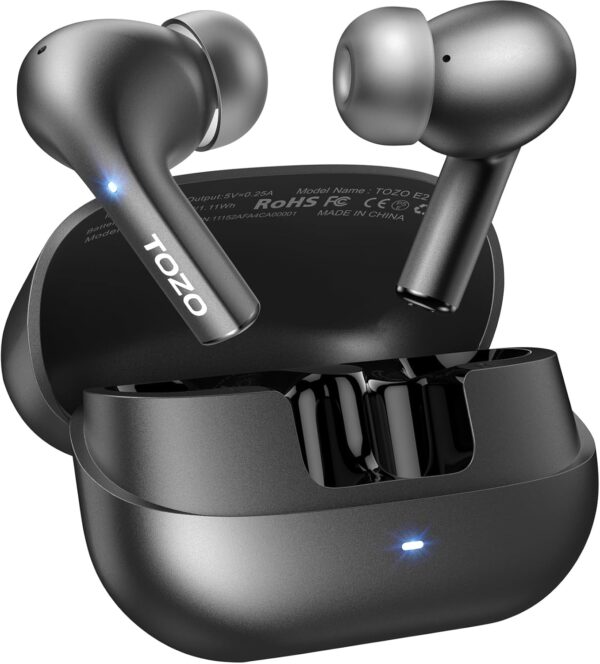
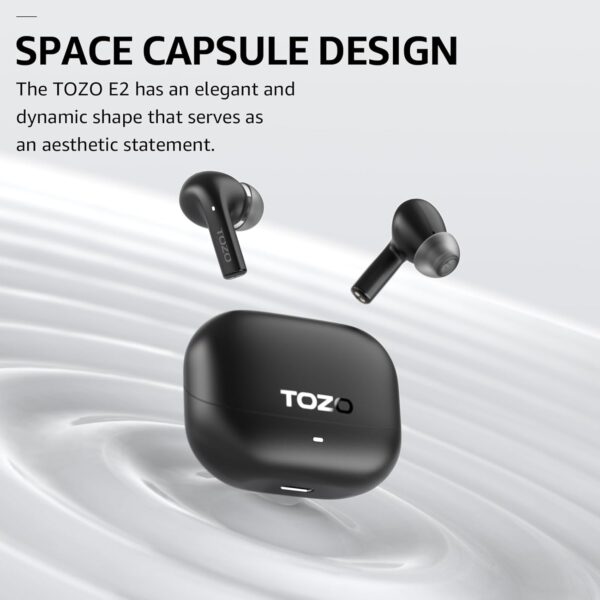
This listing is catalogued under the product code T11152, but the product it describes is the TOZO E2. Both identifiers appear on the same record, with E2 as the model name and T11152 as the item model number, so they refer to one product rather than two. It is a sealed true wireless earbud with 10 millimeter drivers, Bluetooth 5.3, call noise cancellation and a 30 hour combined battery figure, first listed in August 2024.
Who these suit
These are for someone who wants a plain sealed bud with app control and a decent driver, and who does not need active cancellation for listening. Three pairs of ear tips are supplied in small, medium and large, along with the buds, the charging case, a 20 centimeter USB-C cable and a manual. Twenty centimeters is short for a charging cable and worth knowing before you plan where the case will live.
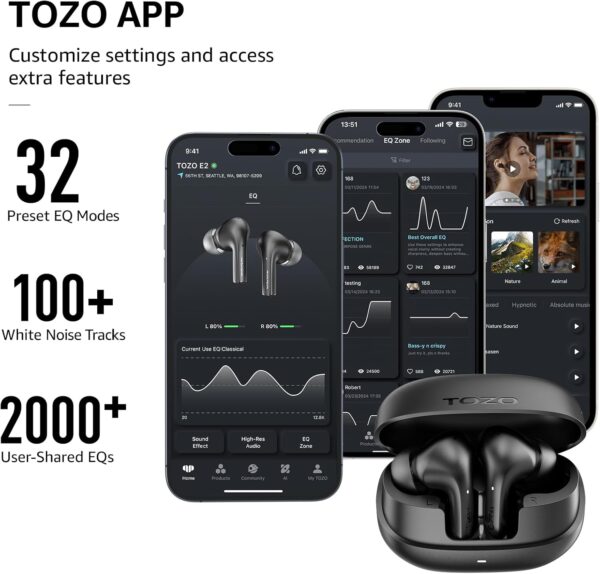
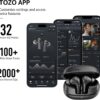
Thirty-two equalizer presets are available through the TOZO app, and the controls are touch panels with app configuration. Touch is quick but misfires with wet hands, which is worth weighing given how this product is marketed for exercise.
Call noise cancellation is not noise cancellation
The product title leads with “Call Noise Cancellation,” and the attribute block separately lists noise control as “Sound Isolation.” Both are accurate and they describe different things, so it is worth being precise.
Call noise cancellation uses the two microphones to clean up the outbound signal, which improves what the person on the other end of a call hears. It does nothing whatsoever for what you hear. Sound isolation is passive: outside noise is reduced only by the physical seal of the ear tip.
There is no active noise cancellation for the listener on this product, and no transparency mode. If cancellation is the requirement, the TOZO NC2 is the model in the same brand’s range that publishes it.
How they connect
Bluetooth 5.3 is listed with a range of 20 meters, which is generous compared with the 10 meters most listings quote. Audio latency is published at 60 milliseconds, a genuinely useful figure that few records include. Sixty milliseconds is low enough that video lip sync is generally acceptable and casual gaming is workable, though it is not in the sub-40 millisecond range a dedicated low latency mode reaches.
No codec is named
There is no AAC entry, no aptX and no LDAC anywhere on this record. Where nothing is named, SBC is the only codec that can be assumed, because SBC is the baseline every Bluetooth device supports. Nothing here supports a high resolution or lossless claim, and any codec that did appear would still require your phone to support the same one. Multipoint and wear detection are not mentioned.
The battery figures, and the one that is missing
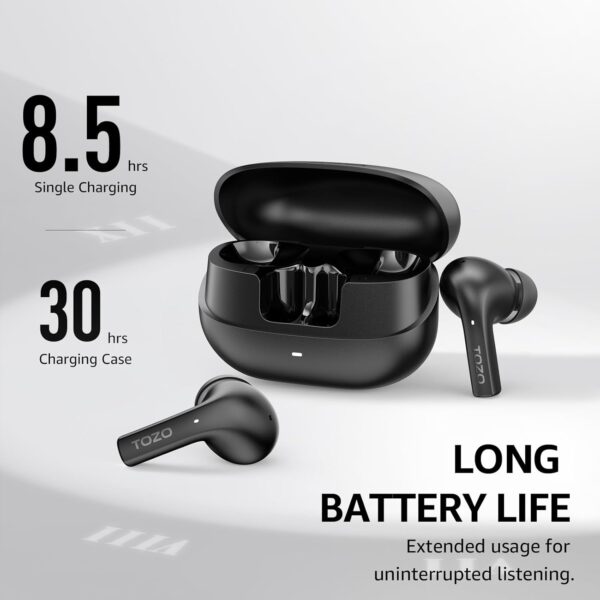
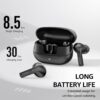
The title quotes 30 hours of playtime, and the attribute data attaches that 30 hours to the carrying case. Charging time is listed at 1.5 hours for both the buds and the case.
The per-bud runtime is not published anywhere on this record. Thirty hours is the combined figure across recharges, which is the number that sells and the least useful for planning a day. The short description previously on this page claimed around eight hours per charge; nothing in this listing supports that and we have removed it.
The battery life attribute field reads “20000 Hours,” which is roughly two and a quarter years of continuous playback and is not a runtime of any kind. The same value appears on other TOZO records in this catalog, which points to a systematic import fault. The batteries field also says “1 Lithium Metal batteries required,” and lithium metal cells are not rechargeable, which contradicts a rechargeable product with a rechargeable case.
Drivers, sensitivity and a volume note
The drivers are 10 millimeter dynamic units, which is at the larger end for an in-ear and the more meaningful of the acoustic figures here. The frequency response field reads “20 KHz” as a single number, which is not a response and should be ignored. No frequency range appears elsewhere on the record.
Published sensitivity is 115 dB, and that figure deserves a note. Sensitivity describes how loud an earbud goes for a given input, and 115 dB is high, considerably above the 99 to 102 dB published on other sets in this catalog such as the TOZO T6 at 100 dB. In practice that means a volume slider position that feels moderate on a less sensitive earbud will be louder here. If you move between devices or between earbuds, check the level before putting these in rather than after.
The water claim has no code behind it
The attribute block records “Water Resistance Level = Waterproof.” No IP code appears anywhere on this record, and the product title, unusually for this brand, does not mention water resistance at all. Other TOZO listings in this catalog lead with IPX8 or IPX5 in the title; this one does not.
Without a code there is no specification, only an adjective, and “waterproof” is the wrong adjective to accept on faith. Treat this as having no published water rating, keep it away from immersion and from heavy sweat, and confirm the code with the seller if exercise is the use case. Where a rating does exist, no IP code covers seawater or pressurized water, and protection degrades as seals age.
The use case fields are a safety problem
The recommended uses field lists cycling, motorcycling, skateboarding and snowboarding among more than a dozen entries, and the specific uses field adds sleeping. These are sealed isolating earbuds with no transparency mode. Sealing your ears while cycling in traffic or operating a motorcycle removes information you need, and in many jurisdictions wearing earphones while driving is restricted or illegal. Treat those fields as a keyword list rather than as advice. If awareness while moving is the requirement, an open-ear design is the right category.
Other oddities, and what to compare
The item weight is listed as 0.001 ounces, roughly 28 milligrams, which no physical object of this kind weighs. The theme field holds a list of unrelated activity and genre keywords. A “Number of USB 2 Ports” field appears on a pair of earbuds. The product dimensions of 3.7 by 3.35 by 1.22 inches are packaged figures rather than product figures. Unpublished: impedance, bud and case weight, case capacity, wireless charging support, and the number of microphones beyond the two mentioned for calls.
Within our own listings, the TOZO T10 publishes even less than this record does, the Soundcore P20i is the name-brand competitor with a similar driver size, and the wider earbud headphone listings we track cover the rest of the field.
Who should buy them, who should not
Buy the E2 if a 10 millimeter driver, a published 60 millisecond latency and a 32 preset app cover what you want from a simple sealed bud. Skip them if you need to know the per-bud runtime before committing, if you need a published water rating for exercise, if you want active cancellation rather than call-side processing, or if a 115 dB sensitivity figure with no volume limiting gives you pause.