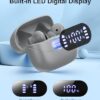

Description
The TUMJUN A3 Pro is a gray true wireless set, ASIN B0CRHGF3HL, listed since January 2024, carrying a 4.7 star average across 901 ratings and ranked 8,233rd in Amazon’s Earbud and In-Ear Headphones category. A 4.7 average is high for this bracket. The specification is short but publishes one figure most rivals hide, the driver material and size, and it also contains a battery field written in scientific notation that conflicts with the headline number. Both are covered below.
Who this set suits
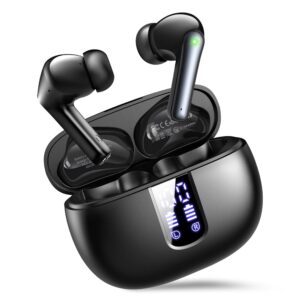
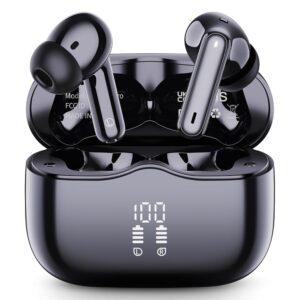
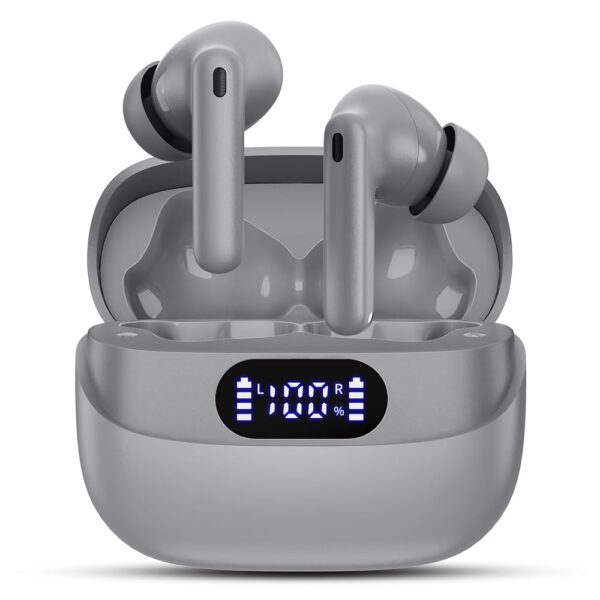
The listing pitches everyday use across music, calls and video, with an LED charge display on the case and a claimed lightweight in ear fit. The buyer this suits wants a straightforward sealed earbud with a long total runtime and a charge readout, and does not need cancellation, an app or multipoint pairing.
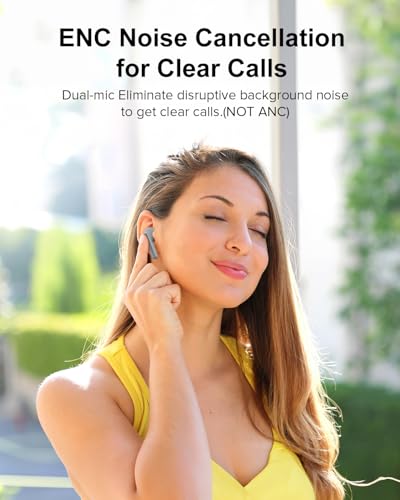
On that last point, the title deserves reading closely. It says “Call Noise Cancelling”, and the third bullet says the set is “set up with thoughtful call noise reduction”. That is microphone side processing: it cleans up what the person on the other end of a call hears. It does nothing about the noise reaching your own ears. There is no active noise cancellation on this product, no ANC specification and no decibel figure. If cancelling what you hear is the requirement, sets with a published hybrid ANC design such as the CMF Buds Pro 2 are the correct comparison.
Connection: Bluetooth 5.3 and a range figure worth noting
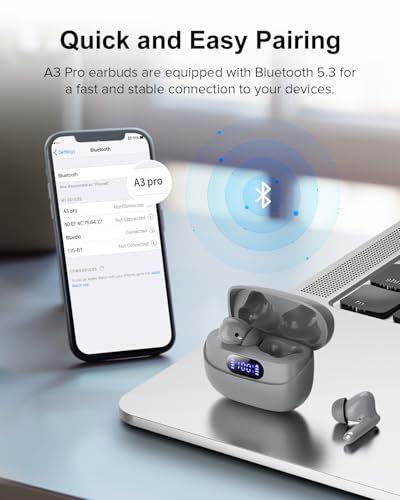
The listing states Bluetooth 5.3 and quotes a connection distance of 15 meters, roughly 49 feet, which is higher than the 10 meter figure most competitors publish. Take that as an optimistic line of sight number; range through walls, bodies and crowded radio environments will be considerably shorter regardless of the quoted figure.
Bluetooth 5.3 improves connection stability and power draw and adds groundwork for LE Audio. It does not raise sound quality by itself, and the bullet describing “fast and stable transmission speed with low latency” gives no latency figure in milliseconds, so there is nothing to plan around if lip sync on video matters to you.
The codec gap behind the HiFi claim
The product title uses the term “HiFi Stereo”. No codec is named anywhere on this page. Not SBC, not AAC, not aptX, not aptX Adaptive, not LDAC. High fidelity over Bluetooth depends entirely on the codec, and a codec only works when both the phone and the earbuds support the same one, which means an unnamed codec is an unanswerable question. Where nothing is published, assume SBC only, the baseline every device supports and the lowest quality tier in general use. The HiFi wording in the title is marketing language unsupported by the published specification.
Multipoint pairing to two devices at once is not mentioned. Neither is a companion app, transparency mode, wear detection or firmware updating. Assume none exist.
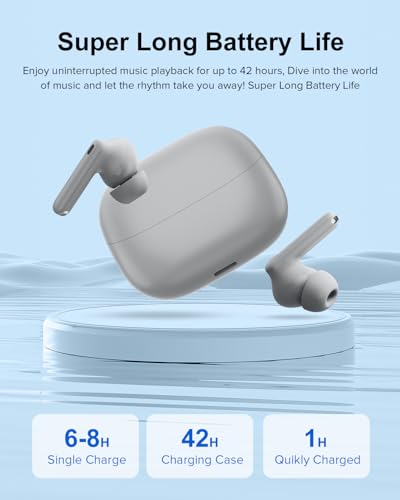
Battery: 42 hours in the title, 40 in the specification
The second bullet and the title both say up to 42 hours of use with the charging case. The specification block gives Battery Life as “4E+1 Hours”. That is scientific notation for 40 hours, which is a data entry artifact rather than a deliberate figure, and it does not match the 42 hours quoted twice elsewhere. The gap is small, but it is a gap, and it shows the numbers on this page were not checked against each other.
The far more important omission is that no per bud runtime is published anywhere. The 42 hour figure is explicitly “with the charging box”, meaning it is the total for the whole system between wall charges. What you actually need to know is how many hours you get from a single charge before the buds go back in the case, and this listing never says. In this bracket a 40 hour total usually implies somewhere between 5 and 8 hours per bud charge, but that is an inference, not a specification. Ask the seller for the bud figure before buying on battery.
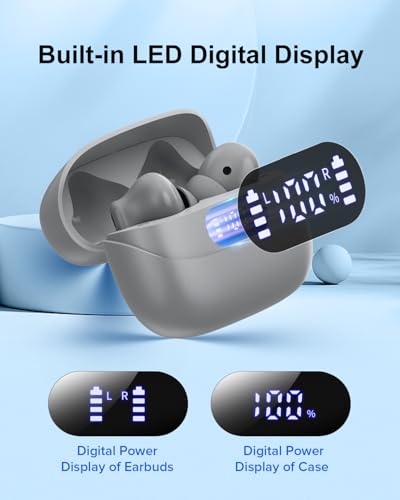
Sets that publish both halves of the number, such as the TOZO T20, give you something you can plan a day around. The LED digital display on the case here shows remaining charge, which is a useful convenience but not a substitute for a published runtime.
Drivers, fit and the water rating
The one genuinely informative audio specification is the driver: 13.4 millimeters, described as titanium. That is a large driver for an in ear design, and titanium coated diaphragms are a common approach to stiffening the moving surface. It is a real specification and more than most rivals in this bracket publish. What is not published is a frequency response tolerance, an impedance figure or a sensitivity number, so the 20 Hz to 20,000 Hz range in the specification is the standard human hearing span quoted by almost every headphone made and distinguishes nothing.
The number of ear tip sizes in the box is not published. Included Components reads only “Charging Case”. That is a meaningful gap, because a sealed in ear set that does not seal loses its bass and sounds thin, and tips are the only way to fix it. If you have unusual ear canals, budget for aftermarket tips.
On water, the title and the fifth bullet both state IPX7, and the specification field reads “Water Resistance Level: Waterproof”. IPX7 is a real immersion rating, covering fresh water to one meter for thirty minutes under laboratory conditions, and it is stronger than the IPX4 splash rating most sets in this tier carry. Two limits apply regardless. No IP rating covers seawater, chlorinated pool water or pressurized water, and seals degrade with age, heat and repeated charging port exposure. Note also that the case itself carries no rating; IP claims on earbuds almost never extend to the case.
The specification includes a “Theme” field reading “Cycling, Work, Sports”. Cycling should be rejected as a use case. These are sealed in ear buds with passive isolation and no transparency mode, which removes your awareness of traffic. Use them indoors or on a treadmill, and choose from the designs that leave the ear canal open if you train on roads.
What else is missing, and the alternatives
There is no microphone count, no ENC or CVC label, no Bluetooth codec, no latency figure, no charging time and no bud only runtime. Package weight is 3.52 ounces, which is the shipped box rather than a per bud figure. The shell material is listed as ABS plastic and the color as gray. Controller Type reads “Media Control” while Control Type reads “Touch Control”, which are two ways of describing the same touch panel rather than a conflict.
For alternatives with fuller published specifications at a similar price, the Soundcore A3949 and the JLab JBuds Mini both name their battery split clearly. A broader shortlist is in the in ear and earbud style headphones section.
Who should buy this, and who should not
Buy it if a 13.4 millimeter titanium driver and a published IPX7 rating are what you are shopping on, you want a case display, and a 4.7 star average across 901 ratings reassures you. On driver disclosure and water rating this listing is above average for its bracket.
Do not buy it on battery alone, because no per bud runtime is published and the total is given as 42 hours in one place and 40 in another. Do not read “Call Noise Cancelling” as active noise cancellation. Do not read “HiFi” as a resolution claim, since no codec is named. And do not use these on a bicycle despite the Theme field suggesting it. Before ordering, ask for the bud only playtime and the number of ear tip sizes.