
Description
The one product here where the connector decides everything
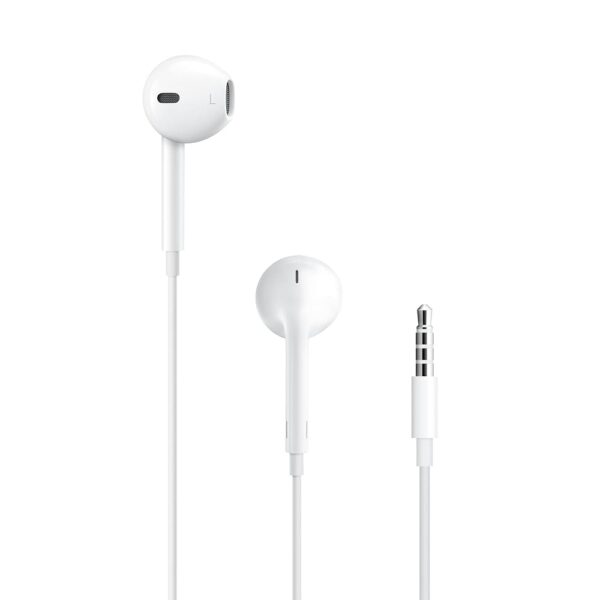
Apple EarPods with a 3.5mm plug are a wired, passive, unsealed earbud with an inline three button remote and a microphone. They have no battery, no radio, no app and no processing of any kind. In a catalog dominated by true wireless products, that makes them either the simplest thing on the shelf or completely unusable, and the deciding factor is a single question: does the device you want to use have a 3.5mm headphone jack?
This matters more than any other point in this review, because Apple removed the headphone jack from the iPhone in 2016 and has not brought it back. If you are buying these for a current iPhone, they will not plug in without a Lightning or USB-C adapter, which Apple does not include here. Apple’s own compatibility bullet is honest about it: works with all devices that have a 3.5mm headphone jack. Where they do plug straight in is laptops, desktops, many tablets, older phones, aircraft entertainment systems with an adapter, gym equipment, audio interfaces and portable players. Apple also sells USB-C and Lightning versions of the same EarPods, so check the model number on the box against the port you actually have. This listing is item MWU53AM/A, the 3.5mm version.
Connection: analog, and what that changes
There is no Bluetooth here, so the codec discussion that dominates every other review in this catalog simply does not apply. There is no SBC, no AAC, no aptX, no pairing, no version number and no latency. Audio travels as an analog signal from your device’s own headphone amplifier down the cable to the drivers, which means the sound depends on the drivers, the cable and the quality of the source device’s output stage. That last part is worth knowing if you are using a cheap adapter: some dongles include a better digital to analog converter than others, and on a phone with no jack the dongle is doing the conversion.
The inline remote is the actual feature
The remote handles volume up, volume down, play and pause, track control, answering and ending calls, and Siri with a long press. The integrated microphone works for phone calls, FaceTime and voice input. On a Mac or an iPhone with an adapter this all works as expected. On an Android phone the volume buttons may or may not function depending on how the device implements the remote standard, and Apple does not address that. It is a small thing, but if volume control from the cable is the reason you are buying, confirm it against your device.
No battery, and the durability question that replaces it
There is nothing to report about runtime, and that is the point. No bud figure, no case figure, no charge cycles, no capacity loss after two years. Wired headphones are the only category here where the battery discussion is absent entirely, and it removes the failure mode that eventually retires most earbuds.
What will end these instead is the cable. The strain point where the cable meets the plug, and the point where it splits toward each earbud, are where wired headphones fail, and nothing on this listing addresses cable construction, strain relief or cable length. Cable length is a genuine omission: it decides whether the plug reaches your pocket, your laptop on a desk or a seatback jack. Confirm it before ordering if your setup is specific.
The specification block also claims “1 A batteries required”, which is nonsense on a passive wired headphone with no electronics at all. It is a good example of how little the structured data on these listings can be trusted.
Fit, seal and why these behave differently from everything else here
EarPods do not seal. That is the single most important physical fact about them and it separates them from almost every other product in this catalog. Instead of a silicone tip that plugs the ear canal, the housing is shaped to rest in the concha, the bowl of the outer ear, with the sound port aimed inward. There are no ear tips at all, no tip sizes, and no way to adjust the fit. Apple’s design argument is that the geometry follows the shape of the ear rather than being a generic circle, and it goes further, claiming the result is more comfortable for more people than any other earbud style headphone. That is a manufacturer comparison with no test behind it and we are attributing it rather than repeating it as fact.
The practical consequences of not sealing run in both directions. On the downside, isolation is minimal, so on a train or a plane you will hear the environment and will be tempted to raise the volume to compensate, which is exactly the habit worth avoiding. Bass is also weaker than a sealed earbud can produce, because there is no closed cavity to load the driver. On the upside, you retain far more awareness of your surroundings than any sealed earbud allows, and many people find an unsealed design more comfortable over long sessions because there is no pressure in the canal and no occlusion effect making your own footsteps thump.
Apple’s recommended uses list includes cycling. We would put that more carefully. An unsealed earbud does preserve more ambient hearing than a sealed one, which makes it the less bad option if you are going to wear headphones outdoors at all, but a dangling cable is a snag hazard on a bike and any audio at meaningful volume still masks traffic. Check what your local law says about headphones while riding or driving, keep the volume low enough that conversation is still audible, and treat awareness as your responsibility rather than a product feature.
On water: the listing states plainly that these are not water resistant. There is no IP code and none is claimed. That is the honest answer and it means sweat is a real risk. These are not a gym product.
What Apple does not publish, and the alternatives
No driver size. No impedance. No sensitivity. No frequency response. No cable length. Apple publishes essentially nothing measurable here and relies on the phrase high quality audio, which is not a specification. There is no basis for a high resolution claim and Apple does not make one. Product dimensions of 2.7 by 2.7 by 1.1 inches describe the retail box. Item weight of 0.634 ounces covers the whole assembly.
If you want a wired earbud that does seal and is built for exercise, our JBL Endurance Run 2 Wired review is the direct alternative and carries an IPX5 rating these do not. For a wired over ear at a similar outlay, see our Panasonic RP-HT161-K review. If you would rather go wireless and keep the unsealed Apple shape, the Apple AirPods 4 review covers the current open fit model and our Apple AirPods MPNY3LL/A review covers an earlier generation. Broader options sit in our earbud headphone listings.
Buy or skip
Buy them if you have a jack, you want a spare pair for a laptop or a desk drawer, you prefer an unsealed fit, or you need something with no battery to fail. Skip them if your phone has no jack and you will not carry an adapter, if you want isolation on a commute, if you need bass weight, or if you plan to sweat in them, since the listing states they are not water resistant. Confirm the cable length before ordering, because Apple does not publish it.