Description
Before anything else about sound: this particular listing is not the ordinary domestic product. The title ends “Latin American Version (Silver),” and one of the manufacturer bullets states outright, “International Model without Domestic Warranty.” That is an import unit. It should work exactly like the retail model, but a warranty claim in the United States is not covered by the same terms, and firmware and language defaults on regional stock are not always identical. Anyone comparing this against a domestic listing should factor that in first, because it is the single largest difference between them and it has nothing to do with audio.
Who this shape of earbud is for
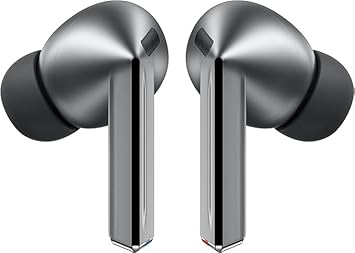
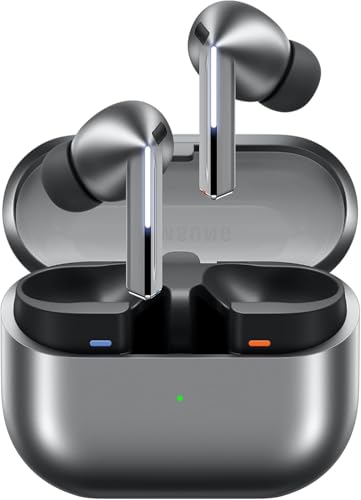
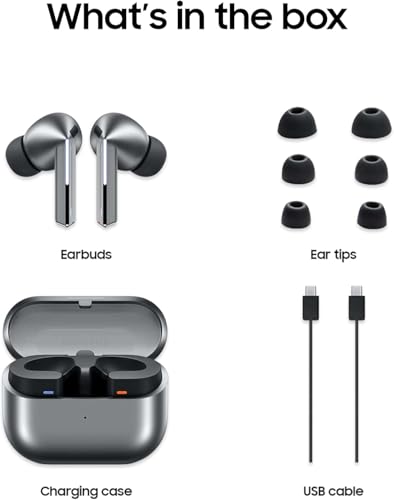
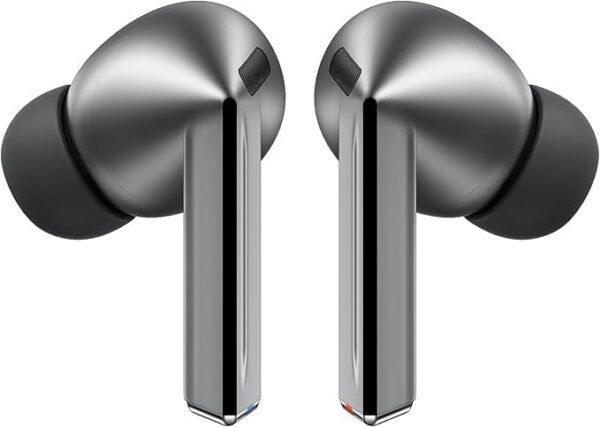
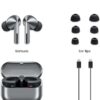
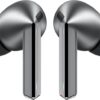
The Galaxy Buds 3 Pro is a sealed in-ear bud with adaptive noise cancellation, a stem, three sizes of ear tip and a charging case that takes both wireless and wired power. Samsung records the intended uses as music, travel and calling, and gives the age range as adult. The listing is unusually direct about its real audience: the advanced features are described as “optimized for Android, particularly Samsung Galaxy devices,” and the bullets state that Galaxy AI functions require a Samsung Galaxy handset for full functionality.
That framing is honest and it should shape the buying decision. If you carry a recent Galaxy phone, a large part of what this listing advertises is available to you. If you carry an iPhone, the listing itself concedes that the buds connect over Bluetooth but that “certain features are exclusive to Galaxy Android devices.” Buying these for the translation and spatial audio features on an iPhone is buying something you will not receive.
Connection, and the codec question
Samsung states Bluetooth 5.4. As always, that number describes connection housekeeping rather than sound: lower power draw, better behavior in crowded radio environments, fewer dropouts. It does not by itself make anything sound better, and no listing should be read as saying it does.
What “24bit/96KHz” actually depends on
The listing claims high resolution audio, and to its credit it names the codecs: “SSC HiFi and UHQ audio codecs, delivering 24bit/96KHz audio.” Those are Samsung’s own codecs. SSC, the Samsung Seamless Codec, is not a universal Bluetooth codec and is not implemented by other phone makers. The high resolution claim therefore carries a condition the marketing copy skips: it requires a Samsung source device that supports the codec, with the feature enabled, and it does not apply on an iPhone or on a non-Samsung Android phone. Read as a general statement about sound quality it is unsupported. Read as a statement about a Galaxy phone paired to Galaxy buds it is a real specification.
The listing also advertises 360 Audio with Direct Multi-Channel and describes it as most effective “when paired with Samsung Galaxy devices,” which is the same conditional in different words. Multipoint pairing to two devices at once is not mentioned anywhere in this listing. Wear detection is not mentioned. Neither is aptX or LDAC. Where a feature is not published, we do not assume it exists.
Battery: two numbers that do not agree
The listing gives the battery figure twice and the two versions conflict. The description says “up to 8 hours of playback with ANC on, and up to 18 hours with the charging case.” The compatibility bullet says the buds “provide 5-8 hours of playback depending on Active Noise Cancellation (ANC) usage, and up to 18 hours with the charging case.” Those cannot both be right. Either eight hours is the figure with cancellation running, or eight hours is the figure with cancellation off and five hours is the figure with it on. Samsung does not reconcile them here and we are not going to pick one for you.
What is consistent is the split, and it is the split that matters. The eighteen hour number is the total including the case, not a single charge. Bud runtime is somewhere between five and eight hours depending on which sentence you believe, and the case adds roughly one and a bit more refills on top. Eighteen hours total is a modest figure for this class of product. Several cheaper models in our true wireless earbud listings publish forty hours or more with the case, though almost always without a comparable cancellation system running.
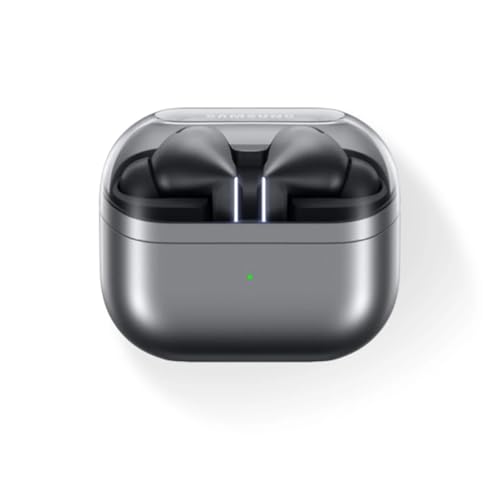
The case supports wireless and wired charging and the listing mentions fast charging, but does not state how many minutes of charge produce how many minutes of playback. That omission is common and it makes the fast charge claim unverifiable.
Fit, seal, controls and water resistance
Three ear tip sizes are supplied, listed as S, M and L. Three is the ordinary count and it covers most ears, but a sealed bud that does not seal will sound thin and will cancel poorly, so anyone who has struggled with stock tips before should plan on aftermarket ones. Samsung describes the design as stemmed and redesigned for comfort fit, weighing 0.19 ounces, with quoted dimensions of 1.31 by 0.71 by 1.31 inches. Controls are touch only, which means no physical button and a higher chance of accidental triggers under a hat or a helmet strap.
The driver field says “Planar Magnetic Driver” with no size given, and the impedance is listed as 25.75 ohms. That impedance figure is suspiciously precise for a consumer listing and no measurement conditions are stated, so treat it as a data field rather than a specification you can act on. Frequency range is quoted as 20 Hz to 20,000 Hz, which is the standard boilerplate range and tells a buyer nothing, because it comes with no tolerance figure.
On water, the listing is better than most. The description states an IPX7 rating and the bullets repeat it. IPX7 is an immersion rating, which is a genuine step above the IPX4 splash rating carried by the majority of this catalog, including the Sony WF-1000XM5. Two cautions all the same. The specification table separately records “Water Resistance Level: Waterproof” with no code attached, and a bare word is not a rating. And no IP code covers seawater, pressurized water or a hot shower, and the seals that earn the rating degrade with age and impact.
What is missing, and the duplicate listing problem
Customer feedback sits at 4.4 out of 5 from 332 ratings, with the sales rank given as 772nd in Electronics and 109th in the earbud and in-ear headphone group. The model is recorded as SM-R630, first available in July 2024.
Worth knowing before you buy: this catalog carries the Galaxy Buds 3 Pro more than once, under separate ASINs and separate regional SKUs. Our Galaxy Buds3 Pro review covering the SM-R630NZAEXAR listing and our writeup of a further Galaxy Buds 3 Pro listing describe the same hardware from different sellers, with different warranty situations. Compare the fine print, not just the headline specification.
If the AI features are not what you are buying, the previous generation is the sober alternative and our Samsung Galaxy Buds2 Pro review sets out what you give up. Readers who want the same sealed shape without the Samsung ecosystem tie should start from the general in-ear headphone listings instead.
Who should buy it and who should not
Buy it if you own a recent Samsung Galaxy phone, you want the immersion-grade IPX7 rating, and eighteen hours total including the case is enough for your travel pattern. Do not buy it for the high resolution claim on an iPhone or a non-Samsung Android phone, because SSC and UHQ will not be available to you and the listing says so itself. Do not buy this particular listing if a United States warranty matters, because it is explicitly described as an international model without domestic warranty. And before ordering, ask the seller which of the two conflicting battery figures applies with cancellation switched on.