Description
The use case this is built around
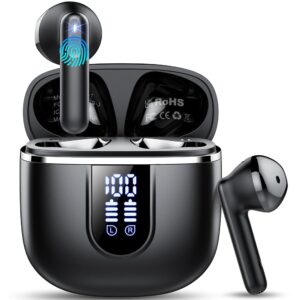
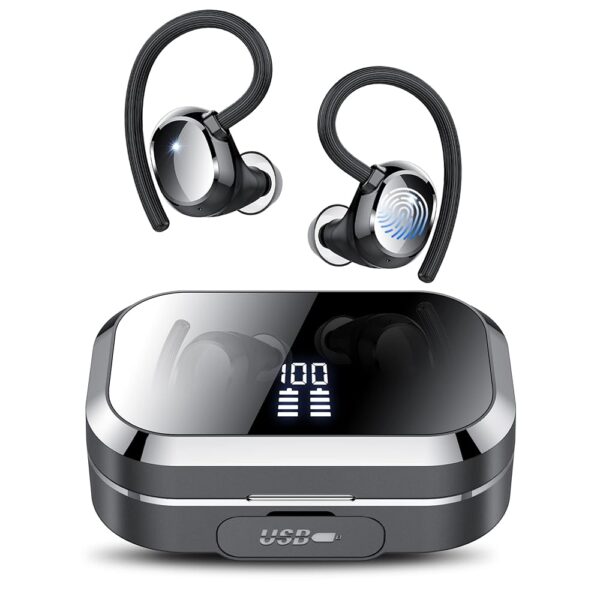
The KT1 Q25 is an ear hook sport earbud. Ear Placement reads Over Ear while Form Factor reads In Ear, and taken together those two fields describe exactly what the product is: a bud that sits in the canal with a hook that loops over the top of the ear to hold it there. The bullets describe soft rubber wings sized to work in smaller ears as well as larger ones. Specific Uses reads sport and the recommended use is running. That is a coherent product brief, and it is the shape most people reach for when a standard bud keeps working loose during exercise.
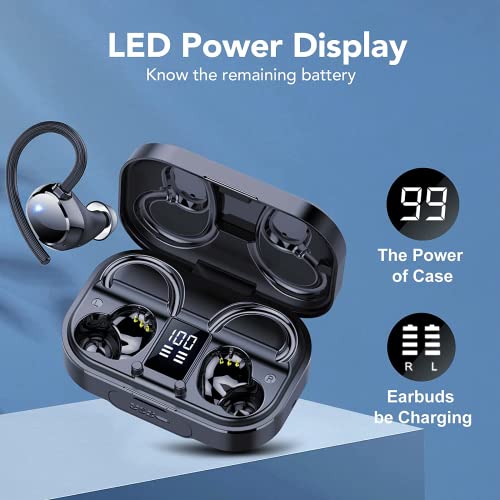
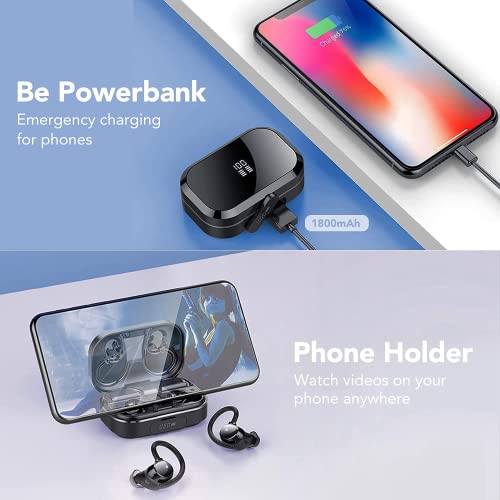
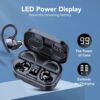
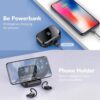
The published rating is 4.4 out of 5 across 4,689 ratings, and the listing places the model 550th in the earbud and in-ear headphone category. It first appeared in March 2023. The most visible feature beyond the hooks is an LED digital display on the charging case showing remaining charge for both the buds and the case.
Connection, latency and what is not claimed
The specification gives Bluetooth 5.3 with a 10 meter range, and the bullets add a detail that is unusually specific for this level: a minimum latency of 42 milliseconds, achieved with what KT1 calls an advanced ceramic antenna. Forty two milliseconds is a reasonable figure. It is low enough that video lip sync should be acceptable and high enough that competitive gaming would still notice it. The bullet also claims fifty percent signal enhancement from the antenna, which is a number without a baseline. Fifty percent better than what is never stated, so it should not carry weight in a decision.
No audio codec is named. SBC is the guaranteed baseline, AAC is unconfirmed, and neither aptX nor LDAC is claimed. There is therefore no support for calling this a high resolution or lossless product, whatever the marketing around graphene drivers might suggest. The frequency range given, 20 Hz to 20,000 Hz, is boilerplate that appears on nearly every headphone listing and carries no information about how the product actually sounds. Multipoint is not mentioned. Noise Control reads None, so there is no active noise cancellation and no transparency mode on this model.
Bass claims with no baseline
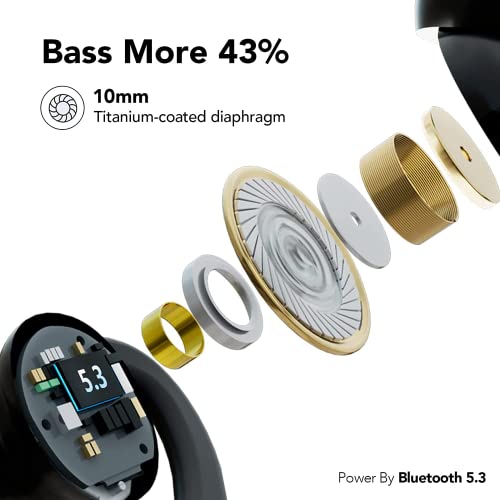
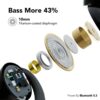
The title advertises Deep Bass 2.0 and the feature bullet describes enhanced bass 3.0 technology delivering forty three percent more bass. Those are two different version numbers for the same feature on the same page, and forty three percent more than an unnamed reference point is not a measurement. The substantive part is the driver itself, described in the bullet as a 10mm graphene unit, though the specification table has no Audio Driver Size field to confirm it. Graphene is a real material used in driver diaphragms and it is not, by itself, a guarantee of anything.
Battery, split into the numbers that matter
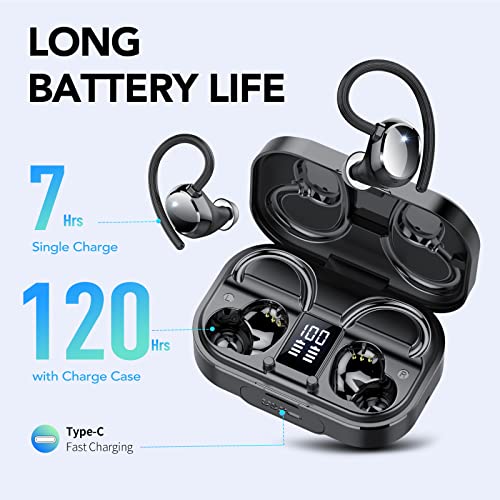
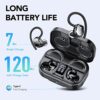
The title says 120 hours of playtime and the Battery Life field repeats it. The feature bullet does the honest work: the earbuds run for 7 hours on a full charge, and the case takes the combined total to 120 hours. So your continuous listening session is 7 hours, and 120 is what you get across many case recharges before the case itself needs a wall socket. A 120 hour headline is one of the largest in this catalog and it is almost entirely a statement about case capacity rather than about the earbuds.
Charging figures are given as 1.5 hours for the buds and 2 hours for the case. One specification entry is worth flagging as an import artifact rather than a fact: the Carrying Case Weight reads 7E plus 1 Grams, which is scientific notation for 70 grams. That is a plausible case weight, but a field rendering numbers in exponential form is a sign the data has passed through a spreadsheet on its way here, and it is a good reason to treat neighbouring figures with care. The Batteries field says three lithium ion batteries required and does not mark them as included, which for a rechargeable product is another entry that does not describe reality.
Fit, seal, controls and the water rating
The hook and wing arrangement is the main fit mechanism, and the bullets specifically claim it suits smaller ears because the in-ear portion is compact. What the listing does not state anywhere is how many ear tip sizes are included, and the Included Components field reads only CD, which is an obvious import error on a product that ships no disc of any kind. Tip count decides whether the seal works, and the seal decides how much bass you actually perceive, so its absence is a real gap on a product sold on bass.
The water rating appears only in the title, as IPX7. The Water Resistance Level field says nothing more than Waterproof. IPX7 would mean immersion in fresh water to one meter for thirty minutes, which is a strong rating for a running earbud, but a title only claim with no supporting specification entry deserves caution. No IP code covers seawater, chlorinated pool water or pressurized water, and every seal degrades with age and heat.
Control fields contradict each other three ways. Control Type reads Media Control, Control Method reads Remote, and Controller Type reads Button. Buttons are the most likely answer given the hook design, but the listing does not settle it. Weight is given as 101.3 grams and 3.57 ounces, which agree with each other and describe the packaged set rather than what you wear.
What is missing, and the alternatives
Not published: codec support, ear tip count, driver size in the specification table, impedance, sensitivity, multipoint, transparency mode, wear detection or app support. The 42 millisecond latency figure and the 7 hour bud runtime are the two genuinely useful numbers on the page.
Very long case totals are a competitive category all of their own now. The Bcaikair BX17 and its 80 hour claim and the Catitru BX17 quoting the same 80 hour figure both chase the same buyer, while the OFNEX X19 with a 90 hour headline and the hadbleng Q22 claiming 128 hours push the number further still. In every case the question to ask is the same one: what is the bud runtime. Browse the true wireless earbud section and the wider in-ear headphone listings for the rest.
Who should buy it, who should not
Buy it if a hook mounted fit is what keeps earbuds in your ears during exercise, if 7 hours per charge covers your sessions, and if a charge display on the case is genuinely useful to you. Skip it if you need active noise cancellation, if a named codec matters, if you want a water rating confirmed in the specification rather than the title, or if the 120 hour number was doing the persuading, because that figure describes the case and not the earbuds.