


Description
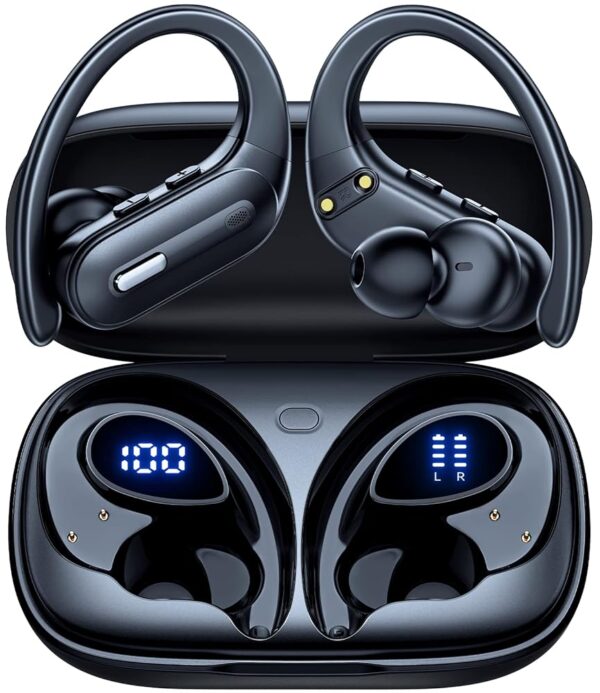
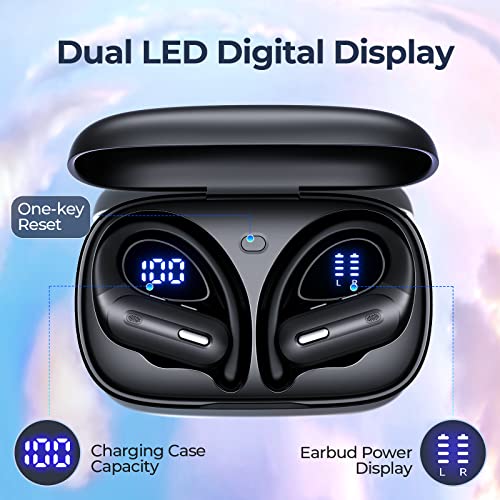
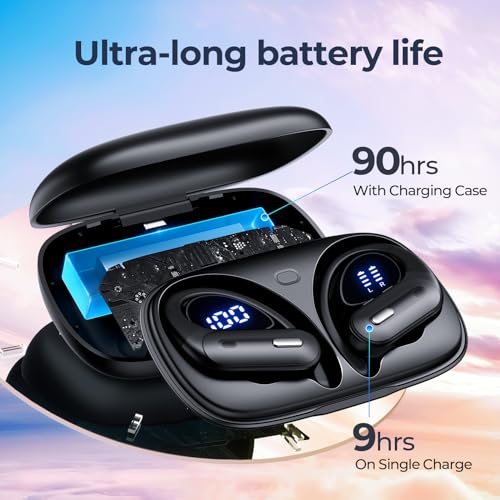
The OFNEX X19 is a hook mounted true wireless set built around a large 14.2 mm driver, physical buttons rather than a touch panel, and a wireless charging case with a power display. Its headline is 90 hours of playtime. That figure is real in the sense that OFNEX explains where it comes from, which puts this listing ahead of most of its neighbors, but several structured fields in the same record are visibly wrong and the product is filed under the wrong form factor throughout.
Who this is built for
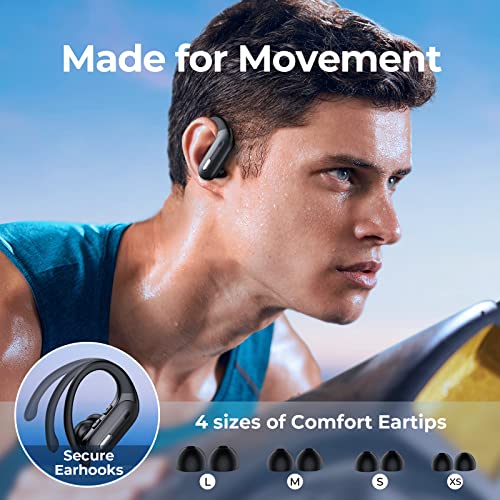
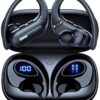
Hooks solve retention. OFNEX describes flexible secure fit ear hooks intended to hold through vigorous exercise, and pairs them with four pairs of rubber tips in extra small, small, medium and large. Four sizes is more than most competitors ship and it is one of the genuinely useful specifications in this listing, because tip size decides seal and seal decides how the product sounds.
This is a gym and training product. The tips seal the canal, so situational awareness drops, and that rules out road running and cycling in traffic regardless of what the marketing suggests. A sealed bud with music playing masks an approaching vehicle, and there is no transparency mode in this listing to restore the missing cues. Riders should be looking at the clip and hook designs in the open ear headphone category. There is a volume caution attached: sealing buds in a loud gym tempt the listener to raise the level until the music wins, and sustained high volume is how hearing loss accumulates without warning. Set the level in a quiet room.
Connection: Bluetooth 5.3 and an unsupported Hi-Fi claim
OFNEX gives Bluetooth 5.3 and describes faster transfer speed, a more stable connection and automatic pairing once the buds leave the case after the first setup. Bluetooth 5.3 improves connection maintenance and power draw and lays groundwork for LE Audio. It is a radio specification and it does not improve sound quality by itself.
What the listing claims and what it can support
The bullets promise Hi-Fi stereo audio and say the connection will sync audio and video without delay. Neither claim has anything behind it in the specification. No codec is named anywhere in this listing, so SBC is the only one a buyer can rely on, since every Bluetooth device supports it. High resolution audio requires a named codec such as aptX Adaptive or LDAC and requires the source phone to support it too, because both ends of the link must agree, and most iPhones support neither. The video sync claim carries no latency figure in milliseconds and no low latency mode, so anyone buying for gaming or video should assume ordinary SBC delay. Buyers who want a codec they can verify against their own handset should compare with the Soundcore Space A40 review, which names LDAC and states the device requirement openly.
Multipoint pairing is not mentioned, nor is wear detection or app support. Noise Control is recorded as None, which is consistent with the bullets: there is no active cancellation and no transparency mode here. Whatever isolation the product provides comes from the tip seal alone.
Battery: eight hours in the ear, ninety with the case
OFNEX is unusually clear about this. Each bud offers up to 8 hours of continuous listening on a single charge, and the case brings the combined total to 90 hours. The 90 hour headline therefore describes roughly eleven bud charges from a full case, not a single session, and 8 hours is the number that governs any given workout or flight.
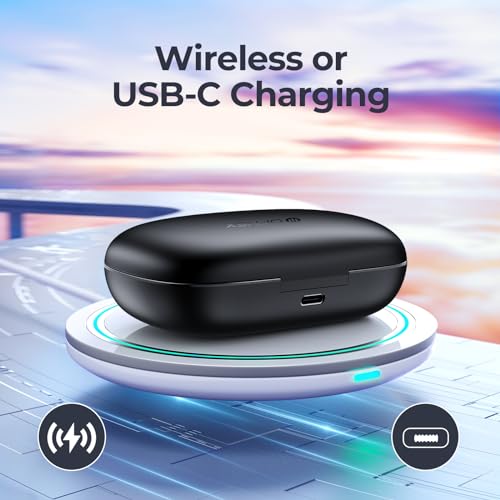
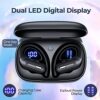
Both figures are best case ratings, normally measured at moderate volume, and there is no cancellation circuitry here to drain the reserve further. The case can be recharged over the supplied USB-C cable or on any Qi certified wireless pad, with the listing noting that the pad is not included. Curiously, the structured specification table contains no battery fields at all, so both numbers come from the marketing copy rather than the data sheet, and no charging time or case capacity is published anywhere.
Fit, controls and a water claim with no consistent code
Four tip sizes and flexible hooks make this one of the better documented fit stories in this part of the catalog. A poor seal is the most common cause of an earbud sounding thin, because low frequency energy escapes rather than pressurizing the canal, and having extra small through large available means most buyers can correct it. The driver is quoted at 14.2 mm with a dual chamber design, which is large for an in ear and consistent with the emphasis on deep bass, though no frequency response figure is published and driver size on its own predicts very little about tuning.
Controls are a strength, and also the site of a data contradiction. The bullets describe separate multifunction and volume buttons on each bud, with complete volume and track control available from either side independently. Physical buttons resist accidental triggering in a way touch panels do not, which matters when sweat and hook adjustments are involved. The structured fields, however, list Control Type as Volume Control, Control Method as Touch and Controller Type as Button. Those three cannot all be right, and the bullet description of physical buttons is the most detailed and most likely correct.
The water claim is less resolvable. The product title says waterproof. Bullet three says IPX7 waterproof. The structured Water Resistance Level field says only Waterproof with no code. IPX7 is an immersion rating and the most specific claim on offer, but it appears in exactly one place. We will not describe this product as waterproof on the strength of a marketing word, and a buyer intending to submerge these should get the IPX7 confirmed in writing. Even a genuine IPX7 covers fresh water under laboratory conditions and never covers seawater, chlorinated pools or high pressure spray, and seals degrade with age and sweat salt. For a sport set whose rating is stated consistently, the JBL Endurance Peak 3 review is a fair comparison.
The data errors, and where to look instead
Two fields in this record are not usable. Item Weight is recorded as 1.1 grams and again as 0.039 ounces, which agree with each other and are both impossible for a pair of hook mounted earbuds; a single bud of this type typically weighs four to six grams before the hook. More consequentially, Ear Placement and Form Factor are both recorded as Over Ear, and the Amazon rank places the product 337th in over ear headphones. This is a hook mounted in ear earbud, and the Earpiece Shape field correctly says Hook. The over ear classification is wrong in the source data.
OFNEX states a 4.9 out of 5 rating across 351 ratings, unusually high for this category and reported as the listing gives it. Buyers wanting the same hook security with a fuller published sheet should compare the JBL Endurance Race review or, for a sealed set with real cancellation, the Sony WF-C700N review. More sport oriented designs sit in the true wireless earbud listings.
Who should buy it and who should not
Buy the OFNEX X19 if you want hook retention, four tip sizes including an extra small, physical buttons with volume on the bud, and a case you can drop on a Qi pad. Eight hours per charge and 90 hours total are both strong for the money. Skip it if you need noise cancellation, since the specification says there is none, or if you need a named codec, a latency figure, or an immersion rating you can rely on. Confirm the IPX7 with the seller before any exposure beyond sweat.
![SAMSUNG Galaxy Buds 3 Pro AI True Wireless Bluetooth Earbuds, Noise Cancelling, Sound Optimization, Redesigned Comfort Fit, Silver [US Version, Amazon Exclusive, 2Yr Warranty]](https://wirelessemporium.com/wp-content/uploads/2025/04/samsung-galaxy-buds-3-pro-ai-true-wireless-bluetooth-earbuds-noise-300x300.jpg "SAMSUNG Galaxy Buds 3 Pro AI True Wireless Bluetooth Earbuds, Noise Cancelling, Sound Optimization, Redesigned Comfort Fit, Silver [US Version, Amazon Exclusive, 2Yr Warranty]")