




Description
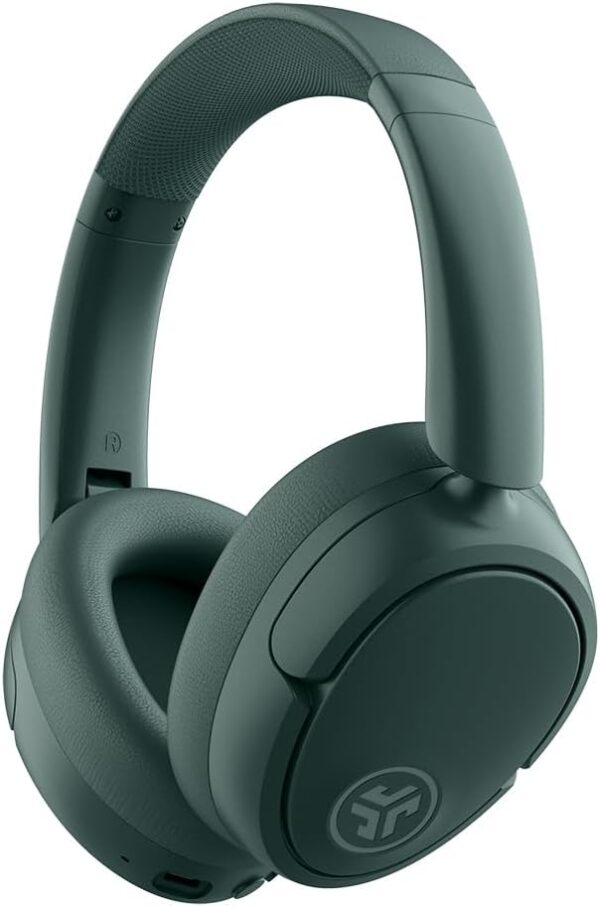
The JLab JBuds Lux ANC, model HBJLUXANCSGE20WEB in the Sage colorway, is an over-ear Bluetooth headphone with hybrid active noise cancellation, 40mm drivers and one of the longest quoted battery figures in this catalog. It became available on January 5, 2024 and shows a 4.5 star average across 1,180 ratings, ranked 733rd in Electronics and 39th in Over-Ear Headphones in the captured listing data. The feature list is unusually complete for its class, and unusually, most of it is stated rather than implied.
Who this suits
This is a commuter, student and work-from-home headphone. JLab lists travel, workout and commute as the intended situations, and the design supports that: a folding frame with rotating ear cups, faux leather over one inch foam cushions, and a battery long enough that charging becomes a weekly rather than nightly job. The app is central to the pitch, so this suits someone who is willing to install one and use it, and suits a buyer who wants a transparency mode and multipoint without stepping up to a flagship.
It suits a road cyclist or a runner in traffic less well. Be Aware mode does let ambient sound in, but this remains a closed over-ear design with a cancellation circuit, and the safe default is to treat it as an indoor and seated-transport headphone rather than something to wear near moving vehicles.
Connection: strong on features, silent on codecs
The connection feature list is where the Lux ANC earns its place. Bluetooth multipoint is stated explicitly, letting the headphone hold two devices at once and switch between them. Google Fast Pair is listed for Android setup, and Google Find My Device support is listed for locating the headphone if you lose it, which is a genuinely uncommon inclusion at this level. Wireless Share Mode lets two pairs of Lux headphones share one audio source.
What is missing is the part that decides sound quality over the air. The listing publishes no Bluetooth version number and names no codec. No SBC, AAC, aptX or LDAC appears anywhere in the record. SBC is the baseline every device supports, and in the absence of anything else stated, that is the only assumption you can safely make. No high resolution or lossless claim is made here, which is to JLab’s credit, but it also means there is nothing to verify.
Spatial Audio is a compatibility claim, not a feature
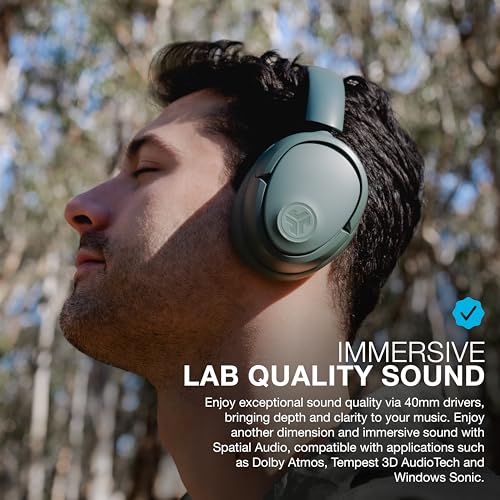
JLab lists the headphone as “Spatial Audio Compatible” with applications such as Dolby Atmos, Tempest 3D AudioTech and Windows Sonic. Read that precisely. Those are platform features that render spatial audio on the source device and then send ordinary stereo to the headphone. The headphone is compatible with them in the sense that any stereo headphone is. There is no head tracking claim and no on-board spatial processing described. It is not a reason to choose this model over another.
Battery, split properly by the manufacturer
JLab quotes 70 or more hours of playtime, and 40 or more hours with cancellation switched on. Both numbers are given in the same sentence, which is the disclosure most listings avoid. The specification field records only “Battery Life = 70 Hours,” so anyone reading the field rather than the bullet takes away the wrong figure. If you intend to run cancellation, the number that matters is 40.
Neither figure comes with a stated volume level, and quoted playtimes are always measured at a moderate level. The listing does not publish a charging time, a fast charge figure, a battery capacity, or even the charging port type. The included components are given only as “Headphones, User Manual, Charging Cable,” so the connector is not identified. The battery field says “2 Lithium Polymer batteries required,” which most likely reflects one cell per cup rather than an error, but the listing does not explain it.
Fit, controls and cancellation
The ear cups are described as form-fitted to the outline of the ear with one inch Cloud Foam cushions and adjustable hinges, in faux leather and plastic. Over-ear cushions seal around the ear rather than pressing on it, which is why this shape blocks low frequency noise better than an on-ear design such as the Beats Solo 4 before any electronics are involved. Controls are touch based and, unusually, remappable through the JLab app along with the ANC and Be Aware settings and three EQ presets named JLab Signature, Balance and Bass Boost.
The listed item weight of 235 milligrams is not a real figure. That is under a quarter of a gram. The intended number is almost certainly 235 grams, which would be normal for a cancelling over-ear headphone, but we are not going to correct a specification on the manufacturer’s behalf. Take the weight as unpublished.
On cancellation, JLab states the smart ANC eliminates external distractions “up to 35 dB” and describes it as continually learning how best to cancel noise. The 35 dB figure is JLab’s own, with no test standard named and no frequency range attached, so it is not comparable to any competitor’s number. The mechanism is the same as every ANC headphone: it works on constant low frequency noise such as engine and cabin drone, and much less well on speech. No headphone makes a room silent. Be Aware mode is the opposite setting, deliberately passing ambient sound through.
On water, the record says “Water Resistance Level = Water Resistant” and publishes no IP code. That is a word, not a rating. Without an IPX number there is nothing that tells you whether it survives sweat, a rain shower or neither, and we will not translate the phrase into a code that was never printed. Treat the workout suggestion in JLab’s own comfort bullet with corresponding caution.
The hearing safety point, stated carefully
Two things in this record need to be read together. The age range field says “Adult, Teen, Kid,” which means the product is being offered for children. And the app bullet says a “Safe hearing option allows you to protect your ears from hearing damage with volume limits.”
The listing does not state what the limit is. No decibel figure is given anywhere, so there is no published cap to evaluate. More importantly, the limit is an app setting, which means it is a setting that can be switched off by whoever has the app. A volume limit is only meaningful if it cannot be bypassed by the person wearing the headphone, and nothing in this listing describes any lock, passcode or parental control. We cannot describe this or any headphone as safe for a child’s hearing. If it is going to a young listener, set a volume limit on the source device itself as well, and check it cannot be turned off in settings.
What is not published, and where else to look
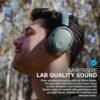
Not in the record: Bluetooth version, codec, charging port, charging time, sensitivity, impedance, frequency response, microphone count, or a real weight. The call microphones are described as “cutting-edge noise-canceling” with no count and no measurement, and phrases like “lab quality sound” and “impeccable conversation experience” are brand language rather than specification.
For comparison, the Soundcore Life Q20 is the long-standing budget cancellation option with a similar battery approach, the Soundcore A3035 sits nearer this feature level, and the Sony WH-CH720N is the mainstream-brand alternative. Wider options are in the wireless headphones section.
Who should buy it
Buy the JBuds Lux ANC if you want multipoint, a transparency mode, remappable controls, an EQ app and a 40 hour cancellation battery, and you are comfortable that the app is part of the product. Skip it if you need a published IP code, a named codec, a stated charging standard, or a volume limit that a child cannot switch off.