Description
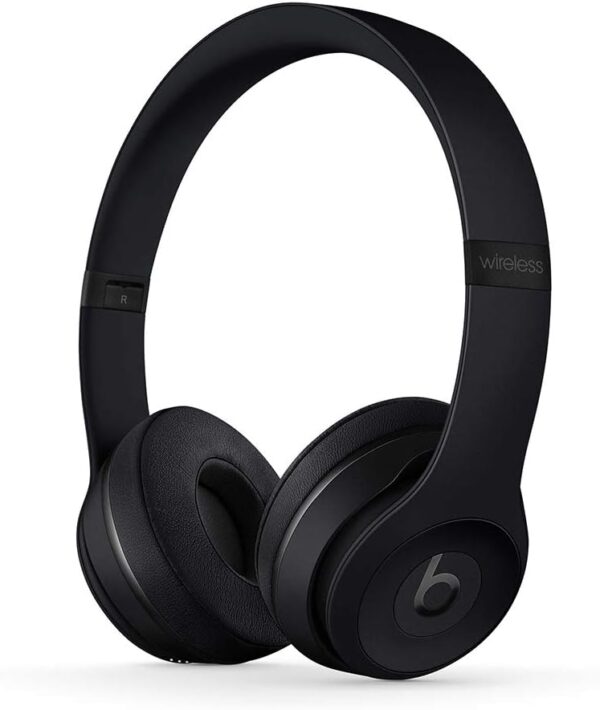
The Beats Solo3 Wireless, model MX432LL/A, is an on-ear Bluetooth headphone built around Apple’s W1 chip and a quoted 40 hours of battery life. The listing gives October 15, 2019 as the date first available, which makes this one of the older active products in this catalog and explains several of its design choices, including the charging port. It ships in black with a nylon carrying case and a 3.5mm RemoteTalk cable, and Apple is named as the manufacturer under the Beats brand.
The use case this actually serves
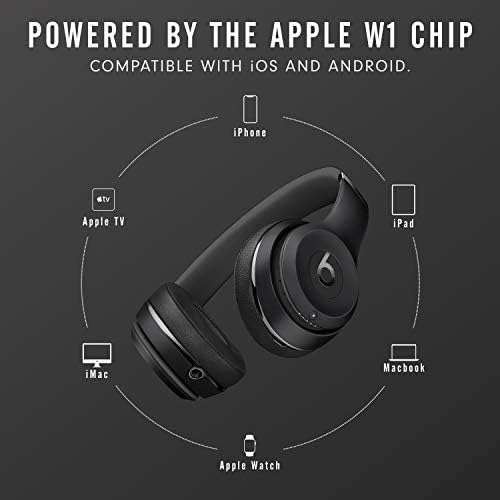
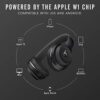
The Solo3 is a daily-carry on-ear headphone for someone inside the Apple ecosystem. The W1 chip is the reason to consider it over a generic Bluetooth headphone: on an iPhone, iPad or Mac signed into the same account, W1 handles pairing and switching between devices without going through the Bluetooth settings menu each time. If your listening happens across several Apple devices, that convenience is the feature. If you are on Android, the headphone still works as a standard Bluetooth device and you lose the part that distinguishes it.
It is worth being clear about what W1 is and is not. It is a pairing and connection chip. It is not a codec and it does not carry a high resolution audio claim. The listing names no codec at all, which means SBC is the only universal baseline you can assume, and no claim about audio resolution appears anywhere in the published specification. Any framing of the W1 chip as a sound quality upgrade goes beyond what this listing supports.
Connection: Class 1 Bluetooth and what the record leaves out
Beats lists “Class 1 wireless Bluetooth connectivity,” which is a transmit power tier rather than a version number or a quality tier. In practice it means more range headroom before the link starts dropping out when you walk away from the source. No Bluetooth version number is published in this record at all, which for a 2019 product is a meaningful omission, because it is the field that would tell you whether the headphone is eligible for any of the newer low energy audio features. There is also no mention of multipoint pairing to two devices at once, no transparency mode, no wear detection and no companion app feature list. Where a listing does not mention those, assume they are absent.
Two fields in the record are simply wrong
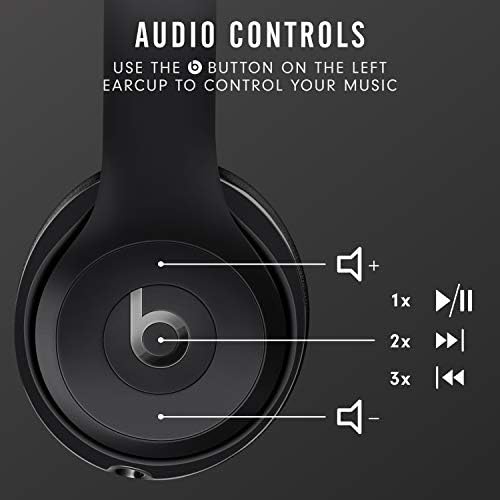
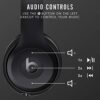
The specification block says “Wireless Communication Technology = Bluetooth, True Wireless.” The Solo3 is a headband headphone with two cups joined by an arch. It is not a true wireless product, and that field has been inherited from a different category. Separately, “Control Method = App” sits beside a feature bullet describing on-ear multifunction controls for calls, music and Siri. The bullets describe physical controls on the ear cup; the specification field describes an app. Both cannot be the primary control method, and the listing does not reconcile them.
Battery: a good number and a broken field
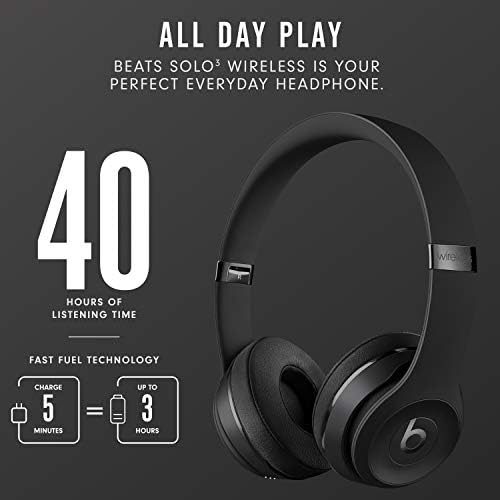
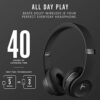
Beats quotes up to 40 hours of listening time, with Fast Fuel giving 3 hours of playback from 5 minutes of charging when the battery is low. As a single headphone with no charging case, 40 hours is the entire figure; there is no bud runtime and case total to untangle here. Forty hours is credible for this design because there is no active cancellation circuit drawing power in the background, which is the same trade the whole Solo line makes.
The specification field “Charging Time = 40 Hours” is not a real number. The battery life value has been copied into the charging time field. The listing publishes no actual recharge duration and no battery capacity, so the only charging data you can trust here is the Fast Fuel claim.
The charging port is the age showing. The box contains a “Universal USB charging cable (USB-A to USB Micro-B),” so this is a Micro-USB product, not USB-C, and the listing states that a USB power adapter is sold separately. In 2019 that was normal. Today it means carrying a cable you probably do not otherwise own. The newer Beats Solo 4 moves to USB-C and raises the quoted figure to 50 hours, and that generational difference is the clearest reason to compare the two before buying.
Fit, isolation and an explicit lack of water resistance
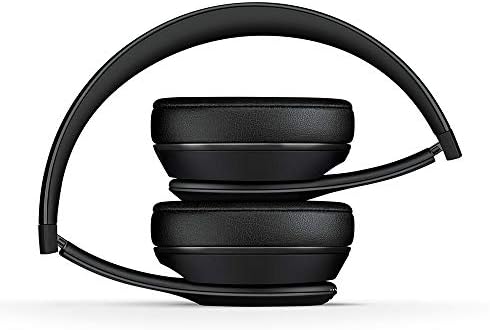
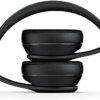
The Solo3 uses comfort-cushioned ear cups on an adjustable, foldable headband, and weighs 7.6 ounces, or roughly 215 grams. That is heavier than several on-ear competitors; the JBL Tune 510BT is listed at 160 grams for the same body shape. Weight on an on-ear design translates into pressure on a small contact patch, so it is a comfort specification and not a trivia item.
Noise control is listed as “Sound Isolation,” meaning passive blocking only. There is no active noise cancellation on this product. On-ear pads press against the outside of the ear rather than sealing around it, so low frequency noise such as engine drone passes through more than it would on an over-ear design. If cancellation is what you are shopping for, the over-ear Bose QuietComfort and Sony WH-1000XM4 both publish it as an actual feature rather than leaving you to infer it.
On water, this listing is refreshingly direct: “Water Resistance Level = Not Water Resistant.” No IP code, and none implied. That is an honest field, and it should be read as a hard limit rather than a formality.
The recommended uses field contradicts that directly
The same record lists “Recommended Uses For Product = Motorcycling, Snowboarding, Running, Exercising, Gaming.” Snowboarding, running and exercising all involve moisture, and the record has already said the product is not water resistant. Those two fields cannot both be good advice.
Motorcycling is a separate and more serious problem. This is a closed on-ear headphone that isolates passively, with no transparency mode published, and it will reduce your ability to hear traffic, sirens and your own engine. Nothing in this catalog should be read as endorsing that. Do not use a closed, isolating headphone on a motorcycle or a bicycle in traffic. If you want audio while moving on a road, the correct product category is an open-ear or bone conduction design that leaves the ear canal clear, not this one. The recommended uses field on this listing appears to be generated rather than considered, and it should be ignored.
What the listing does not publish
Missing from the record entirely: driver diameter, impedance, sensitivity, Bluetooth version, codec support, microphone count, and any customer rating or sales rank, which most other products in this catalog carry. The frequency range is given as 20 Hz to 20,000 Hz, which is the standard nominal figure quoted on almost every headphone and tells you nothing comparative on its own. The material is listed simply as “Plastic.”
The marketing copy describes “award-winning sound and design” and “fine-tuned acoustics” without naming an award, a measurement or a tuning target. Read that as brand language, not specification. The one genuinely practical inclusion is the 3.5mm RemoteTalk cable, which means the Solo3 keeps working as a wired headphone when the battery is flat or when you are handed an airplane seat jack. That is a real advantage over models with no analog input, and it partly offsets the dated charging port.
Wider on-ear and over-ear comparisons across the catalog sit in the wireless headphones section.
One note on listening level. Because this headphone isolates passively rather than actively, noisy places push listeners to raise the volume to cover what the pads let through. Set the volume in a quiet room and avoid chasing background noise upward on a train.
Who should buy it
Buy the Solo3 if you are on Apple devices, want W1 pairing convenience, value a 40 hour battery and a wired 3.5mm fallback, and do not mind a Micro-USB charging port on a 2019 design. Skip it if you want active noise cancellation, USB-C charging, any water resistance, or a published codec, and ignore the field on the listing that recommends it for motorcycling.