
Description
The listener this one is designed around
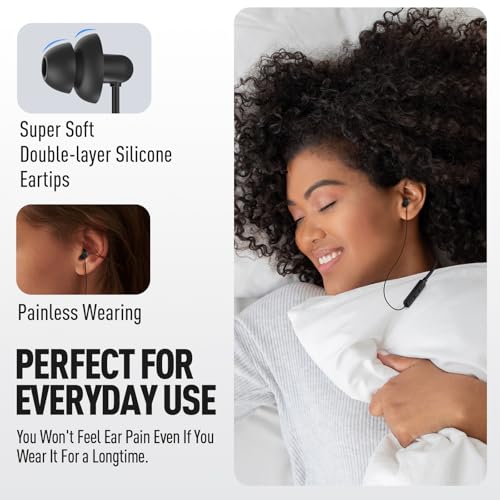
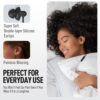
The Hearprotek SE02 is not a general purpose earbud that happens to be comfortable. It is a sleep product. Hearprotek’s own title names side sleepers, relaxing and meditating as the intended uses, and the design follows from that brief: two layer flange silicone tips with a deliberately low profile, so the bud sits close enough to the side of the head that a pillow does not press it into the ear canal. The Specific Uses For Product field says Travel, which sits oddly next to a sleep product, but the feature bullets are unambiguous about the purpose.
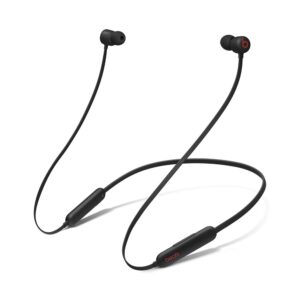
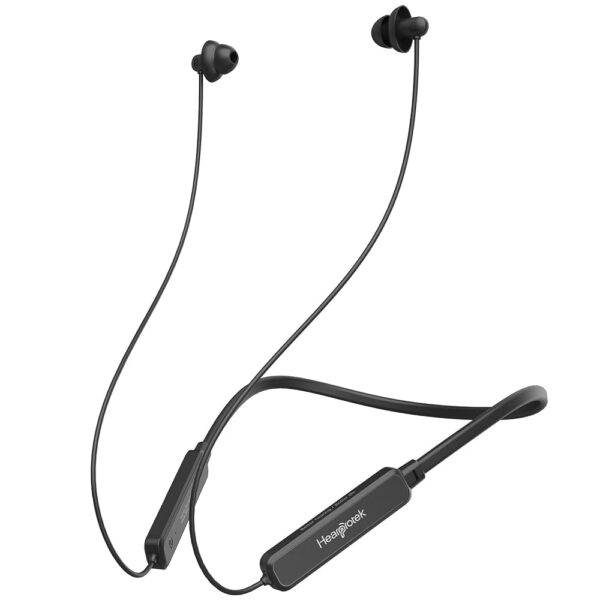
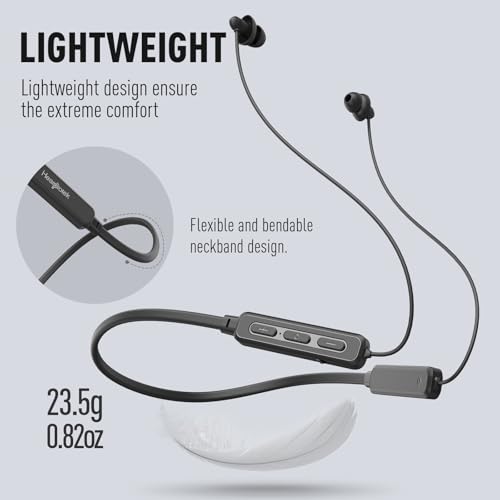
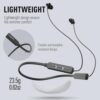
One structural point matters before anything else, because the product title calls these wireless earbuds and that is only half true. The bullets describe earbuds attached to wires that run along the length of a neckband, with the controls at your fingertips. This is a neckband design, not a true wireless pair. There is no charging case anywhere in the picture, and the included components list confirms it: a velvet pouch and a USB charging cable, nothing else. If you were expecting two independent buds in a case, this is not that product. The published rating is 3.8 out of 5 across 1,484 ratings, on the low side of what this catalog carries, and the listing places it 672nd in the earbud and in-ear headphone category.
Connection and what the specification will and will not confirm
Hearprotek’s title says Bluetooth 5.4. The Connectivity Technology field agrees, reading Wireless, Bluetooth v5.4. The specification table has no standalone Bluetooth Version field at all, though, which is where that number normally lives, so the claim rests on the title and one combined field rather than on the usual dedicated entry. Range is given as 10 meters, and compatible devices are listed broadly as smartphones, tablets, laptops, desktops and smart speakers.
No codec is named anywhere. Not AAC, not aptX, not LDAC. SBC is therefore the only thing you can count on, and for a sleep product that is a smaller loss than it would be elsewhere, because the material is usually podcasts, rain noise or quiet music rather than a mix you are evaluating critically. What it does mean is that nothing here supports a high resolution description, and any such claim would go past what Hearprotek published.
What the version number is doing, and what it is not
Bluetooth 5.4 is a newer standard than most of this catalog carries, and its practical benefits are connection stability, lower power draw and support for newer low energy features. It is not a sound quality specification. A 5.4 radio feeding an SBC only chain still sounds like SBC. Multipoint pairing is not mentioned, so assume a single device connection at a time, which is worth knowing if you wanted to fall asleep to a laptop and still hear your phone ring.
Battery, and what the single number leaves out
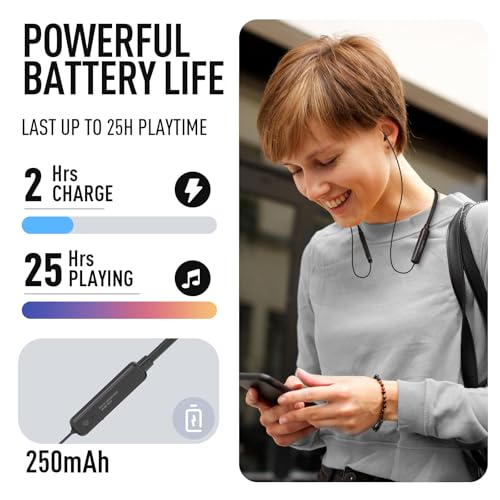
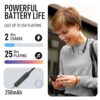
This one is simpler than most, precisely because there is no case. Hearprotek states 25 plus hours of continuous music or call time from a 250 mAh rechargeable battery, with a 2 hour charging time. Because there is no charging case, that 25 hours is bud runtime and total runtime at the same time. There is no second number hiding behind it, which is a genuine advantage of the neckband format when you are comparing against true wireless products that quote only a combined figure and leave you to guess at the per charge session.
One inconsistency deserves naming rather than smoothing over. The specification says two lithium ion batteries are required and included, while the bullet describes a single 250 mAh cell. Those two statements cannot both be a complete description of the same product. Treat 25 hours as the manufacturer’s best case at moderate volume, and expect less if you sleep with the level up or leave the connection live all night with playback paused.
Fit, seal, controls and a water rating that is not a rating
Fit is the entire argument for this product. The two layer flange tip is soft silicone with a shallow profile so that lying on your side does not drive the bud inward. The listing gives the weight in two places, 0.05 pounds and 0.78 ounces, and the bullet adds 22.3 grams, all of which agree closely enough. What the listing does not give is how many ear tip sizes are included. For a sleep product sold on the promise of a snug seal, tip count is arguably the most important number on the page, and its absence is a real gap. The listed product dimensions of 6.49 by 4.96 by 0.71 inches describe the package rather than anything you wear.
The water resistance field says Water Resistant with no IP code published anywhere on the listing. That means no splash, sweat or waterproof claim can responsibly be made, because none of those words carries a defined meaning without a code behind it. Do not assume this survives being sweated in, and do not assume it survives a glass of water knocked over on a nightstand.
The frequency figures are unusable and should not influence a purchase. The specification lists Frequency Response as 15 KHz and Frequency Range as 15 KHz to 20 KHz. A headphone that only reproduced 15,000 to 20,000 Hz would produce no bass, no midrange and no voices at all. This is an import artifact rather than a measurement, and it is a useful reminder that a number sitting in a specification table is not automatically a fact.
The hearing and safety dimension, plus what to read instead
Sleep earbuds carry a consideration ordinary earbuds do not. Hearprotek’s own selling point is that the tight fit seals your ear canal from external physical sounds. That is what makes the product work, and it is also what deserves thought. A sealed canal on both sides reduces your chance of hearing a smoke alarm, a carbon monoxide detector, a child, or a call you needed to take. Nothing in this specification describes a volume limit or an automatic shutoff timer, so overnight playback continues at whatever level you set. Keep that level low. A volume that seems modest while you are awake still accumulates across a full night of exposure, and exposure time matters as much as level.
If the neckband format is the sticking point, the alternatives split into two shapes. A true wireless sleep bud such as the Soundcore Sleep A20 from Anker keeps the buds independent and adds a case, while the VEKJ L8 Pro built around the same side sleeper brief chases the identical problem. If you would rather have nothing in the ear canal at all, a fabric approach like the MUSICOZY sleep headband with flat drivers avoids the seal question entirely, and the budget minded MINISO X10 and its passive blocking approach is worth a comparison. The broader in-ear headphone section holds the rest of the field.
Who should buy it, who should not
Buy it if you are a side sleeper who wants a low profile in-ear option, you accept a neckband with a cable rather than two independent buds, and 25 hours on a single charge suits an overnight routine better than a case based product would. Skip it if you wanted true wireless, if you need a stated IP rating for gym or outdoor use, if a named codec matters to you, or if you are uneasy about sealing both ears while asleep. The frequency specification on this listing is not usable and the ear tip count is not published, so if seal quality is your deciding factor you are buying on faith rather than on specification.