
Description
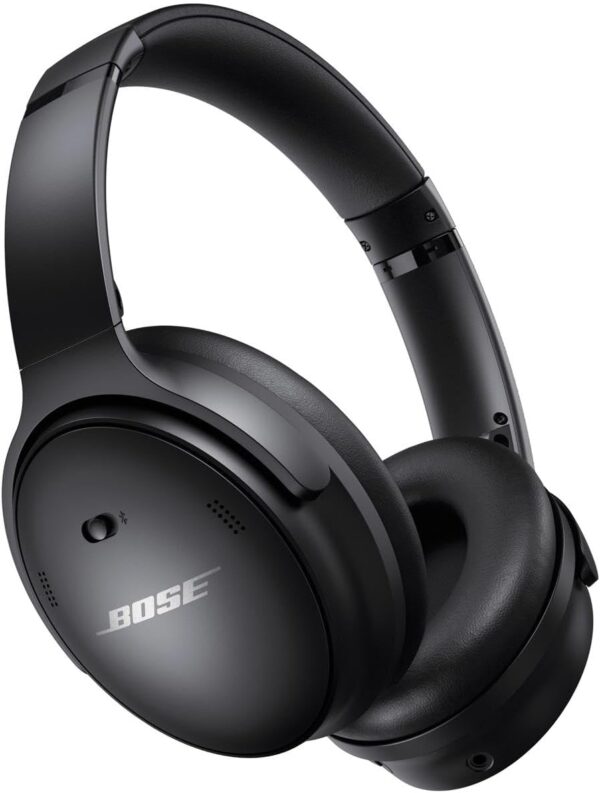
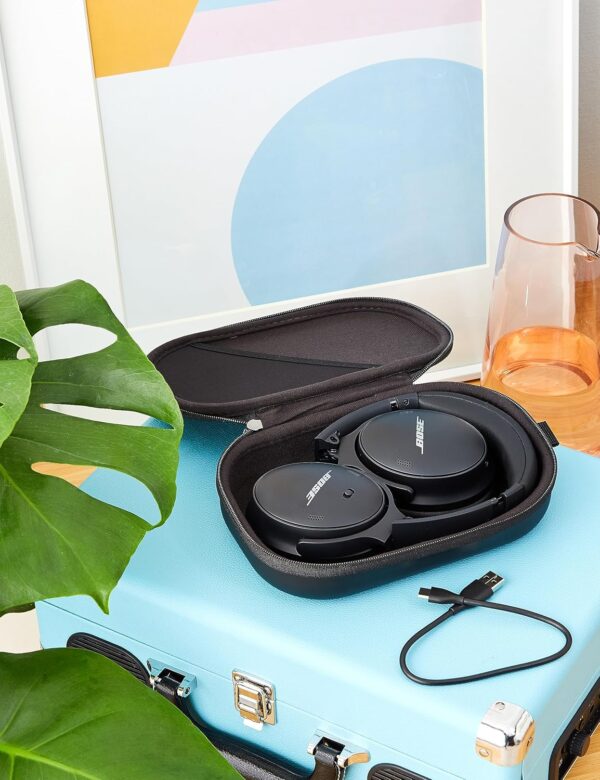
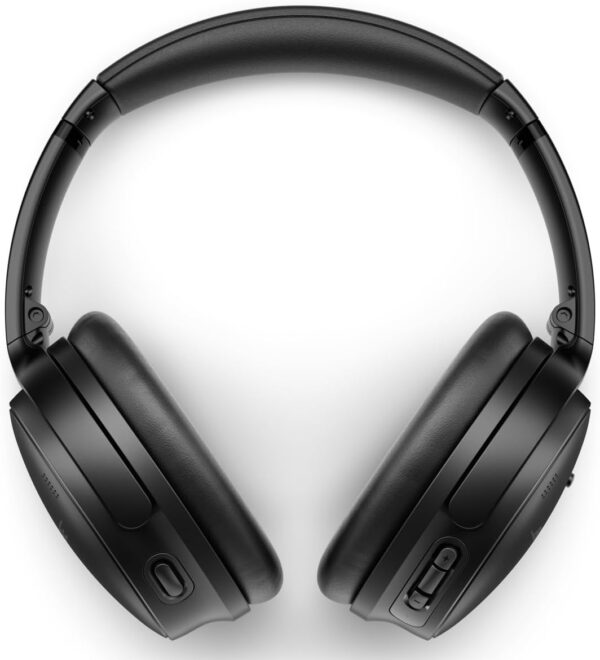
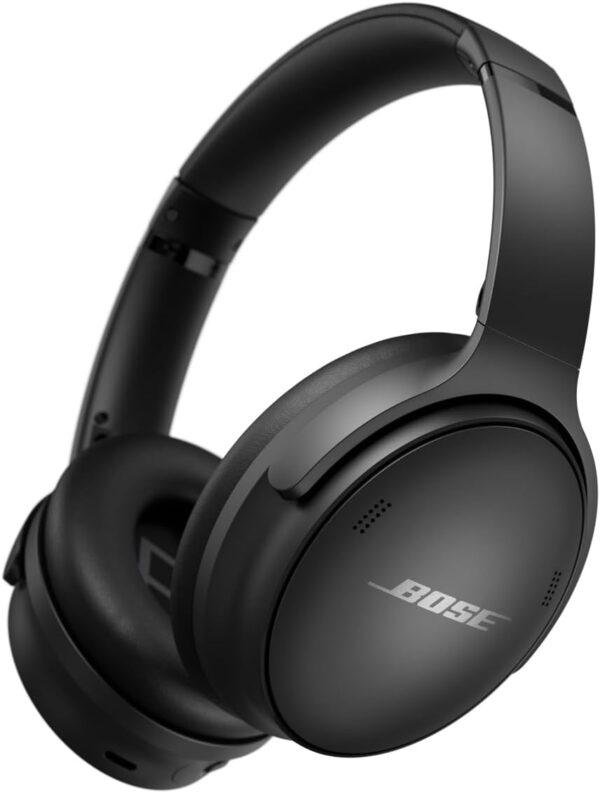
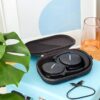
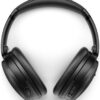
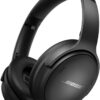
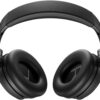
The Bose QuietComfort 45, catalog number 866724-0100, is a closed around-ear Bluetooth headphone with active noise cancellation. Bose lists first availability as August 2021, so this is an established model rather than a new release, and it sits below the QuietComfort Ultra line in the current range. The box contains the headphones, a cable, a protective case and a user manual.
Who this headphone is for
The QC45 is built for travel and for offices. Bose describes minimal clamping force, plush synthetic leather cushions and impact-resistant glass-filled nylon with cast-metal hinges, and the whole design brief is a headphone you can wear for a long flight without noticing it. The listed weight is 15.5 ounces, which is heavier than a light commuting headphone such as the JBL Tune 770NC at 8.2 ounces, so the low clamping force is doing real work in keeping it comfortable.
It is not a sports headphone, and this listing muddies that point badly. The attribute block records water resistance as “Water Resistant” with no IP code attached, and Bose’s own description, bullets and specification make no water resistance claim of any kind for the QuietComfort 45. An ingress claim with no IP code behind it is not a specification, it is a guess. Treat this headphone as having no published water resistance and keep it away from sweat and rain.
How it connects, and the codec question
The attribute data gives Bluetooth 5.1 with a 10 meter range, and Bose’s own bullet puts the reliable range at 30 feet from the paired device, which is the same distance stated differently. Bluetooth 5.1 governs connection stability, power draw and available feature sets. It is not a sound quality figure, and a 5.1 headphone is not audibly worse than a 5.3 one for that reason alone.
No codec is named, so no high resolution claim stands
Bose describes “high-fidelity audio” and a TriPort acoustic architecture with volume-optimized Active EQ, but this listing does not name a single audio codec. There is no AAC entry, no aptX and no LDAC. Where nothing is named, SBC is the only codec that can be assumed, because SBC is the baseline every Bluetooth device supports. Nothing here supports a high resolution or lossless claim, and even if the headphone did support a higher bandwidth codec, the phone would have to support the same one for it to be used. Most iPhones support neither aptX nor LDAC at all.
Multipoint is not mentioned in the description or the bullets. The Bose Music app is described as managing Bluetooth connections, which is not the same thing as running two live audio links simultaneously. If connecting a laptop and a phone at once matters to you, treat multipoint as unconfirmed here, and compare against a headphone that states it plainly.
A wired mode is confirmed, which is genuinely useful on long flights. Bose says the included audio cable lets you listen for even longer in wired mode, and the attribute data gives a 2.5 millimeter jack on the headphone end. That is correct for this model, and it is worth knowing because a lost cable needs a 2.5 to 3.5 millimeter replacement rather than a standard one.
The battery figure, which the listing gives twice and differently
Bose’s bullet states up to 24 hours of battery life from a single charge, with a 15 minute quick charge returning 3 hours. The attribute block on the same record states 22 hours. Those cannot both be the headline figure. Twenty-four hours is the number Bose markets, and 22 is what the imported attribute data holds; we are naming the gap rather than picking one. Charging is over the included USB-C cable, with a listed charging time of 2.5 hours.
Whichever figure you use, it assumes something the listing does not state. Manufacturers normally publish playtime for an ANC headphone with cancellation running, since that is the intended mode, but this record does not confirm which state applies. Active cancellation runs microphones and processing continuously and always costs battery, so read the number as a ceiling at moderate volume.
Two attribute fields on this record belong to a different product category entirely. “Carrying Case Battery Average Life = 10 Hours” and “Carrying Case Weight = 0.44 Kilograms” are true wireless earbud fields. The QuietComfort 45 ships with a passive protective case that holds no battery and charges nothing. Ignore both.
Fit, controls and what the cancellation actually does
Bose offers two modes rather than a sliding scale: Quiet Mode for full cancellation and Aware Mode to let the outside in alongside the music. The Bose Music app adds adjustable noise cancellation settings, guided setup and shortcuts. The cancellation itself is described the honest way, as tiny microphones measuring outside noise and cancelling it with opposite signals, and no decibel reduction figure is claimed. That absence is a point in the listing’s favor, because reduction figures are usually quoted without naming any test standard.
What cancellation is good at is worth stating plainly, because expectations are the main source of disappointment. It works very well on constant low frequency sound such as aircraft cabin drone, train noise and air conditioning. It works far less well on speech, keyboards and other irregular sound. No headphone makes an open-plan office quiet, and Aware Mode is a listening convenience rather than a road safety feature. A sealed around-ear headphone with cancellation running is the wrong choice for cycling or running near traffic under any circumstances.
The control method field says “Touch.” The QuietComfort 45 uses physical buttons on the ear cups, and nothing in Bose’s own description mentions a touch surface. Read that field as import noise. Two frequency fields are also unusable: “Frequency Response = 2400 KHz” and “Frequency Range = [20 | 2400] Hz.” A 2,400 Hz upper limit would put this headphone below the top of a telephone’s range, which is plainly false, and 2400 kHz is not a headphone figure at all. No usable frequency response is published on this record.
What is missing, and what to compare
Unpublished here: impedance, sensitivity, driver diameter, whether the ear cushions are user replaceable, whether wear detection exists, and any real frequency response. Compatible devices is listed as “Television,” which is narrower than reality and reads as another import fault. Ear cushion replaceability matters on a headphone bought to last, because the cushions are the first part to degrade.
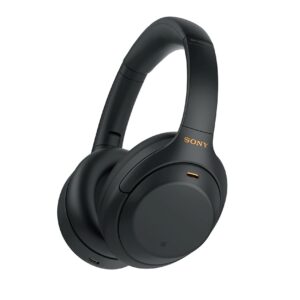
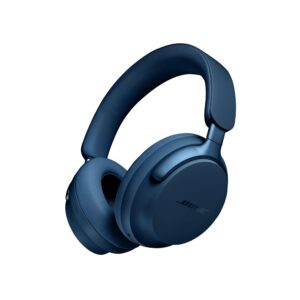
Inside our own listings, the Bose QuietComfort Headphones is the direct successor generation, and the Bose QuietComfort Ultra sits above both with spatial audio. Outside Bose, the Sony WH-1000XM4 is the obvious cross-shop, and the wider wireless over-ear listings are where codec support can be compared side by side.
Who should buy it, who should not
Buy the QuietComfort 45 if cancellation for aircraft and train noise is the main job, if low clamping force matters more to you than feature count, and if a wired fallback for long journeys is useful. Skip it if you need confirmed multipoint, if you want a named high bandwidth codec, if you want spatial audio, or if you were reading the “Water Resistant” field as permission to wear these in the rain. That field is not supported by anything Bose publishes.