
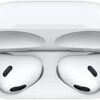
Description
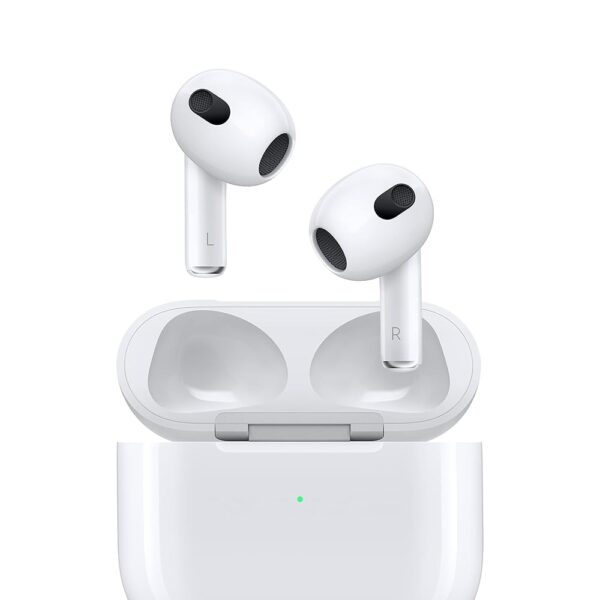
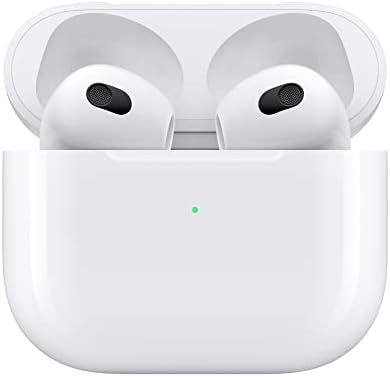
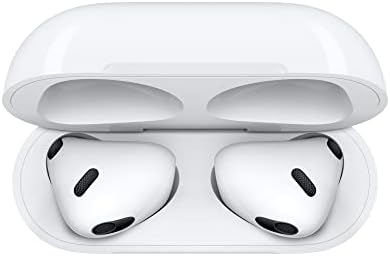
The Apple AirPods (3rd generation), model MME73AM/A, are true wireless earbuds with a MagSafe charging case, spatial audio with dynamic head tracking, Adaptive EQ and a force sensor stem control. Apple made them available on October 18, 2021. The listing quotes 6 hours of listening from the earbuds and up to 30 hours in total with the case, and the record carries no customer rating or sales rank, which most products in this catalog do publish.
The fit is open, and that changes everything
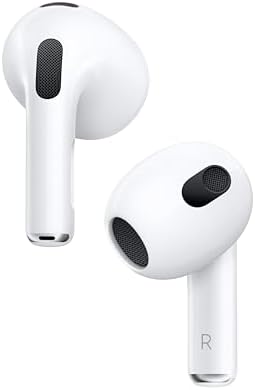
This is the single most important fact about the third generation AirPods and the listing buries it. They use a hard contoured plastic body that rests in the ear rather than a silicone tip that seals the ear canal. The included components are the MagSafe case, documentation, a Lightning to USB-C cable and the AirPods themselves. No ear tips are in the box.
Yet the first bullet on the listing reads: “If the size of the earbud tips does not match the size of your ear canals or the headset is not worn properly in your ears, you may not obtain the correct sound qualities or call performance. Change the earbud tips to ones that fit more snugly in your ear.” That instruction cannot be followed on this product, because it has no interchangeable tips. It is boilerplate attached to the wrong item, and we are flagging it rather than quietly ignoring it.
The practical consequences of an open fit are real and cut both ways. You keep more awareness of your surroundings than any sealed earbud allows, which is genuinely useful walking around a city. Against that, an open fit lets outside noise in, so a bus, a train or an aircraft cabin will come through, and there is nothing to be done about it: the specification field says “Noise Control = Sound Isolation,” but an unsealed earbud isolates very little. There is no active noise cancellation on this model. Bass also depends heavily on how the shape sits in your particular ear, and there is no tip to change if it does not.
Battery: three figures, and the listing gives all of them
Credit where it is due. Apple publishes the split most listings hide, and then publishes a further condition on top of it.
Up to 6 hours of listening time from the earbuds on a single charge, up to 5 hours with spatial audio enabled, up to 4 hours of talk time, and up to 30 hours in total with the MagSafe charging case. The 30 hour figure in the product title is the case total. Six hours is what you get from the buds, and five if you leave spatial audio on, which is the feature the product is sold on.
That one hour difference is the honest cost of the headline feature, and it is exactly the kind of disclosure most manufacturers omit. No volume level is stated for any of the figures, and quoted playtimes are always measured at a moderate level.
The case charges over MagSafe, over a Qi wireless charger, or over the Lightning cable in the box. Lightning rather than USB-C is the age of the design showing, and it means carrying a cable you may not otherwise own if the rest of your devices have moved on.
Connection: the H1 chip is named, the codec is not
The listing names the Apple H1 chip and describes effortless setup, in-ear detection, automatic switching between Apple devices, “Hey Siri” voice access, and audio sharing between two sets of AirPods on an iPhone, iPad, iPod touch or Apple TV. Those are the ecosystem features, and they are the reason to buy these over a generic earbud if you already use Apple devices.
Be clear about what the H1 chip is. It handles pairing, switching and the wireless link. It is not a codec and it carries no high resolution or lossless claim. No codec is named anywhere in this record, and no Bluetooth version number is published either. Without a named codec, no claim about audio resolution would be supportable from this listing, and Apple does not make one here.
Two fields in the record are wrong. “Headphones Jack = 3.5 mm Jack” appears on a product with no jack of any kind. And “Wireless Communication Technology = Wireless, Appel H1 Chip, Bluetooth, NFC” misspells Apple and adds NFC, which is not described anywhere else in the listing. A third, “Theme = TV Series,” is inherited from an unrelated category, and “Control Method = App” sits beside a bullet describing a physical force sensor on the stem.
Spatial audio, and what it needs
Spatial audio with dynamic head tracking places sound around you and adjusts as you turn your head. Adaptive EQ is described as automatically tuning music to your ears. Both are processing features that depend on supported content and a supported source device, and this listing does not say which platforms or apps qualify. They are not improvements to ordinary stereo music by themselves. The Beats Solo 4 in this catalog carries the same spatial audio and head tracking features in an on-ear headphone, if the shape suits you better.
Water resistance: a phrase, not a code
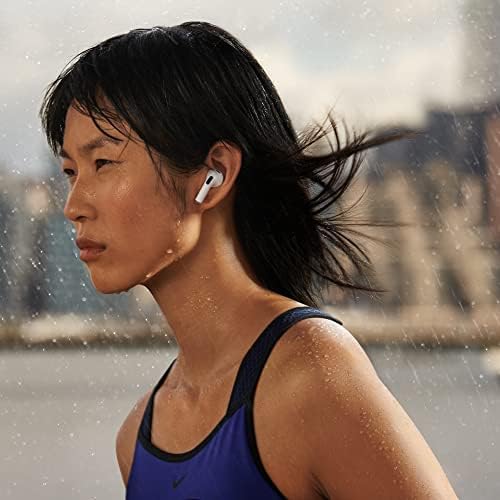
The listing says “Sweat and water resistant,” and the specification field says “Water Resistance Level = Water Resistant.” No IP code is published anywhere in this record. Without an IPX number there is nothing that tells you whether these survive a rain shower, a heavy gym session or neither, and we will not convert marketing wording into a rating that was never printed. Note also that no IP rating, at any level, covers seawater, pools or pressurized water, and that water resistance degrades with age.
The recommended uses field is not advice
The record lists “Recommended Uses For Product = Motorcycling, Snowboarding, Running, Skateboarding, Recording, Exercising, Gaming,” and the compatible devices field includes “Motorcycles.” Snowboarding, running and exercising all involve moisture on a product with no published IP code. Motorcycling is a worse suggestion still: any earbud inside a helmet, open fit or not, competes with wind and engine noise and pushes listening levels up. Nothing in this catalog should be read as endorsing that, and the field reads as generated rather than considered.
What is published, and what is not
Unusually, the record gives real weights and dimensions: each AirPod is 0.15 ounces, or 4.28 grams, and the MagSafe case is 1.34 ounces, or 37.91 grams. The sensor list is also itemized: dual beamforming microphones, inward-facing microphones, a skin-detect sensor, a motion-detecting accelerometer and a speech-detecting accelerometer. The skin-detect sensor is what drives in-ear detection, pausing playback when a bud is removed.
Not published: codec, Bluetooth version, driver size, frequency response, IP code, or a customer rating. A separate field lists the item weight as 0.141 ounces, which conflicts with the properly stated 0.15 ounces per bud in the detailed weight field.
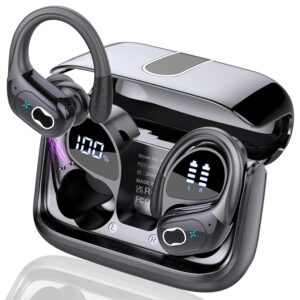
For alternatives, the Samsung Galaxy Buds Plus is the sealed cross-platform comparison with a longer 11 hour bud runtime, and the TOZO T9 publishes an IPX7 code if a stated water rating is what you need. Anyone who wants secure retention for exercise should look at an ear hook design such as the PocBuds T60, since an open fit AirPod has nothing holding it in but the shape of your ear. Wider comparison sits in the wireless earbuds section.
A note on volume. An open fit earbud lets background noise in, which means a noisy street or a train pushes listeners to raise the level to cover it. That is the main hearing risk with this design. No volume limiter is published on this product, and Apple lists the age range as adult. Set the level in a quiet place and resist raising it to fight the room.
Who should buy it
Buy the AirPods 3rd generation if you use Apple devices, prefer an open fit that keeps you aware of your surroundings, and want automatic switching, in-ear detection and spatial audio. Skip them if you want noise isolation or active cancellation, if you need a published IP code or codec, if you want a sealed fit you can adjust with tips, or if you would rather not add a Lightning cable to your bag.