
Description
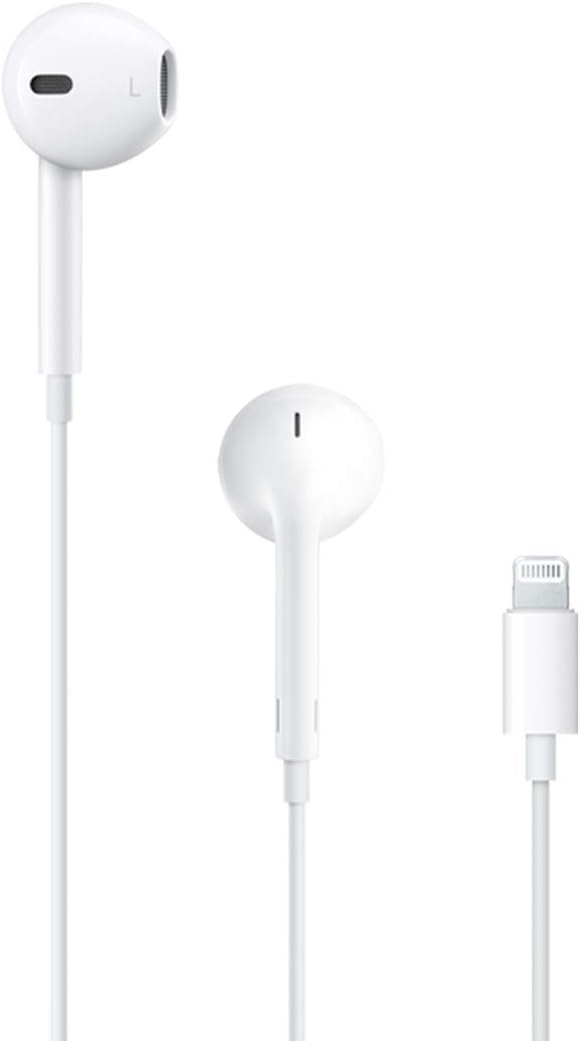
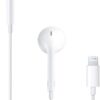
The Apple EarPods with Lightning Connector are the odd item in a wireless catalog: a wired earphone with no battery, no Bluetooth and no charging case. They terminate in a Lightning plug, carry a built in remote on the cable for volume, playback and calls, and include a microphone for phone calls, FaceTime and Siri. Apple lists them as compatible with any device that has a Lightning connector and runs iOS 10 or later, which covers older iPhones, iPads and the iPod touch. The listing has been live since November 1, 2018. This is a new unit, not a renewed or refurbished one, and the specification records the product explicitly as “Not Water Resistant”.
Who these are for, and the connector question that decides it
Before anything else: check what port your phone has. Apple moved the iPhone to USB-C with the iPhone 15, so a Lightning EarPod fits an iPhone 14 and earlier and does not fit anything newer. If you are shopping for a current iPhone, the version you want is the USB-C EarPods, which are the same design with the other plug. Buying the wrong connector is the single most common mistake on this product, and it is not a mistake the listing title makes obvious.
Given the right port, the case for a wired earphone in 2025 is stronger than it sounds. There is no battery to degrade, no pairing, no codec negotiation, no latency worth measuring and no charging case to lose. For video editing, for musicians monitoring on a phone, for anyone who wants a spare pair in a drawer that will work in five years, wired solves problems that wireless creates. They are also the least expensive way to get a microphone and remote that Siri reliably recognizes.
Connection: a wire, and what that removes from the conversation
Everything this site normally has to interrogate simply does not apply here. There is no Bluetooth version, so no question of connection stability or LE Audio. There is no codec, so no SBC, AAC, aptX or LDAC to check against your phone, and no question of whether high resolution audio survives the link. The digital to analog conversion happens in the Lightning connector itself rather than in the phone, which is why these work on iPhones that have no headphone socket. Apple does not publish the specification of that converter, so there is nothing to compare, but the practical point is that latency is effectively zero and the signal path does not depend on what your phone supports.
The remote is a three button inline control: volume up, volume down, and a center button that handles play, pause, track skipping, call answering and Siri. That is a fuller control set than most touch based wireless earbuds manage, and it works without looking.
Battery: there is none
This section is short by nature. EarPods draw the small amount of power they need from the phone through the Lightning connector, so there is no runtime figure, no charging time and no case. The battery field in the imported specification claims “1 12V batteries required”, which is import noise rather than a product fact: nothing about this product uses a 12 volt cell. The trade against wireless is the obvious one, which is that a cable is a cable, and the trade in your favor is that the product does not stop working when a lithium cell reaches end of life three years from now.
Fit, isolation and the absence of a water rating
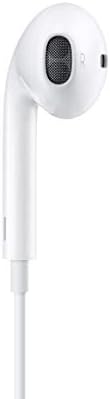
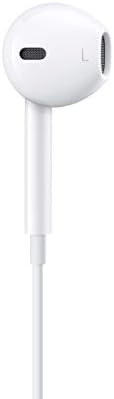
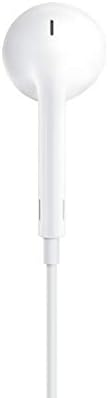
The EarPod shape is the defining characteristic and the reason people either love or reject them. Apple’s claim is that the design follows the geometry of the ear rather than using a circular tip, and that this makes them more comfortable for more people than other earbud style headphones. That is Apple’s claim rather than a measurement, and the practical reality is well established: EarPods either suit your ear or they do not, and there is no tip to swap to fix it. There are no ear tips supplied because none are used.
The consequence that matters most is isolation, and here the specification is wrong. The imported table records noise control as “Sound Isolation”. EarPods do not seal the ear canal, so they provide very little passive isolation and no active cancellation at all. Ambient noise arrives largely unfiltered. In a quiet room that is fine and arguably pleasant. On a train or in a gym it means the noise competes with the music, and the natural response is to raise the volume until the music wins. That is the pattern that damages hearing over time, and no volume limit is published on this product. If you routinely listen in loud places, a sealed or cancelling design lets you listen at a lower level to hear the same detail.
On the other side of that trade, the lack of a seal does leave you more aware of your surroundings than a sealed earbud would. The listing recommends cycling among its uses, and we would still not: a cable running to a phone in a pocket is its own hazard on a bike, and a product that covers the ear canal entrance is not an open ear design. If road use is the requirement, buy something built for it.
Water resistance is stated plainly as “Not Water Resistant”, which is more useful than the vague waterproof language that fills the rest of this category. Keep them out of rain and away from sweat, and note that the cable and connector are the usual failure points on any wired earphone, so how you coil them matters.
What to compare it against
If wireless is what you actually want from Apple, the AirPods 3rd generation, which use the same unsealed shape without a cable is the closest translation of this fit, and the AirPods Pro 2, which add a sealed tip and active cancellation is the choice if isolation is the problem you are solving. For a wired alternative that uses a sealed tip and a 3.5mm plug, the Sony MDR-EX15AP, a long serving budget wired earphone is the comparison. Our coverage of in ear designs sits under earbud headphones, with the cordless formats under wireless earbuds.
Who should buy them and who should not
Buy the Lightning EarPods if you have an iPhone 14 or earlier, an older iPad or an iPod touch, and you want a cheap, reliable set with a proper inline remote and no battery to worry about. Do not buy them for an iPhone 15 or later, because the plug does not fit. Do not buy them if you need isolation on a commute, if you need any water resistance, or if the unsealed shape has never stayed in your ears before, because there is no tip to change.