

Description
Moondrop sells to an audience that reads specification sheets, and the Space Travel listing reflects that: it explains its noise cancellation topology in technical detail and gives a latency figure with a footnote about where the number comes from. It also makes a lossless audio claim without naming a single codec, quotes a four hour bud runtime, and has three bullets that are literally empty because the text failed to import. All of that goes in the same review. Everything below is drawn from the published listing. We do not wear or measure the products covered on this site.
Who this is for
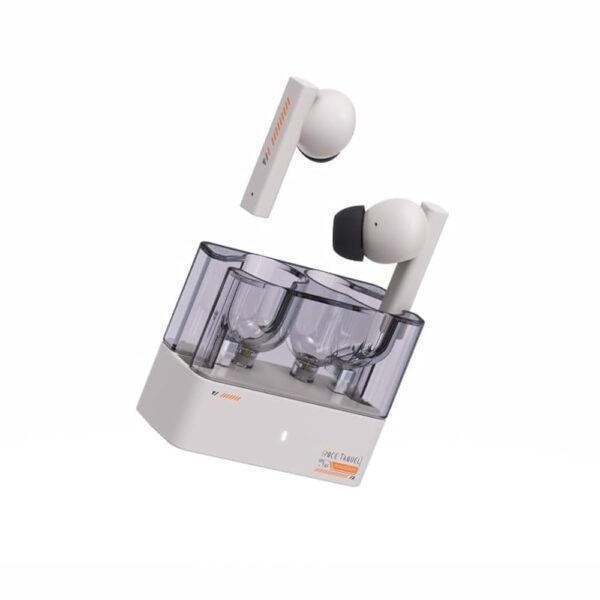
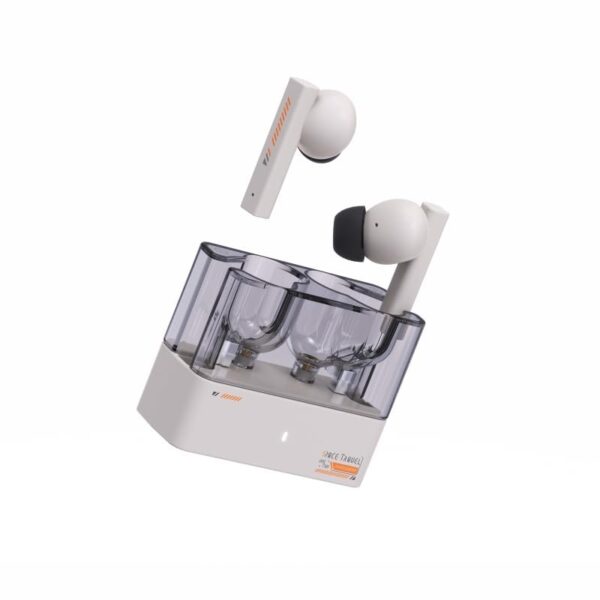
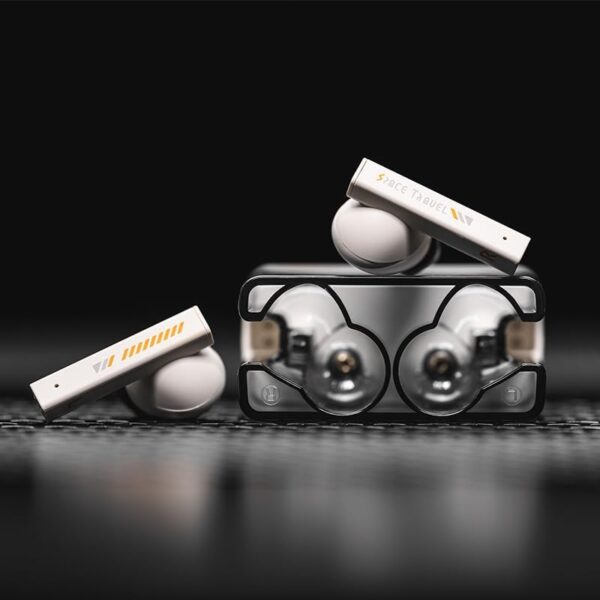
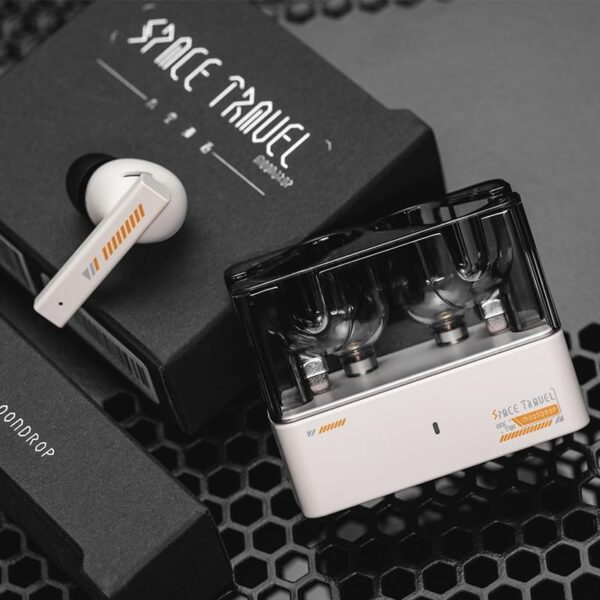
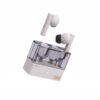
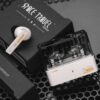
The Space Travel is a sealed true wireless earphone with active noise cancellation, a 13 millimeter dynamic driver and touch controls, in white. The manufacturer description field on the listing is empty, so everything usable comes from the title and the bullets. Moondrop calls the product a true wireless in-ear monitor, and the fit is described as shallow: “SPACE TRAVEL offers a shallow ear fit that is more comfortable than standard in-ear headphones, and can be used by users with small ear canals.”
That is a genuinely useful statement and it identifies the buyer. If deep fitting earbuds hurt, or if you have small canals and most tips sit too far in, a shallow fit is a real advantage. The trade is that a shallow fit generally seals less securely during movement, and the listing does not say how many tip sizes are supplied, which on a sealed design is the specification that decides both bass and isolation.
One specification row is worth ignoring: “Specific Uses For Product: Gaming.” There is a game mode, covered below, but this is a music first product and the field overstates it.
Connection, latency and the claim that does not stand up
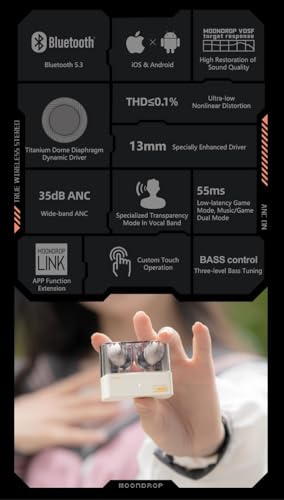
The title gives Bluetooth 5.3, which is the connection housekeeping figure and says nothing about sound. The specification table gives a 10 meter range and lists compatibility with iOS and Android devices.
The problem is in the first bullet, which reads: “Single Feedforward with Lossless Sound Quality, 35dB Depth Wide-band ANC.” Lossless audio over Bluetooth requires a specific codec on both ends of the link, and this listing names no codec at all. Not SBC, not AAC, not aptX, not LDAC. A lossless claim with no codec named and no statement that the source device must support it is unsupported by the published specification, and we will not repeat it as fact. If lossless playback is your reason for considering these, ask Moondrop which codec is implemented and then check whether your phone supports the same one. For a comparison against products that do name the codec, see our Sony WF-1000XM5 review.
The 35 decibel cancellation figure comes with no named test standard, so it cannot be compared against another brand’s number. What the bullet does explain, and this is unusually candid, is the design choice behind it: most cancelling earbuds use a hybrid feedforward and feedback arrangement, and Moondrop states it has dropped the feedback stage because “the noise collected by the feedback microphone in the front cavity can cause loss of bass.” That is a real engineering trade being disclosed rather than hidden, and the practical consequence is that cancellation on a feedforward-only design is generally less effective against noise that leaks past the seal.
The game mode figure
A low latency mode is switched on by tapping the touch faceplate four times, and the listing quotes 55 milliseconds. It also footnotes the number honestly: “The 55ms delay is the official specification of the SOC chip.” That is a component specification rather than an end to end measurement from phone to ear, so treat it as a floor rather than as what you will experience. Buyers shopping specifically on latency may want to compare against our JBL Quantum TWS review.
Battery: four hours, and no total
The specification table gives “Battery Life: 4 Hours.” That is the bud runtime and it is short, shorter than anything else covered so far in this catalog. Charging time is given as 1 hour for the buds and 1.5 hours for the case.
What the listing never states is the total including the case. There is no combined figure anywhere on the page, which means a buyer cannot tell how many refills the case holds. Four hours in the ear with an unknown case reserve is not enough information to plan a flight or a working day around, and it is the question to put to the seller before ordering. As always, a quoted playtime is a best case number at moderate volume and running cancellation continuously will reduce it.
Fit, controls and the missing water rating
There is no IP code anywhere on this listing. No IPX4, no IPX7, no water resistance field in the specification table at all. That means the page publishes no water or sweat protection claim whatsoever. Treat these as unrated: do not exercise in them on the assumption that sweat is covered, and do not take them out in rain until Moondrop or the seller supplies a code in writing.
Controls are touch, with the four tap gesture for game mode noted above and a companion app called MOONDROP Link offering three bass tunings. Here the listing breaks down. The bullet introducing the tunings ends mid sentence with “users can select one of three bass tunings,” and the three bullets that follow contain only a comma, a comma and a period. The names of the three tunings are missing entirely. A buyer therefore knows a bass adjustment exists and cannot find out what the three options are.
Either earbud works alone, with what the listing calls seamless switching between monaural and binaural modes, and automatic reconnection when a bud leaves the case. Listening with one ear changes how you locate sound, so it is not a substitute for real awareness outdoors.
The weight fields are the usual mess. Item weight is given as 0.22 pounds, roughly 100 grams, with a separate figure of 3.53 ounces which is the same quantity, and a carrying case weight of 0.15 pounds. The first of those is the packed weight. No bud weight is published, and the 3.66 by 2.83 by 1.46 inch dimensions are the box.
How it ranks, and the alternatives
Customer feedback sits at 4.3 out of 5 from 1,170 ratings, which is a strong score on a solid sample and the most persuasive thing on the page. The sales rank is given as 3,823rd in Electronics and 483rd in the earbud and in-ear headphone group, which is a high placing. The date first available is July 2023.
If the appeal here is a technically minded brand at a low price, two comparable options are covered in our Nothing Ear a review and our Nothing Ear review, both of which publish more about their codec support than this page does. For the wider field, start from the true wireless earbud listings or the broader in-ear headphone listings.
Who should buy it and who should not
Buy it if a shallow fit suits your ears, you want a 13 millimeter driver and a disclosed cancellation topology at this price, and four hours per charge covers the way you actually listen. Do not buy it on the lossless claim, because no codec is named and no source device requirement is stated. Do not buy it for exercise or rain, because no IP code is published. Do not treat the 55 millisecond figure as an end to end measurement. And ask the seller for the total battery figure with the case, because the listing does not give one.