


Description
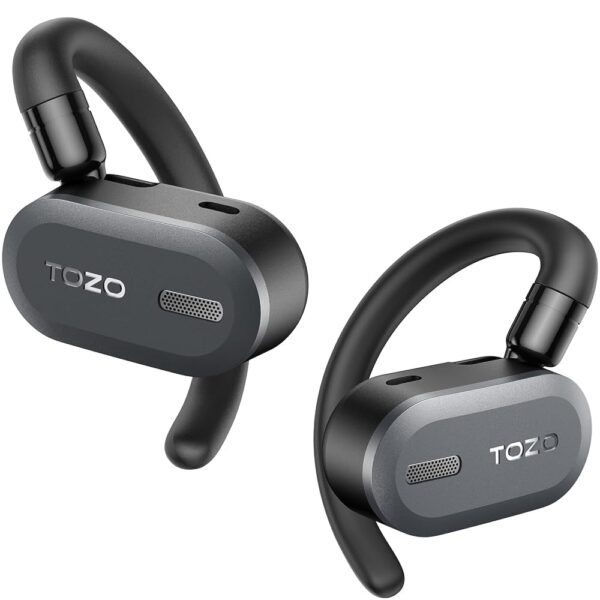
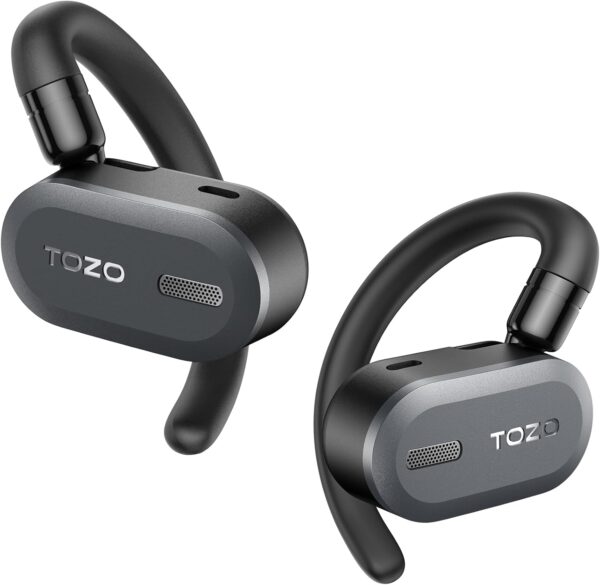
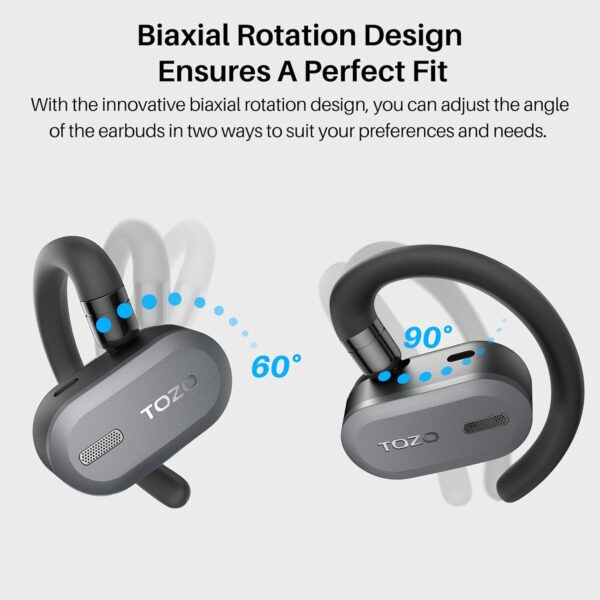
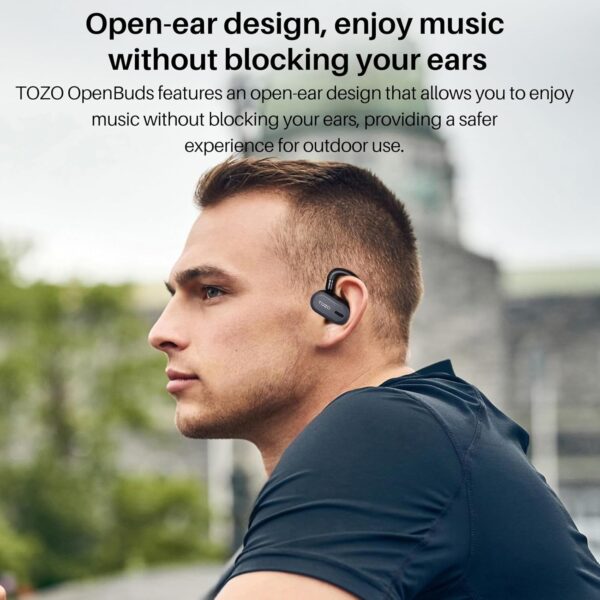
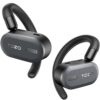
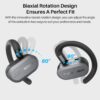
These are open-ear headphones, and that is the whole point of them. The TOZO OpenBuds, sold as the O2 and catalogued here under the product code T13187, sit outside the ear canal rather than in it, held by a dual-axis hinge that adjusts both horizontally and vertically. Nothing goes into your ear, nothing seals it, and you hear your surroundings while you listen.
What open-ear actually changes
An open-ear design directs sound at the ear from a small distance rather than into a sealed canal. The practical consequences run in both directions and both matter.
On the positive side, you retain most of your normal hearing. Traffic, voices, announcements and alarms reach you unmuffled, which is genuinely useful for walking in a city, running on roads, working in a shared space, or being responsible for someone else in the house. There is no ear pressure, no wax contact and no plugged-ear sensation, which for some people is the only reason they can wear headphones at all.
On the other side, bass is thin. A sealed earbud produces low frequencies by pressurizing a closed cavity, and an open design has no cavity to pressurize. This listing publishes the frequency range as 20 Hz to 16,000 Hz, which is unusually honest, since almost every consumer earbud claims 20 kHz whether or not it means anything. Sound also leaks outward, so people near you hear a thin version of what you are playing, and there is no isolation whatsoever.
One bullet in the listing claims the acoustic algorithm delivers “noise isolation” and prevents sound leakage. An open-ear design cannot isolate, because there is no seal, and leakage is reduced by directional design rather than eliminated. That claim contradicts the product’s own architecture and the attribute field that correctly records noise control as “None.”
The driving claim needs separating from the safety claim
Two of the five feature bullets market this product for driving, describing it as designed for comfortable wear while driving and promising a safe driving experience. The attribute theme field simply reads “Driving.”
Here is what we can and cannot say. It is true that an open-ear design preserves far more of your hearing than a sealed earbud, so if you are going to wear headphones while awareness matters, this shape is the right one and a sealed cancelling set is the wrong one. It is not true that any headphone makes driving safer. Wearing headphones while driving is restricted or prohibited in many states and countries, audio in either ear is a cognitive distraction regardless of what you can hear, and a manufacturer’s marketing copy is not a legal opinion. Check your local law, and treat the awareness advantage as harm reduction rather than as a safety feature.
Fit, and the adjustment mechanism
The dual-axis hinge is the real engineering here. Most open-ear designs hook over the ear at a fixed angle and either suit your ear or do not. This one adjusts on two planes, so the driver position over the ear canal can be moved rather than accepted. Since an open design’s bass response depends heavily on how close the driver sits to the canal opening, that adjustment is doing acoustic work as well as comfort work.
The driver is 14.2 millimeters, which is large and appropriate for a design that has to move air without a seal. Published sensitivity is 100 dB. Materials are polyurethane, plastic and metal. The set weighs 2.72 ounces packaged, with the wireless charging case at 100 grams.
How they connect
Bluetooth 5.3 is listed with a 20 meter range, and audio latency is published at 55 milliseconds, which is a useful figure few listings give and is low enough for video without obvious lip sync error.
Dual connectivity is confirmed: TOZO states the OpenBuds connect to two phones simultaneously with seamless switching. That is multipoint, and it is a feature many sets at this level omit. Five equalizer presets are available through the TOZO app, which is fewer than the 32 offered on other TOZO models in this catalog.
No audio codec is named anywhere. Where nothing is named, SBC is the only codec that can be assumed, because SBC is the baseline every Bluetooth device supports, and nothing here supports a high resolution claim. The frequency response attribute field reads “2.4 GHz,” which is a radio band rather than an audio response and should be ignored entirely.
The battery figure, and the one that is missing
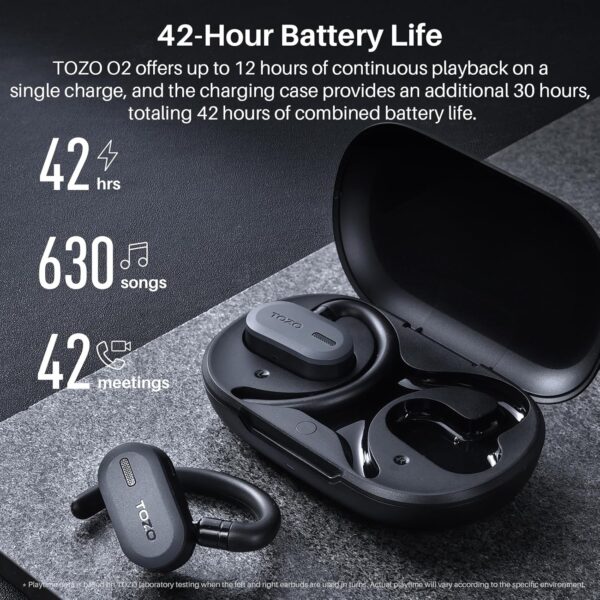
TOZO quotes a total battery life of up to 42 hours, and the attribute data attaches that figure to the charging case. How long a single charge lasts in the buds themselves is not published anywhere on this record. Forty-two hours is the combined number across recharges, which is the figure that sells and the least useful for planning a day.
The batteries field says “1 Lithium Metal batteries required,” and lithium metal cells are not rechargeable, which contradicts a rechargeable product with a wireless charging case. A USB-C cable is included at 20 inches.
The water claim has no code
The attribute block says “Water Resistance Level = Waterproof.” No IP code appears anywhere on this record, and the product title makes no water claim at all. Without a code there is no specification, only an adjective. Treat this as having no published water rating and confirm with the seller before using them for exercise. Where a rating does exist, no IP code covers seawater or pressurized water, and protection degrades as seals age.
What is missing, and what to compare
Unpublished: per-bud runtime, charging times, impedance, individual weights, case capacity, wear detection, and the ingress rating. A “Number of USB 2 Ports” field appears on a pair of headphones. The product is also identified three different ways on the same record, as OpenBuds, as the O2 and as T13187, which is worth knowing when matching a replacement.
Within our own listings, the TOZO OpenEgo and the TOZO OpenEarring are the sibling open-ear designs with different retention mechanisms, and the Amazon Echo Buds take a semi in-ear approach that sits between open and sealed. If you want the opposite of this product, the TOZO NC2 is the sealed cancelling model. The open-ear headphone listings we track cover this shape specifically.
Who should buy them, who should not
Buy the OpenBuds if awareness is the requirement, if sealed earbuds have never been comfortable, and if a two-plane adjustment sounds like the answer to a fit problem. Skip them if bass matters to you, if you need isolation on a commute, if you want to know the per-bud runtime before committing, or if you were buying them specifically because the listing describes them as safe for driving. That is the manufacturer’s wording, not a legal or safety assessment.