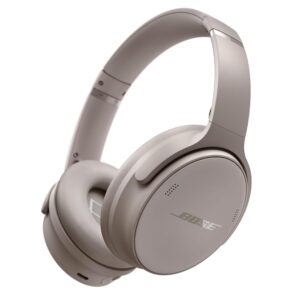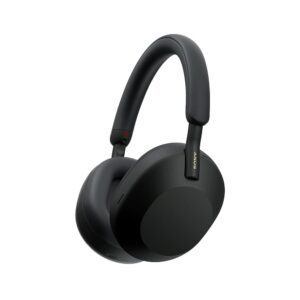

Description
The Corsair HS70 Pro Wireless is a closed gaming headset that connects through a 2.4 GHz USB adapter rather than Bluetooth, and it is one of the better documented records in this catalog. Corsair publishes sensitivity, impedance, headphone frequency response, microphone frequency response and microphone impedance, which is more hard data than most headset listings carry. It also contains several internal contradictions, and those are worth reading before the numbers.
The player this headset suits
This is aimed at a PC or PlayStation player who wants low latency wireless, a detachable boom microphone, and hardware volume and mute controls on the cup. Corsair notes Discord certification and 7.1 surround support on PC, and the included components are the headset, a USB wireless transmitter, a USB charging cable and a warranty card. There is no analog cable, and the attribute data confirms it with “No Headphone Jack.” If wired fallback matters to you, this is not the headset for it, and something like the LucidSound LS15X or the SteelSeries Arctis Pro Wireless, which does list a 3.5 millimeter jack, is worth comparing.
The compatibility statement does not settle cleanly. The product title lists PC, MacOS, PS5 and PS4. The attribute block lists compatible devices as PC and PS4 only, and gives the hardware platform as PC. Corsair’s own description mentions PC and PS4. PS5 appears in the title and nowhere else. If PS5 is your machine, confirm the console mode with Corsair before ordering rather than trusting the title.
How it connects, and what the radio really is
Corsair rates the wireless range at up to 40 feet over a low latency 2.4 GHz link supplied by the included USB adapter. That is the correct architecture for gaming, because standard Bluetooth audio carries enough delay to break the timing between what you see and what you hear. No Bluetooth version appears anywhere on this record, no codec is named, and none should be assumed. There is no phone pairing and no multipoint.
Two attribute fields describe the radio incorrectly
The attribute block lists connectivity technology as “USB” and wireless communication technology as “Wi-Fi.” Neither is right. USB describes the transmitter’s plug and the charging port, not the audio link, and this is not a Wi-Fi device. It is a proprietary 2.4 GHz radio, which happens to share a frequency band with Wi-Fi and is a different thing entirely. Read these two fields as import noise.
The 7.1 surround claim also needs qualifying. Corsair states that it works on PC, through the iCUE software, which means it is virtual surround processing applied by the computer rather than seven discrete drivers in the cups. This headset has one dynamic driver per side. Virtual surround can genuinely help with positional cues in games, but it is software, and it does not travel to the console.
The battery figure
Corsair quotes up to 16 hours of battery life. This is a one-piece over-ear headset with no charging case, so there is no combined figure obscuring a shorter per-session runtime the way there is on true wireless earbuds. Sixteen hours is a modest figure by current standards, well short of the 40 hours the Turtle Beach Stealth 700 Gen 2 MAX claims, and it assumes moderate volume with the microphone in ordinary use.
The charging time field reads “16 Hours,” identical to the battery life. That is the same copied-field error that recurs throughout this catalog and it is not a real recharge figure. The actual recharge time is not published anywhere in this listing, and neither is the battery capacity.
Fit, drivers, controls and water resistance
The drivers are custom-tuned 50 millimeter neodymium units. The attribute data records the size as “5E+1 Millimeters,” which is scientific notation for 50 and another reminder that the imported figures need reading rather than trusting. Corsair publishes headphone frequency response as 20 Hz to 20 kHz, impedance as 32 ohms at 1 kHz, and sensitivity as 111 dB plus or minus 3 dB. Thirty-two ohms is easy to drive from any source, and a sensitivity figure that high means this headset gets loud from very little power, which is a genuine hearing safety consideration. Volume that feels comfortable on a low-sensitivity headphone will be considerably louder here at the same setting.
The fit description contradicts itself. One bullet states “Headphones fit type: On-Ear” while the attribute block records the earpiece shape as “Around ear,” and Corsair’s own description talks about memory foam ear pads for long sessions. Around-ear is the correct reading for the HS70 Pro, but the on-ear line is in the published listing and a buyer sensitive to ear pressure should be aware of the discrepancy. Materials are given as faux leather, plastic and metal, and the weight is 11.7 ounces.
The microphone description contradicts itself too, in the same bullet list. One bullet calls it an omnidirectional microphone with a flip-up mute and an LED indicator. Another calls it a fully detachable, noise-cancelling unidirectional microphone. Omnidirectional and unidirectional are opposite pickup patterns and both cannot be true. Corsair publishes a microphone frequency response of 100 Hz to 10 kHz and a microphone impedance of 2.0 kilohms, which is a normal voice-band specification either way.
Water resistance is answered directly: the attribute field reads “Not Water Resistant,” and no IP code is published. That rules out gym use. It also rules out cycling and road running, for the more important reason that a sealed closed-back headset removes your ability to hear traffic.
One more field to discount. Noise control is listed as “Active Noise Cancellation.” Nothing in Corsair’s description or bullets claims active cancellation for the listener. What is described is a noise-cancelling microphone, which cleans up what your teammates hear and does nothing for what you hear. If active cancellation is what you actually want, buy a headphone that names it as a listening feature, such as the JBL Tune 770NC, and understand that cancellation works best on constant low frequency drone and poorly on speech.
What the listing does not publish
Absent from this record: the real charging time, the battery capacity, whether the ear pads are user replaceable, whether the headset can be used while charging, and any statement about firmware or iCUE requirements on macOS. The category path in the source data degrades into reviewer names after “Video Games, PC, Accessories, Headsets,” so the category information on this record carries no weight. The listed first availability date is November 2022.
Within our own listings, the ASTRO A20 Gen 2 takes a comparable single-radio approach with a console-specific transmitter, and the broader wireless over-ear headphone listings we track are where to look if the headset needs to work away from a desk too.
Who should buy it, who should not
Buy the HS70 Pro Wireless if you play on PC, want published impedance and sensitivity figures rather than adjectives, and want a detachable boom with physical controls. Skip it if you need Bluetooth or phone pairing, if you need a wired fallback, if 16 hours is short for how you play, or if you are buying specifically for a PS5 and cannot confirm the console mode independently of the title.